



Question: Instructions: - Please write all your answers legibly in Blue books. - Please show all the inputs entered in financial calculators. - Please use at
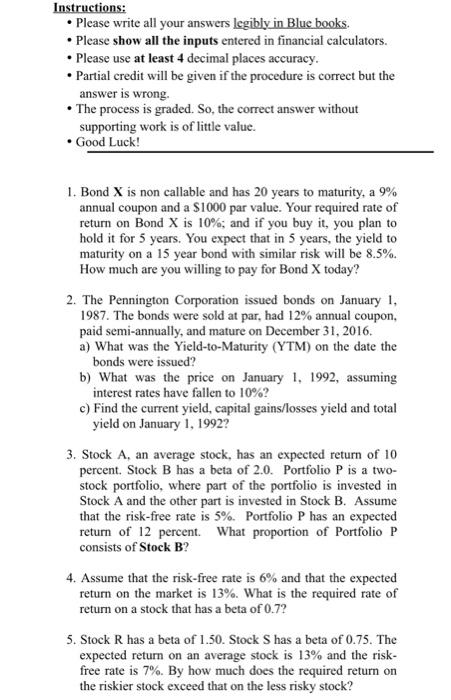
Instructions: - Please write all your answers legibly in Blue books. - Please show all the inputs entered in financial calculators. - Please use at least 4 decimal places accuracy. - Partial credit will be given if the procedure is correct but the answer is wrong. - The process is graded. So, the correct answer without supporting work is of little value. - Good Luck! 1. Bond X is non callable and has 20 years to maturity, a 9% annual coupon and a $1000 par value. Your required rate of return on Bond X is 10%; and if you buy it, you plan to hold it for 5 years. You expect that in 5 years, the yield to maturity on a 15 year bond with similar risk will be 8.5%. How much are you willing to pay for Bond X today? 2. The Pennington Corporation issued bonds on January 1, 1987. The bonds were sold at par, had 12% annual coupon, paid semi-annually, and mature on December 31, 2016. a) What was the Yield-to-Maturity (YTM) on the date the bonds were issued? b) What was the price on January 1, 1992, assuming interest rates have fallen to 10% ? c) Find the current yield, capital gains/losses yield and total yield on January 1, 1992? 3. Stock A, an average stock, has an expected return of 10 percent. Stock B has a beta of 2.0. Portfolio P is a twostock portfolio, where part of the portfolio is invested in Stock A and the other part is invested in Stock B. Assume that the risk-free rate is 5%. Portfolio P has an expected return of 12 percent. What proportion of Portfolio P consists of Stock B? 4. Assume that the risk-free rate is 6% and that the expected return on the market is 13%. What is the required rate of return on a stock that has a beta of 0.7 ? 5. Stock R has a beta of 1.50 . Stock S has a beta of 0.75 . The expected return on an average stock is 13% and the riskfree rate is 7%. By how much does the required return on the riskier stock exceed that on the less risky stock
Step by Step Solution
There are 3 Steps involved in it

Get step-by-step solutions from verified subject matter experts