



Question: Instructions: Read the transcript of the speech made by Charles Munger at Harvard Law School in June 1995. Charlie Munger has been the sidekick of
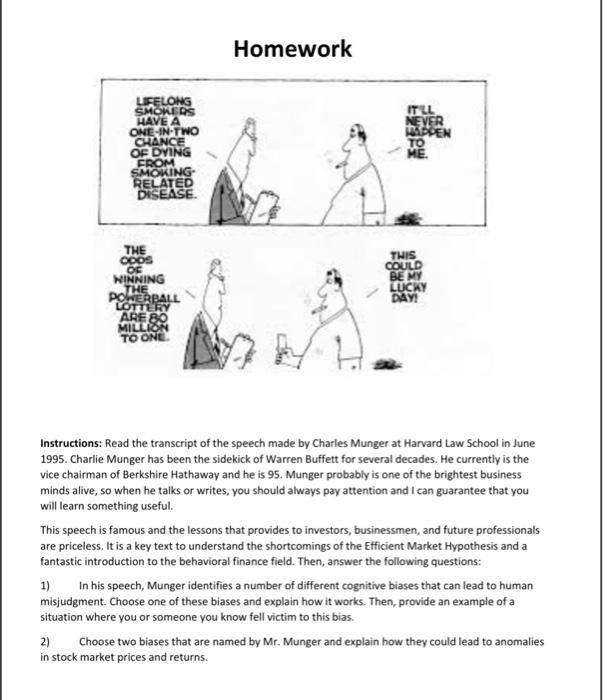
Instructions: Read the transcript of the speech made by Charles Munger at Harvard Law School in June 1995. Charlie Munger has been the sidekick of Warren Buffett for several decades. He currently is the vice chairman of Berkshire Hathaway and he is 95 . Munger probably is one of the brightest business minds alive, so when he talks or writes, you should always pay attention and I can guarantee that you will learn something useful. This speech is famous and the lessons that provides to investors, businessmen, and future professionals are priceless. It is a key text to understand the shortcomings of the Efficient Market Hypothesis and a fantastic introduction to the behavioral finance field. Then, answer the following questions: 1) In his speech, Munger identifies a number of different cognitive biases that can lead to human misjudgment. Choose one of these biases and explain how it works. Then, provide an example of a situation where you or someone you know fell victim to this bias. 2) Choose two biases that are named by Mr. Munger and explain how they could lead to anomalies in stock market prices and returns. 3) What do you believe Mr. Munger thinks about the Efficient Market Hypothesis? What do you think about the EFM? Which of the EFM forms (weak, semi-strong or strong) do you believe applies to the stock market? And why? 4) Munger argues that one key to avoiding misjudgment is to cultivate a multidisciplinary approach to learning. What does he mean by this, and how might it help us to make better decisions? Provide an example of a situation where a multidisciplinary approach could have helped you or someone you know avoid misjudgment. 5) Throughout his speech, Munger emphasizes the importance of being aware of our own limitations and biases. Why does he think this is so crucial, and how can we go about developing this selfawareness? Provide an example of a situation where being aware of your own biases could have helped you make a better decision
Step by Step Solution
There are 3 Steps involved in it

Get step-by-step solutions from verified subject matter experts