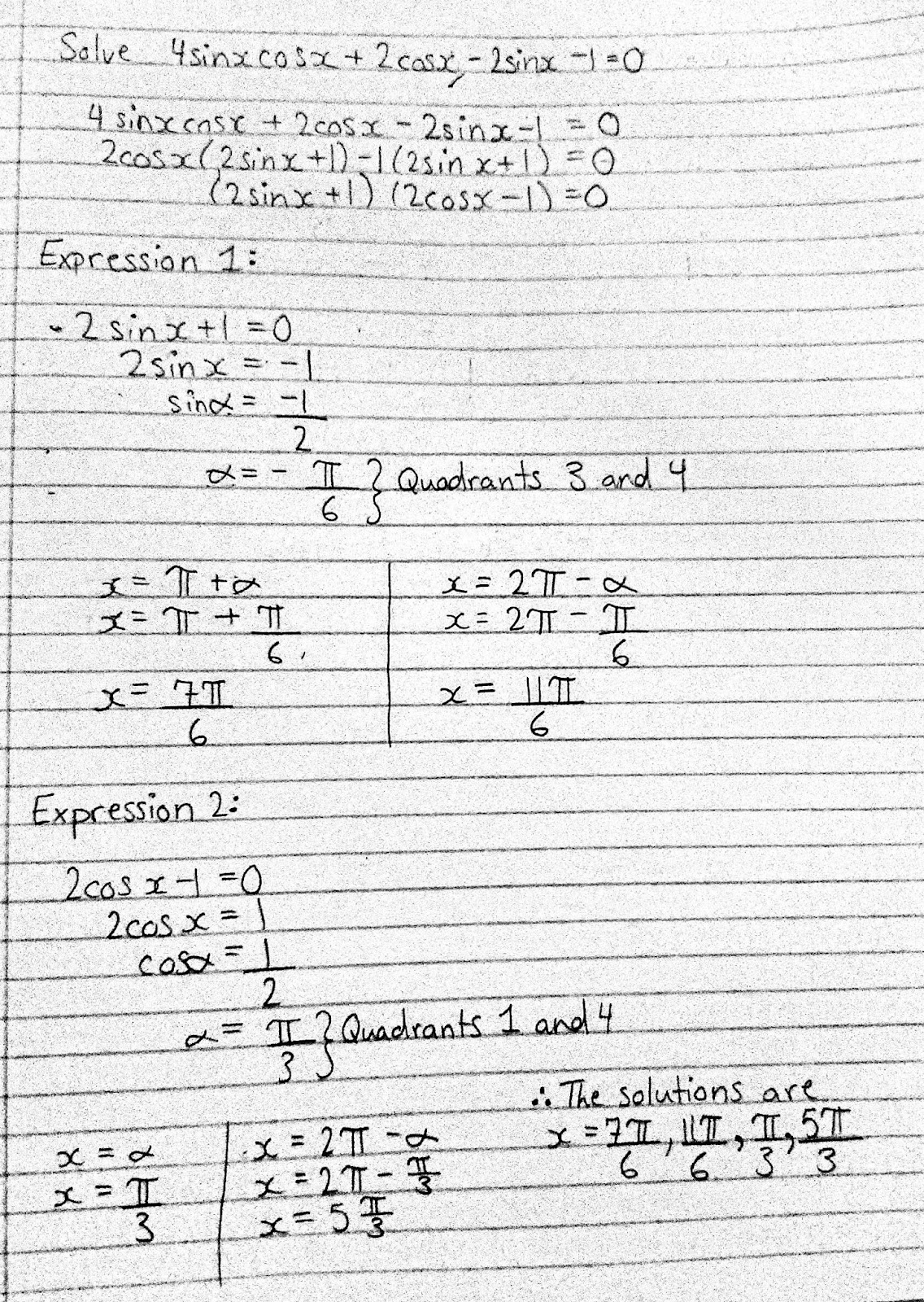
Question: INSTRUCTIONS READ THIS BEFORE YOU START WORKING : the answers bellow are my friends answers what I would like you to do is do the

INSTRUCTIONS READ THIS BEFORE YOU START WORKING :

the answers bellow are my friends answers what I would like you to do is do the same thing as bellow but change the examples change the graphs change the words make it looks good do me something similar to below but keep a note if you copy the same thing from below then going to give a bad rate.

  • change the words
  • change the format
  • change the graphs and do graphs in desmos and upload the pictures too
  • for the handwritein at the end make an example like it and write it down in hand writing

NOTE: the goal in this is very simple just do me something same as bellow but don't copy any examples of it

here is my friends answer :
INSTRUCTIONS READ THIS BEFORE YOU START WORKING :INSTRUCTIONS READ THIS BEFORE YOU START WORKING :
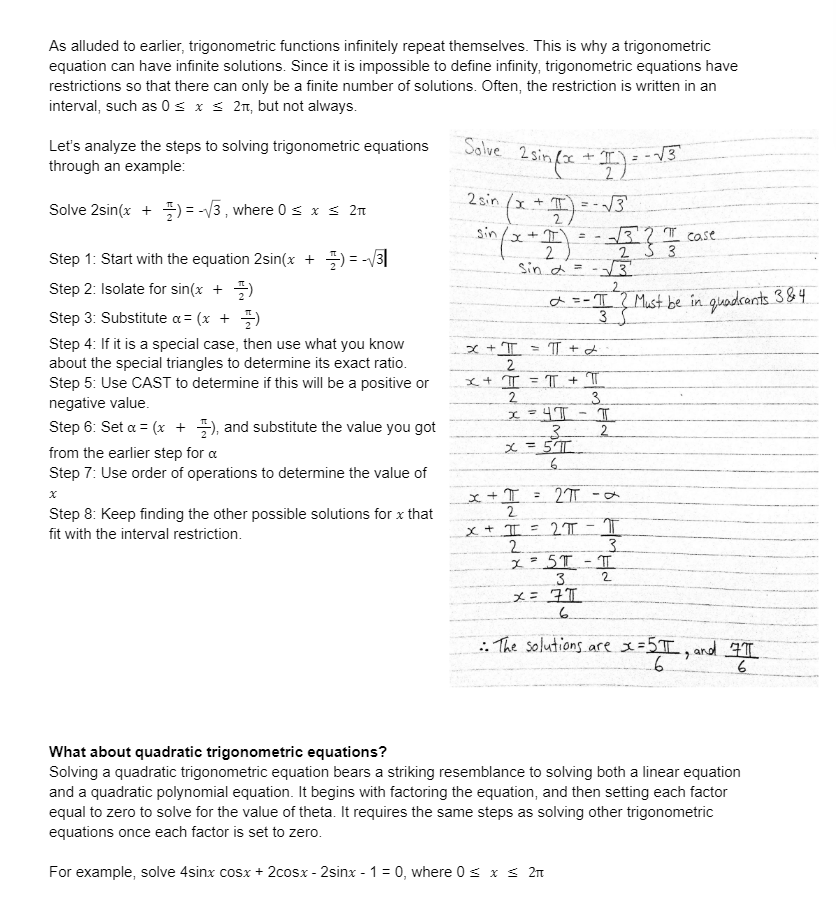
As alluded to earlier. trigonometric functions innitely repeat themselves. This is why a trigonometric equation can have innite solutions. Since it is impossible to define infinity, trigonometric equations have restrictions so that there can only be a finite number of solutions. Often, the restriction is written in an interval, such as CI 5 x 1: 211 but not always. Let's analyze the steps to solving trigonometric equations through an example: Solve Qsimjx + g) = WE i where D 1: x 5 Zn Step 1: Start with the equation 2sin{x + %}| : 435' Step 2: Isolate for sinfx + %} Step 3: Substitute a: {x + %:I Step 4: If it is a special case, then use what you know about the special triangles to determine its exact ratio. Step 5: Use CAST to determine if this will be a positive or negative value. Step 6: Set 0: = (x + %}: and substitute the value you got from the earlier step for o: Step ?: Use order of operations to determine the value of :1." Step 8: Keep nding the other possible solutions for x that t with the interval restriction. What about quadratic trigonometric equations? 13* (:1: +111): J? 1 Sm *l'~=-:s tits: (at 2)...1..3 a Ema-H :' JCS: -- - d_e_f_r;9:?-Hu be fr. ghalffs 3' 5H ..DC +1? 1T__EE____ ' .. __- ''''' Z .. ____ __ ____ 1+ 1. .r \"if + 1L. _.1........._._.':':_ _ 2?.;_L-- _ _ __ - . _3_...;L_ _ 3-: = ...6.-.___ ____ _ _ _. x+j Efm-w -- 1. a + 1-3. 1'11\". -.1t_..__ '_' ______ __ l -. .1- ..... _ 3' :.__..1L _ 3 'L 31:. 31... _ _ ' ...s.-- __ .2\"er Solutn'nnsart i=5? ,wi 31 .. . __ 9; Solving a quadratic trigonometric equation bears a striking resemblance to solving both a linear equation and a quadratic polynomial equation. It begins with factoring the equation, and then setting each factor equal to zero to solve for the value of theta. It requires the same steps as solving other trigonometric equations once each factor is set to zero. For example. solve 4sinx cosx + Ecosx - 2sinx -1 = {I}. where U =_: x 5 2n \f

Step by Step Solution

There are 3 Steps involved in it

1 Expert Approved Answer
Step: 1 Unlock blur-text-image

Question Has Been Solved by an Expert!

Get step-by-step solutions from verified subject matter experts

Step: 2 Unlock
Step: 3 Unlock

Students Have Also Explored These Related Mathematics Questions!