







Question: Instructions Using the file below, develop a develop TWO fair procedures that will be used to determine the merit raises and then decide the dollar
Instructions Using the file below, develop a develop TWO fair procedures that will be used to determine the merit raises and then decide the dollar raise to be given to each professor and answer the following questions:
1.Describe the procedure you used to allocate merit raises.
2.How did you determine the most important areas of the position?
3Explain how your procedure creates a standard that can be used yearly.
4.Using the procedure described in #1, how did you allocate the money to each professor?
Scenario: Small State University is located in the eastern part of the United States and has an enrollment of about 8,000 students. The College of Business has 40 full-time and more than 30 part-time faculty members. The college is divided into five departments: management, marketing, finance and accounting, decision sciences and informational technology. Faculty members in the management department are evaluated each year based on three primary criteria: teaching, research and service. Teaching performance is based on student course evaluations over a two-year period. Service to the university, college, profession and community is also based on accomplishments over a two-year period. Research is based on the number of journal articles published over a three-year period. Teaching and research are considered more important than service to the university. In judging faculty performance, the department chair evaluates each professor in terms of four standards: Far Exceeds Standards; Exceeds Standards; Meets Standards; and Fails to Meet Standards. The results of this years evaluations are below. This year the state has agreed to give raises totaling $17,400 to the management department. Your task as department chair is to divide the $17,400 among faculty members. Keep in mind that these raises will likely set a precedent for future years and that the professors will view the raises as a signal for what behavior is valued and what is not. Brief faculty profiles: Prof. Houseman: 55 years old; 25 years with the university; teaches Principles of Management mass sections with over 400 students per year; has written over 40 articles and given over 30 presentations since joining the college; wants a good raise to catch up with others. Prof. Jones: 49 years old; 10 years with the university; teaches HRM and Organizational Behavior; stepped down as department chair 3 years ago; teaches about 200 students per year; has written over 30 articles and 2 books since joining the college; recently received an $80,000 grant for the college from a local foundation. Wants a good raise as a reward for obtaining the grant. Prof. Smith: 61 years old; 6 years with the university; teaches Labor Relations and Organizational Development; stepped down as dean of the College of Business two years ago and took a $20,000 pay cut; teaches about 180 students per year; has written only two articles in the last 6 years due to administrative duties; very active in the community and serves on several charity boards. Wants a good raise to make up for loss of $20,000 Dean Stipend. Prof. Matthews: 28 years old; new hire only 4 months with the university; teaches Employee Relations and Compensation Management; just graduated with a PhD; will teach about 110 students this year. To be competitive in the market, the college needed to pay Mathews $97,000 and provide a reduced teaching load for 2 years and a $6,000 per summer stipend; none of the other faculty received this when they were first hired or subsequently; had two minor publications while a doctoral student, but none since joining the college. Wants a good raise to pay student loans and furnish a new residence.
Nkomo, S.M., Fottler, M.D., & McAfee, R.B. (2008). Human Resource Management Applications (6th Ed.). Mason, OH: Thomson Higher Education. Prof. Karas: 32 years old; 4 years with the university; teaches International Business and Honors sections of Management Principles; teaches about 150 students per year; won Teacher of the Year award this year; published 12 articles in the last 4 years; has been interviewing for a new job at other universities and may leave if good raise is not forthcoming. Prof. Franks: 64 years old; 18 years with the university; teaches Principles of Management and HRM; teaches about 150 students per year; principle advisor for management-minor students; has not written any articles during the last 4 years; plans on retiring within 2-3 years. Wants a good raise to enhance pension plan. 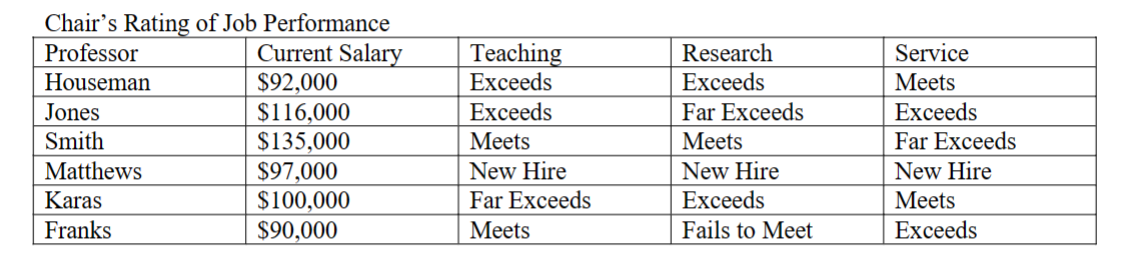
Chair's Rating of Job Performance \begin{tabular}{|l|l|l|l|l|} \hline Professor & Current Salary & Teaching & Research & Service \\ \hline Houseman & $92,000 & Exceeds & Exceeds & Meets \\ \hline Jones & $116,000 & Exceeds & Far Exceeds & Exceeds \\ \hline Smith & $135,000 & Meets & Meets & Far Exceeds \\ \hline Matthews & $97,000 & New Hire & New Hire & New Hire \\ \hline Karas & $100,000 & Far Exceeds & Exceeds & Meets \\ \hline Franks & $90,000 & Meets & Fails to Meet & Exceeds \\ \hline \end{tabular}
Step by Step Solution
There are 3 Steps involved in it

Get step-by-step solutions from verified subject matter experts
 Study Help