







Question: Instructions: You may work individually or in a pair (2 people in a group). Answer the following questions. Be sure to give justification to all
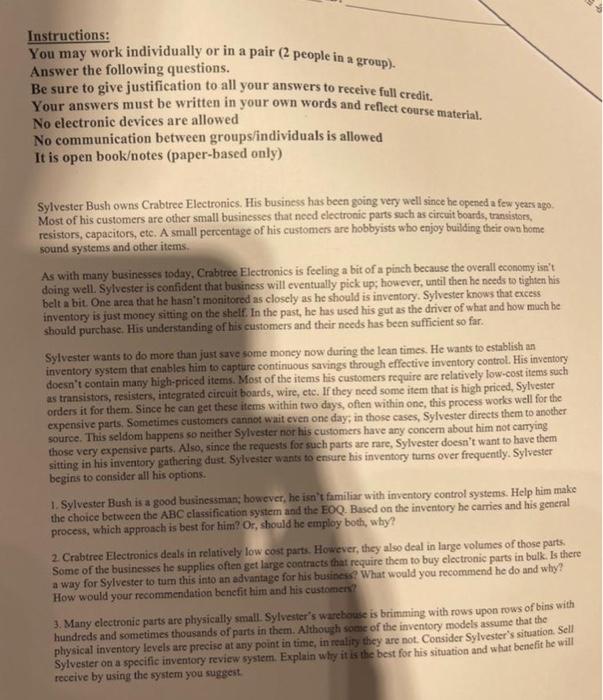
Instructions: You may work individually or in a pair (2 people in a group). Answer the following questions. Be sure to give justification to all your answers to receive full credit. Your answers must be written in your own words and reflect course material. No electronic devices are allowed No communication between groups/individuals is allowed It is open bookotes (paper-based only) Sylvester Bush owns Crabtree Electronics. His business has been going very well since he opened a few years ago Most of his customers are other small businesses that need electronic parts such as circuit boards, transistors, resistors, capacitors, etc. A small percentage of his customers are hobbyists who enjoy building their own home sound systems and other items As with many businesses today, Crabtree Electronics is feeling a bit of a pinch because the overall economy isn't doing well. Sylvester is confident that business will eventually pick up; however, until then he needs to tighten his belt a bit. One area that he hasn't monitored as closely as he should is inventory. Sylvester knows that excess inventory is just money sitting on the shelf. In the past, he has used his gut as the driver of what and how much he should purchase. His understanding of his customers and their needs has been sufficient so far. Sylvester wants to do more than just save some money now during the lean times. He wants to establish an inventory system that enables him to capture continuous savings through effective inventory control. His inventory doesn't contain many high-priced items. Most of the items his customers require are relatively low-cost items such as transistors, resisters, integrated circuit boards, wire, ctc. If they need some item that is high priced, Sylvester orders it for them. Since he can get these items within two days, often within one, this process works well for the expensive parts. Sometimes customers cannot wait even one day, in those cases, Sylvester directs them to another source. This seldom happens so neither Sylvester nor his customers have any concern about him not carrying those very expensive parts. Also, since the requests for such parts are rare, Sylvester doesn't want to have them sitting in his inventory gathering dust. Sylvester wants to ensure his inventory turns over frequently. Sylvester begins to consider all his options. 1. Sylvester Bush is a good businessman; however, he isn't familiar with inventory control systems. Help him make the choice between the ABC classification system and the EOQ. Based on the inventory he carries and his general process, which approach is best for him? Or, should he employ both, why? 2. Crabtree Electronics deals in relatively low cost parts. However, they also deal in large volumes of those parts. Some of the businesses he supplies often get large contracts that require them to buy clectronic parts in bulk. Is there a way for Sylvester to turn this into an advantage for his business? What would you recommend he do and why? How would your recommendation benefit him and his customers? 3. Many electronic parts are physically small. Sylvester's warehouse is brimming with rows upon rows of bins with hundreds and sometimes thousands of parts in them. Although some of the inventory models assume that the physical inventory levels are precise at any point in time, in reality they are not. Consider Sylvester's situation Sell Sylvester on a specific inventory review system. Explain why it is the best for his situation and what benefit he will receive by using the system you suggest
Step by Step Solution
There are 3 Steps involved in it

Get step-by-step solutions from verified subject matter experts
 Study Help