







Question: Instructions: You will answer case questions 10-18 and 10-19 by providing analysis and evaluation of the case questions and provide an argument to solve an
Instructions:
You will answer case questions 10-18 and 10-19 by providing analysis and evaluation of the case questions and provide an argument to solve an issue, or make a decision. In addition, you will research the IMF and World Bank websites to gather information and/or data to support conclusions made as you answer the questions.
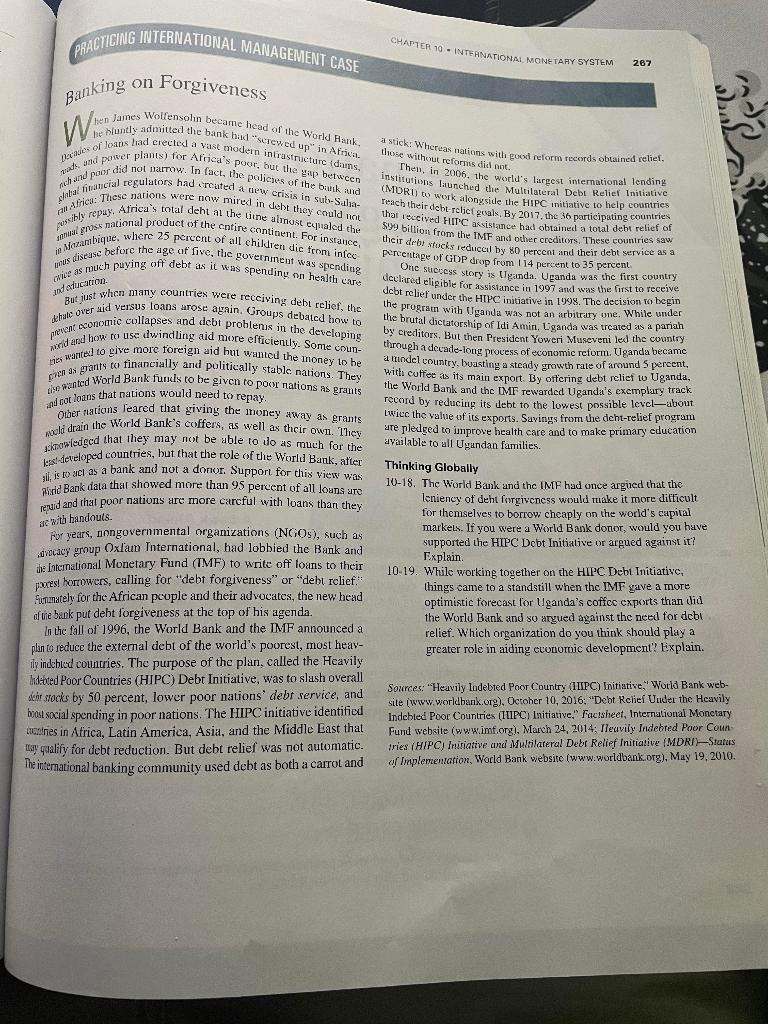
10-18. The World Bank and the IMF had once argued that the leniency of debt forgiveness would make it more difficult for themselves to borrow cheaply on the world's capital markets. If you were a World Bank donor, would you have supported the HIPC Debt Initiative or argued against it? Explain. 10-19. While working together on the HIPC Debt Initiative, things came to a standstill when the IMF gave a more optimistic forecast for Uganda's coffee exports than did the World Bank and so argued against the need for debt relief. Which organization do you think should play a greater role in aiding economic development? Explain.
wite as much paying off debt as it was spending nn health care declired elipible for assistance in 1997 and was the first to receive yod aluedtion. When many countries were recciving debt relief, the debt relief under the HTPC initiative in 1998 . The decision fo begin ghale over uid versus loans arose again. Groups debated how to the the progratn with Wganda was not an arbittary une. While under prid and how to use dwindling aid more efficienuly. Some coun- through a decade-long process of economic reform, Uganda became ties wanted to give more foreign aid hut wanted the money to be a mancl country, boasting a steady growth rate of around 5 percent, fren ai gants to financially and politically stable nations. They with coffer as its main export. By offering debt relief to Uganda, the manted World Bark funds to be given to pocy nations as grants the World Bank and the IMFF rewarded uganda's excmplary track and oot loans that nations would need to repay. Other rlations leared that giving the inoney away as grants twicc the walue of irs exports. Savings from the deht-telief program nold drain the World Bank's coffers, as well as thcir own. They ure pledged to improve health care and to make primary education sknomidged that they may not be able to tlo as much for the Ty indebled countries. The purpose of the plan, called the Heavily adeted Poor Countries (HIPC) Debt Initiative, was to slash overall kir slocks by 50 percent, lower poor nations' debt service, and Sources. 'Heavily lndebted Poor Country (IIIPC) Initiative,' World Bank webDost social spending in poor nations. The HIPC initiative identified sile (whw, worldbank.org), Ocroher 10,2016 ; "Debt Relief Uuder the Heavily wines in Africa, Latin America, Asid, and the Mfiddle East that Indebted Poor Countries (IIIPC) Initiative, Factsheet, international Monctary 3y qualify for debt reduction. But debt relief was not automatic. tries iHfPC) initiative and Multilateral Debr Relief Initiative (MDRI)-Status a international banking community used debt as both a carrot and of Implementation, World Bank website iwww.worldbank, org), May 19,2010
Step by Step Solution
There are 3 Steps involved in it

Get step-by-step solutions from verified subject matter experts
 Study Help