







Question: Instructor-created question Question Help The table shows the purchasing power of a dollar in recent years, with the year 2000 being the base year. For
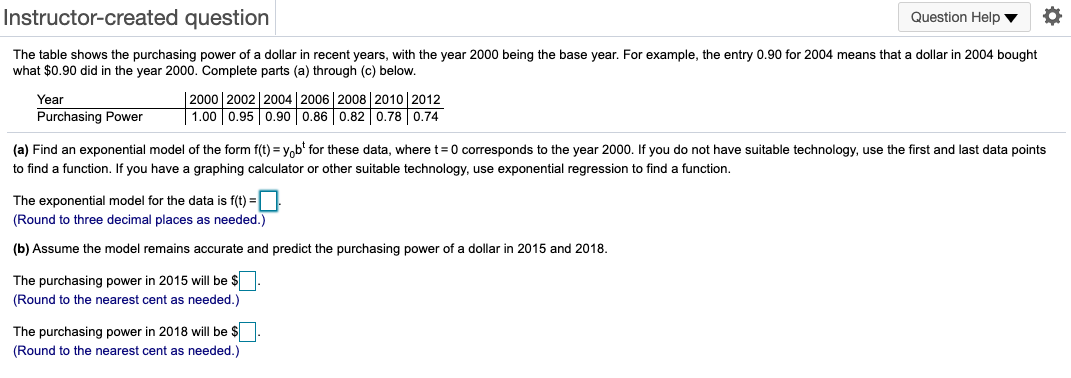
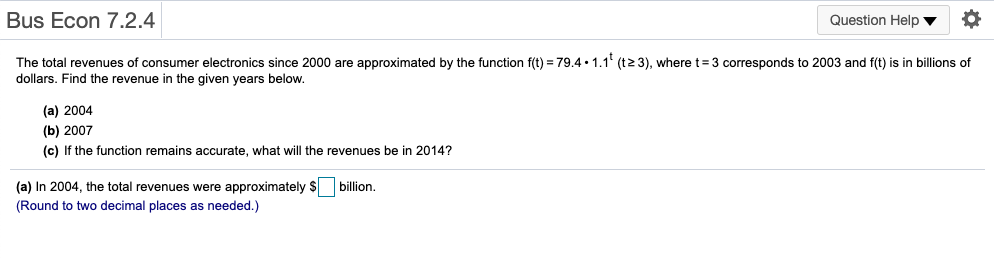
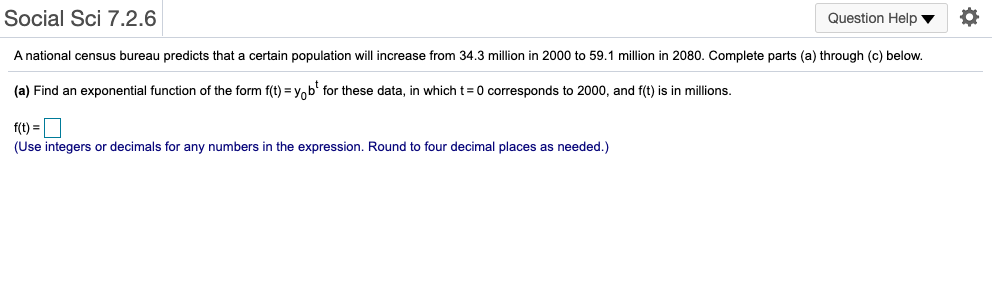
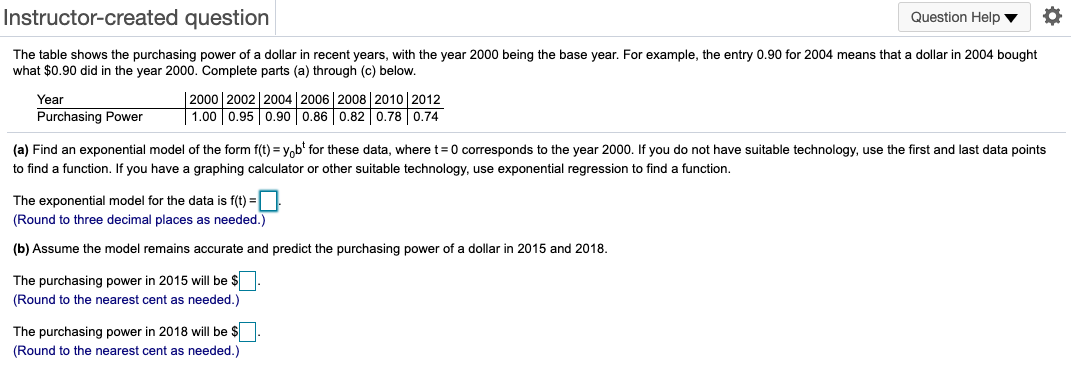
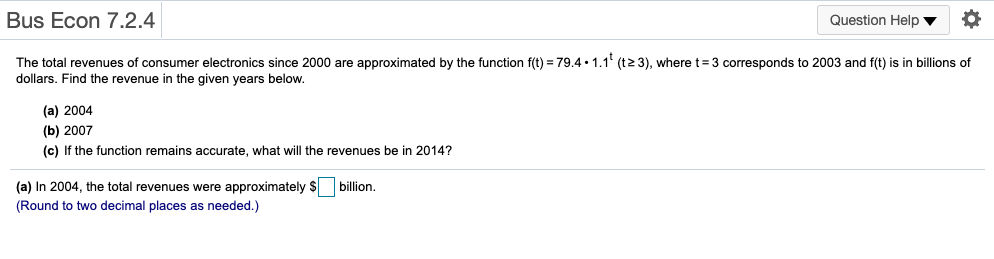
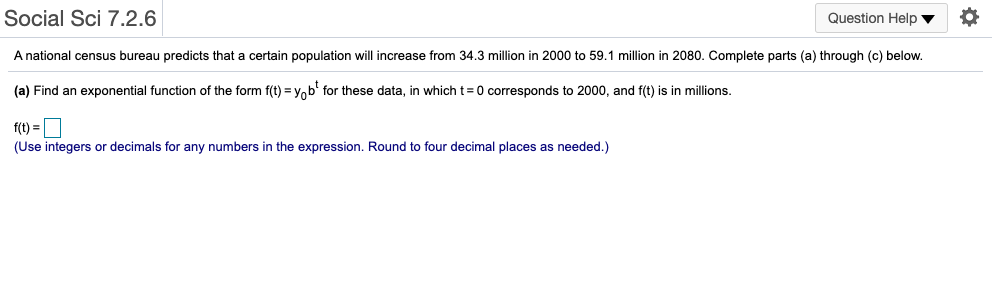
Instructor-created question Question Help The table shows the purchasing power of a dollar in recent years, with the year 2000 being the base year. For example, the entry 0.90 for 2004 means that a dollar in 2004 bought what $0.90 did in the year 2000. Complete parts (a) through (c) below. Year 2000 2002 2004 2006 2008 2010 2012 Purchasing Power 1.00 0.95 0.90 | 0.86 0.82 0.78 0.74 (a) Find an exponential model of the form f(t) = yob' for these data, where t= 0 corresponds to the year 2000. If you do not have suitable technology, use the first and last data points to find a function. If you have a graphing calculator or other suitable technology, use exponential regression to find a function. The exponential model for the data is f(t) = (Round to three decimal places as needed.) (b) Assume the model remains accurate and predict the purchasing power of a dollar in 2015 and 2018. The purchasing power in 2015 will be $ (Round to the nearest cent as needed.) The purchasing power in 2018 will be $ (Round to the nearest cent as needed.)Bus Econ 7.2.4 Question Help The total revenues of consumer electronics since 2000 are approximated by the function f(t) = 79.4 - 1.1' (t2 3), where t=3 corresponds to 2003 and f(t) is in billions of dollars. Find the revenue in the given years below. (a) 2004 (b) 2007 (c) If the function remains accurate, what will the revenues be in 2014? (a) In 2004, the total revenues were approximately $ billion. (Round to two decimal places as needed.)Social Sci 7.2.6 Question Help A national census bureau predicts that a certain population will increase from 34.3 million in 2000 to 59.1 million in 2080. Complete parts (a) through (c) below. (a) Find an exponential function of the form f(t) = yob' for these data, in which t= 0 corresponds to 2000, and f(t) is in millions. f(t) = (Use integers or decimals for any numbers in the expression. Round to four decimal places as needed.)
Step by Step Solution
There are 3 Steps involved in it

Get step-by-step solutions from verified subject matter experts
 Study Help