



Question: Intermediate Accounting 1 Chapter 1 True False 1. Financial accounting is the process of identifying, measuring, analyzing, and communicating financial information needed by management to
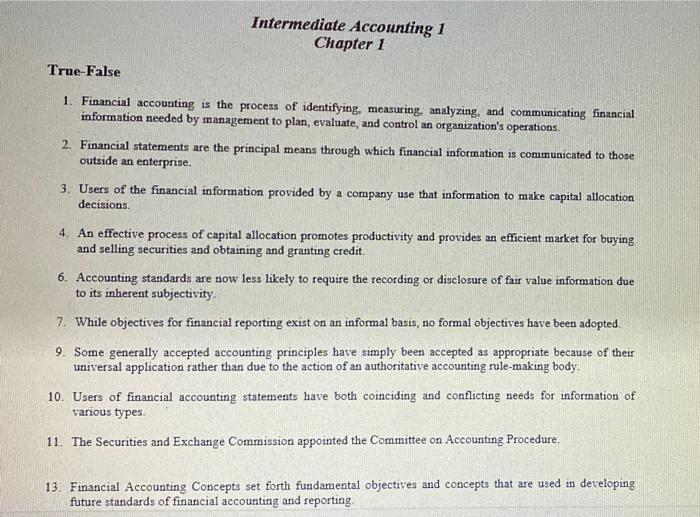
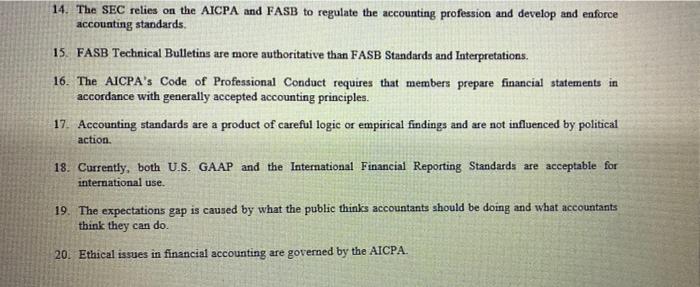
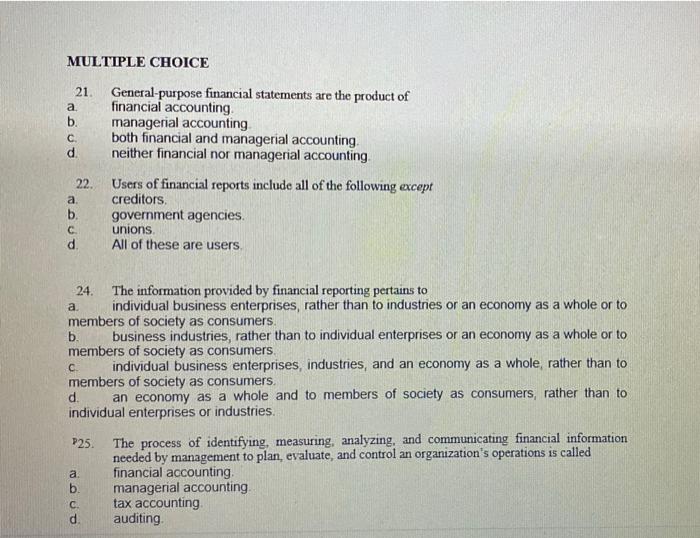
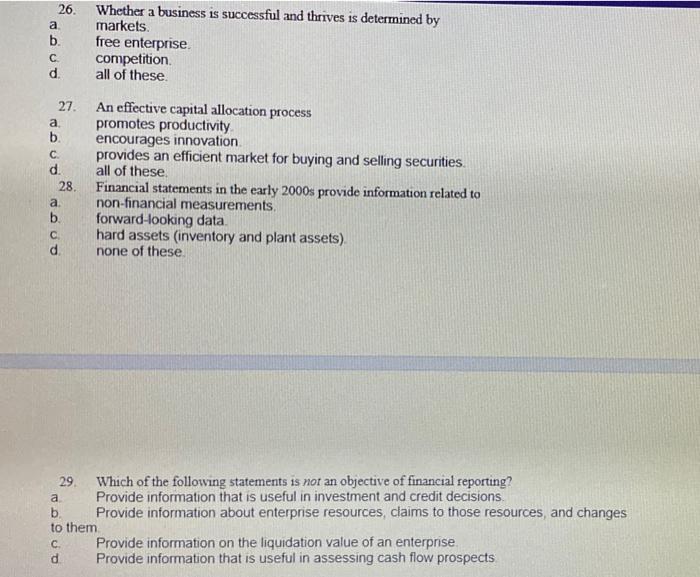
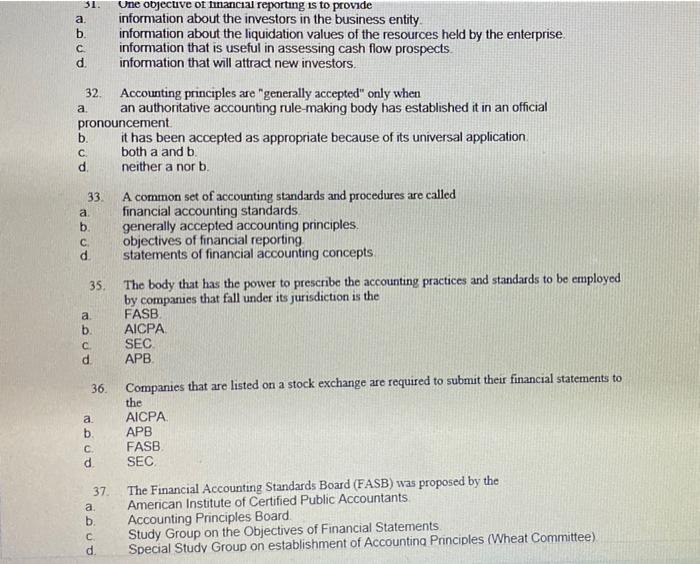
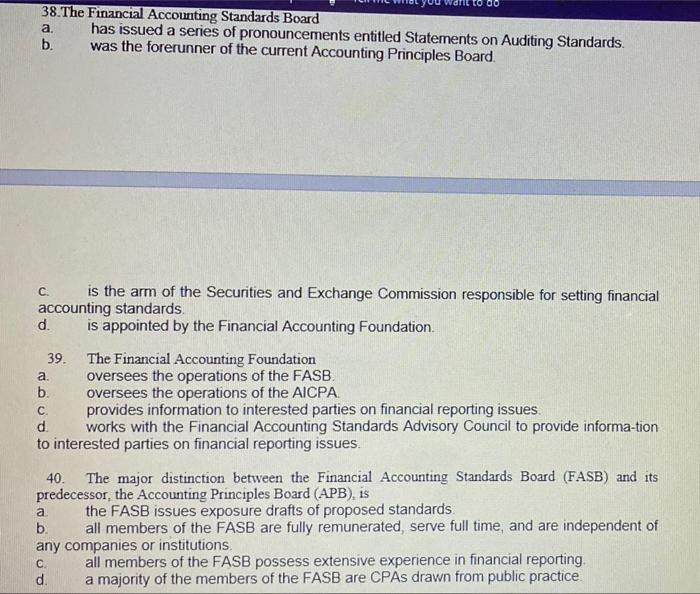
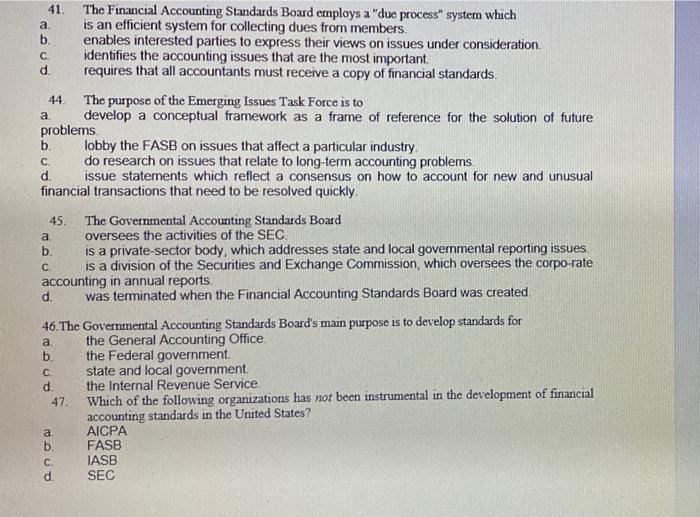
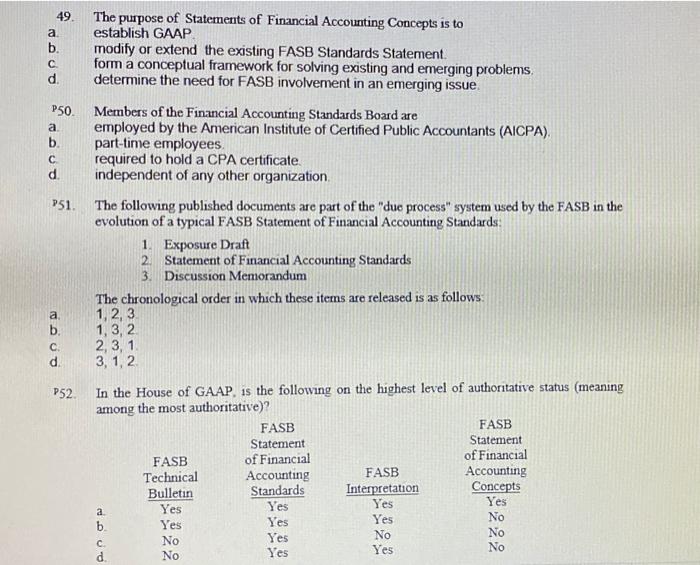
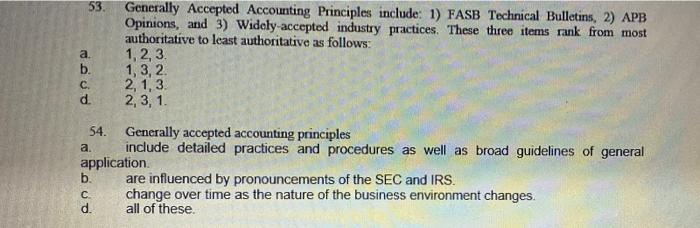
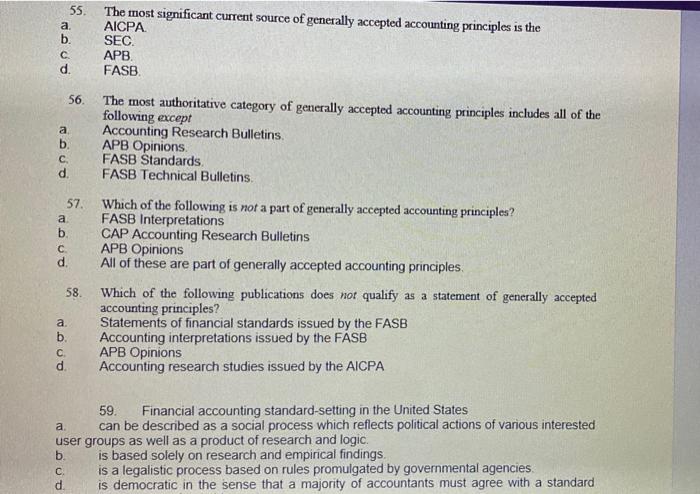

Intermediate Accounting 1 Chapter 1 True False 1. Financial accounting is the process of identifying, measuring, analyzing, and communicating financial information needed by management to plan, evaluate, and control an organization's operations. 2. Financial statements are the principal means through which financial information is communicated to those outside an enterprise. 3. Users of the financial information provided by a company use that information to make capital allocation decisions. 4. An effective process of capital allocation promotes productivity and provides an efficient market for buying and selling securities and obtaining and granting credit. 6. Accounting standards are now less likely to require the recording or disclosure of fair value information due to its inherent subjectivity. 7. While objectives for financial reporting exist on an informal basis, no formal objectives have been adopted. 9. Some generally accepted accounting principles have simply been accepted as appropriate because of their universal application rather than due to the action of an authoritative accounting rule-making body. 10. Users of financial accounting statements have both coinciding and conflicting needs for information of various types. 11. The Securities and Exchange Commission appointed the Committee on Accounting Procedure. 13. Financial Accounting Concepts set forth fundamental objectives and concepts that are used in developing future standards of financial accounting and reporting. 14. The SEC relies on the AICPA and FASB to regulate the accounting profession and develop and enforce accounting standards. 15. FASB Technical Bulletins are more authoritative than FASB Standards and Interpretations. 16. The AICPA's Code of Professional Conduct requires that members prepare financial statements in accordance with generally accepted accounting principles. 17. Accounting standards are a product of careful logic or empirical findings and are not influenced by political action. 18. Currently, both U.S. GAAP and the International Financial Reporting Standards are acceptable for international use. 19. The expectations gap is caused by what the public thinks accountants should be doing and what accountants think they can do. 20. Ethical issues in financial accounting are governed by the AICPA. MULTIPLE CHOICE a. PDCR b. C. d. a. b. PDCH C. a. 21. 22. General-purpose financial statements are the product of financial accounting. managerial accounting. both financial and managerial accounting. neither financial nor managerial accounting. Users of financial reports include all of the following except creditors. government agencies. unions. All of these are users. 24. The information provided by financial reporting pertains to individual business enterprises, rather than to industries or an economy as a whole or to members of society as consumers. b. business industries, rather than to individual enterprises or an economy as a whole or to members of society as consumers. C individual business enterprises, industries, and an economy as a whole, rather than to members of society as consumers. d. an economy as a whole and to members of society as consumers, rather than to individual enterprises or industries. ADCR P25. The process of identifying, measuring, analyzing, and communicating financial information needed by management to plan, evaluate, and control an organization's operations is called financial accounting. a b. C. d. managerial accounting. tax accounting auditing. a. b. ADCR C. d. a. b. 26. 27. 27 ADCA C. d. a. b. ADOP C d 28. Whether a business is successful and thrives is determined by markets. free enterprise. competition. all of these. An effective capital allocation process promotes productivity. encourages innovation. provides an efficient market for buying and selling securities. all of these. Financial statements in the early 2000s provide information related to non-financial measurements. forward-looking data. hard assets (inventory and plant assets). none of these. a b. 29. Which of the following statements is not an objective of financial reporting? Provide information that is useful in investment and credit decisions. to them. ADUCH C. Provide information about enterprise resources, claims to those resources, and changes Provide information on the liquidation value of an enterprise. d Provide information that is useful in assessing cash flow prospects 31. a. b. ADCA d. 32. a. Une objective of financial reporting is to provide information about the investors in the business entity. information about the liquidation values of the resources held by the enterprise. information that is useful in assessing cash flow prospects. information that will attract new investors. Accounting principles are "generally accepted" only when an authoritative accounting rule-making body has established it in an official pronouncement. b. it has been accepted as appropriate because of its universal application. both a and b. C d. a. b. C. d a. b. PPCO d ADOP 33. 35 35. 36. neither a nor b. A common set of accounting standards and procedures are called financial accounting standards. generally accepted accounting principles. objectives of financial reporting statements of financial accounting concepts The body that has the power to prescribe the accounting practices and standards to be employed by companies that fall under its jurisdiction is the FASB AICPA SEC. APB Companies that are listed on a stock exchange are required to submit their financial statements to the AICPA APB a. b. C. FASB d. a. 37. 37 ADCA b. SEC The Financial Accounting Standards Board (FASB) was proposed by the American Institute of Certified Public Accountants Accounting Principles Board. C. Study Group on the Objectives of Financial Statements. d. Special Study Group on establishment of Accounting Principles (Wheat Committee). do 38.The Financial Accounting Standards Board 320 a. b. has issued a series of pronouncements entitled Statements on Auditing Standards. was the forerunner of the current Accounting Principles Board. C. is the arm of the Securities and Exchange Commission responsible for setting financial accounting standards. d. a. b. C. d. 39. is appointed by the Financial Accounting Foundation. The Financial Accounting Foundation oversees the operations of the FASB. oversees the operations of the AICPA provides information to interested parties on financial reporting issues. works with the Financial Accounting Standards Advisory Council to provide informa-tion to interested parties on financial reporting issues. 40. The major distinction between the Financial Accounting Standards Board (FASB) and its predecessor, the Accounting Principles Board (APB), is a. the FASB issues exposure drafts of proposed standards. b. all members of the FASB are fully remunerated, serve full time, and are independent of any companies or institutions. C. d. all members of the FASB possess extensive experience in financial reporting. a majority of the members of the FASB are CPAs drawn from public practice a. b. C. d. a. 41. 44. The Financial Accounting Standards Board employs a "due process" system which is an efficient system for collecting dues from members. enables interested parties to express their views on issues under consideration. identifies the accounting issues that are the most important. requires that all accountants must receive a copy of financial standards. The purpose of the Emerging Issues Task Force is to develop a conceptual framework as a frame of reference for the solution of future problems. b. lobby the FASB on issues that affect a particular industry. C. do research on issues that relate to long-term accounting problems d. issue statements which reflect a consensus on how to account for new and unusual financial transactions that need to be resolved quickly. a b. 45. The Governmental Accounting Standards Board oversees the activities of the SEC. is a private-sector body, which addresses state and local governmental reporting issues. is a division of the Securities and Exchange Commission, which oversees the corpo-rate accounting in annual reports. C d. was terminated when the Financial Accounting Standards Board was created. 46. The Governmental Accounting Standards Board's main purpose is to develop standards for the General Accounting Office a. b. C. d 47. the Federal government. state and local government the Internal Revenue Service. Which of the following organizations has not been instrumental in the development of financial accounting standards in the United States? PDOR a AICPA b. FASB C. IASB d. SEC a. b. ADCR d. 49. P50. a. b. PDCR d. P51. The purpose of Statements of Financial Accounting Concepts is to establish GAAP modify or extend the existing FASB Standards Statement. form a conceptual framework for solving existing and emerging problems. determine the need for FASB involvement in an emerging issue. Members of the Financial Accounting Standards Board are employed by the American Institute of Certified Public Accountants (AICPA). part-time employees. required to hold a CPA certificate. independent of any other organization. The following published documents are part of the "due process" system used by the FASB in the evolution of a typical FASB Statement of Financial Accounting Standards: 1. Exposure Draft 2. Statement of Financial Accounting Standards 3. Discussion Memorandum The chronological order in which these items are released is as follows: ADCR a. 1, 2, 3 b. 1, 3, 2 C. 2, 3, 1. d. 3, 1, 2 P52. In the House of GAAP, is the following on the highest level of authoritative status (meaning among the most authoritative)? FASB Statement of Financial Accounting Concepts Yes FASB Statement FASB Technical of Financial Accounting FASB Bulletin Standards Interpretation A9CP a. Yes Yes Yes b. Yes Yes Yes No C. 22 No Yes No No No Yes Yes No 222 a. 53. 53 Generally Accepted Accounting Principles include: 1) FASB Technical Bulletins, 2) APB Opinions, and 3) Widely-accepted industry practices. These three items rank from most authoritative to least authoritative as follows: 1, 2, 3. ADCR b. 1, 3, 2. C. 2, 1, 3. d. 2, 3, 1. a. 54. F4 Generally accepted accounting principles include detailed practices and procedures as well as broad guidelines of general application. b. C. d. are influenced by pronouncements of the SEC and IRS. change over time as the nature of the business environment changes. all of these. a. b. ADCH d. a PDCR b. C. d. a b. C. ADCP d. a. ADCR b. C. d. a. 55. 56. The most significant current source of generally accepted accounting principles is the AICPA SEC. APB. FASB. The most authoritative category of generally accepted accounting principles includes all of the following except Accounting Research Bulletins. APB Opinions. FASB Standards. FASB Technical Bulletins. 57. Which of the following is not a part of generally accepted accounting principles? 58. FASB Interpretations CAP Accounting Research Bulletins APB Opinions All of these are part of generally accepted accounting principles. Which of the following publications does not qualify as a statement of generally accepted accounting principles? Statements of financial standards issued by the FASB Accounting interpretations issued by the FASB APB Opinions Accounting research studies issued by the AICPA 59. Financial accounting standard-setting in the United States can be described as a social process which reflects political actions of various interested user groups as well as a product of research and logic. POA b. C. d. is based solely on research and empirical findings. is a legalistic process based on rules promulgated by governmental agencies. is democratic in the sense that a majority of accountants must agree with a standard 60.The purpose of the International Accounting Standards Board is to a. issue enforceable standards which regulate the financial accounting and reporting of multinational corporations. b. develop a uniform currency in which the financial transactions of companies through-out the world would be measured. c. d. promote uniform accounting standards among countries of the world arbitrate accounting disputes between auditors and international companies
Step by Step Solution
There are 3 Steps involved in it
Sure lets go through the answers TrueFalse 1 False 2 True 3 True 4 True 5 Not provided 6 False 7 False 8 Not provided 9 True 10 True 11 False 12 Not p... View full answer

Get step-by-step solutions from verified subject matter experts