







Question: International Finance Chapter 14 Case Study The case study should be typed (not hand written) and should include excel spreadsheet imbedded in the word document
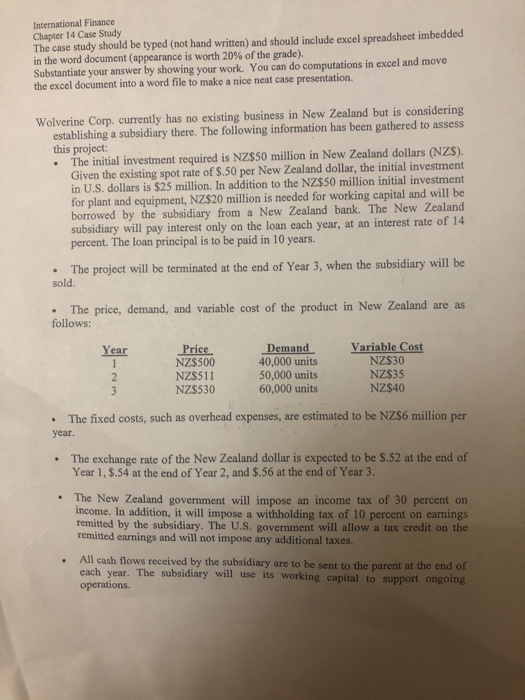
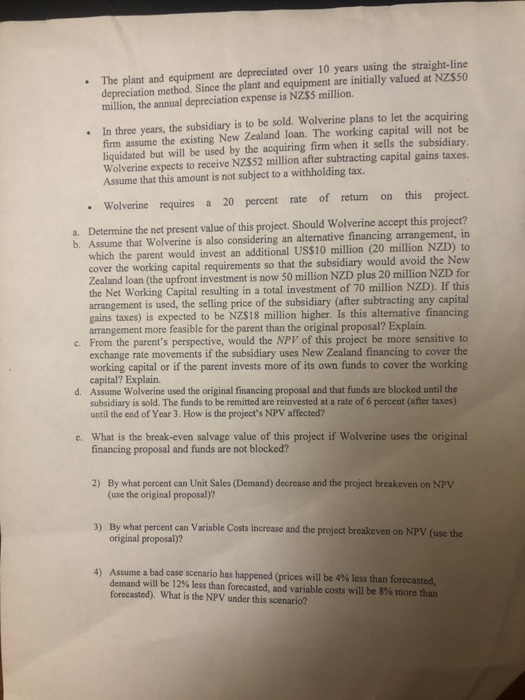
International Finance Chapter 14 Case Study The case study should be typed (not hand written) and should include excel spreadsheet imbedded in the word document (appearance is worth 20% of the grade). Substantiate your answer by showing your work. You can do computations in excel and move the excel document into a word file to make a nice neat case presentation. Wolverine Corp. currently has no existing business in New Zealand but is considering establishing a subsidiary there. The following information has been gathered to assess nis Pho ential nvestment required is N250 The initial investment required is NZ$50 million in New Zealand dollars (NZS). Given the existing spot rate of S.50 per New Zealand dollar, the initial investment in U.S. dollars is $25 million. In addition to the NZS50 million initial investment for plant and equipment, NZS20 million is needed for working capital and will be borrowed by the subsidiary from a New Zealand bank. The New Zealand subsidiary will pay interest only on the loan each year, at an interest rate of 14 . percent. The loan principal is to be paid in 10 years. . The project will be terminated at the end of Year 3, when the subsidiary will be sold. The price, demand, and variable cost of the product in New Zealand are as follows: DemandVariable Cost 40,000 units 50,000 units 60,000 units Price NZS500 NZS511 NZS530 Year NZS30 NZ$35 NZ$40 The fixed costs, such as overhead expenses, are estimated to be NZS6 million per year. The exchange rate of the New Zealand dollar is expected to be $.52 at the end of Year 1, $.54 at the end of Year 2, and $.56 at the end of Year 3. . The New Zealand government will impose an income tax of 30 percent on income. In addition, it will impose a withholding tax of 10 percent on earnings remitted by the subsidiary. The U.S. government will allow a tax credit on the remitted earnings and will not impose any additional taxes. All cash flows received by the subsidiary are to be sent to the parent at the end of each year. The subsidiary will use its working capital to support ongoing operations. The plant and equipment are depreciated over 10 years using the straight-line depreciation method. Since the plant and equipment are initially valued at NZS50 million, the annual depreciation expense is NZ$5 million. .In three years, the subsidiary is to be sold. Wolverine plans to let the acquiring firm assume the existing New Zealand loan. The working capital will not be liquidated but will be used by the acquiring firm when it sells the subsidiary Wolverine expects to receive NZS52 million after subtracting capital gains taxes. Assume that this amount is not subject to a withholding tax. Wolverine requires a 20 percent rate of return on this project. a. Determine the net present value of this project. Should Wolverine accept this project? b. Assume that Wolverine is also considering an alternative financing arrangement, in which the parent would invest an additional US$10 million (20 million NZD) to cover the working capital requirements so that the subsidiary would avoid the New Zealand loan (the upfront investment is now 50 million NZD plus 20 million NZD for of 70 million NZD). If this arrangement is used, the selling price of the subsidiary (after subtracting any capital gains taxes) is expected to be NZ$18 million higher. Is this altemative financing arrangement more feasible for the parent than the original proposal? Explain. c. From the parent's perspective, would the NPV of this project be more sensitive to exchange rate movements if the subsidiary uses New Zealand financing to cover the working capital or if the parent invests more of its own funds to cover the working capital? Explain. Assume Wolverine used the original financing proposal and that funds are blocked until the subsidiary is sold. The funds to be remitted are reinvested at a rate of 6 percent (after taxes) until the end of Year 3. How is the project's NPV affected? d. What is the break-even salvage value of this project if Wolverine uses the original e. financing proposal and funds are not blocked? 2) By what percent can Unit Sales (Demand) decrease and the project breakeven on NPV (use the original proposal)? By what percent can Variable Costs increase and the project breakeven on NPV (use the original proposal)? 3) Assume a bad case scenario has happened (prices will be 4% less than forecasted, demand will be 12% less than forecasted, and variable costs will be 8% more than forecasted). What is the NPV under this scenario? 4) International Finance Chapter 14 Case Study The case study should be typed (not hand written) and should include excel spreadsheet imbedded in the word document (appearance is worth 20% of the grade). Substantiate your answer by showing your work. You can do computations in excel and move the excel document into a word file to make a nice neat case presentation. Wolverine Corp. currently has no existing business in New Zealand but is considering establishing a subsidiary there. The following information has been gathered to assess nis Pho ential nvestment required is N250 The initial investment required is NZ$50 million in New Zealand dollars (NZS). Given the existing spot rate of S.50 per New Zealand dollar, the initial investment in U.S. dollars is $25 million. In addition to the NZS50 million initial investment for plant and equipment, NZS20 million is needed for working capital and will be borrowed by the subsidiary from a New Zealand bank. The New Zealand subsidiary will pay interest only on the loan each year, at an interest rate of 14 . percent. The loan principal is to be paid in 10 years. . The project will be terminated at the end of Year 3, when the subsidiary will be sold. The price, demand, and variable cost of the product in New Zealand are as follows: DemandVariable Cost 40,000 units 50,000 units 60,000 units Price NZS500 NZS511 NZS530 Year NZS30 NZ$35 NZ$40 The fixed costs, such as overhead expenses, are estimated to be NZS6 million per year. The exchange rate of the New Zealand dollar is expected to be $.52 at the end of Year 1, $.54 at the end of Year 2, and $.56 at the end of Year 3. . The New Zealand government will impose an income tax of 30 percent on income. In addition, it will impose a withholding tax of 10 percent on earnings remitted by the subsidiary. The U.S. government will allow a tax credit on the remitted earnings and will not impose any additional taxes. All cash flows received by the subsidiary are to be sent to the parent at the end of each year. The subsidiary will use its working capital to support ongoing operations. The plant and equipment are depreciated over 10 years using the straight-line depreciation method. Since the plant and equipment are initially valued at NZS50 million, the annual depreciation expense is NZ$5 million. .In three years, the subsidiary is to be sold. Wolverine plans to let the acquiring firm assume the existing New Zealand loan. The working capital will not be liquidated but will be used by the acquiring firm when it sells the subsidiary Wolverine expects to receive NZS52 million after subtracting capital gains taxes. Assume that this amount is not subject to a withholding tax. Wolverine requires a 20 percent rate of return on this project. a. Determine the net present value of this project. Should Wolverine accept this project? b. Assume that Wolverine is also considering an alternative financing arrangement, in which the parent would invest an additional US$10 million (20 million NZD) to cover the working capital requirements so that the subsidiary would avoid the New Zealand loan (the upfront investment is now 50 million NZD plus 20 million NZD for of 70 million NZD). If this arrangement is used, the selling price of the subsidiary (after subtracting any capital gains taxes) is expected to be NZ$18 million higher. Is this altemative financing arrangement more feasible for the parent than the original proposal? Explain. c. From the parent's perspective, would the NPV of this project be more sensitive to exchange rate movements if the subsidiary uses New Zealand financing to cover the working capital or if the parent invests more of its own funds to cover the working capital? Explain. Assume Wolverine used the original financing proposal and that funds are blocked until the subsidiary is sold. The funds to be remitted are reinvested at a rate of 6 percent (after taxes) until the end of Year 3. How is the project's NPV affected? d. What is the break-even salvage value of this project if Wolverine uses the original e. financing proposal and funds are not blocked? 2) By what percent can Unit Sales (Demand) decrease and the project breakeven on NPV (use the original proposal)? By what percent can Variable Costs increase and the project breakeven on NPV (use the original proposal)? 3) Assume a bad case scenario has happened (prices will be 4% less than forecasted, demand will be 12% less than forecasted, and variable costs will be 8% more than forecasted). What is the NPV under this scenario? 4)
Step by Step Solution
There are 3 Steps involved in it

Get step-by-step solutions from verified subject matter experts
 Study Help