







Question: Internet Protocol version 6 (IPv6) is the most recent version of the Internet Protocol (IP). the communications protocol that provides an identification and location system
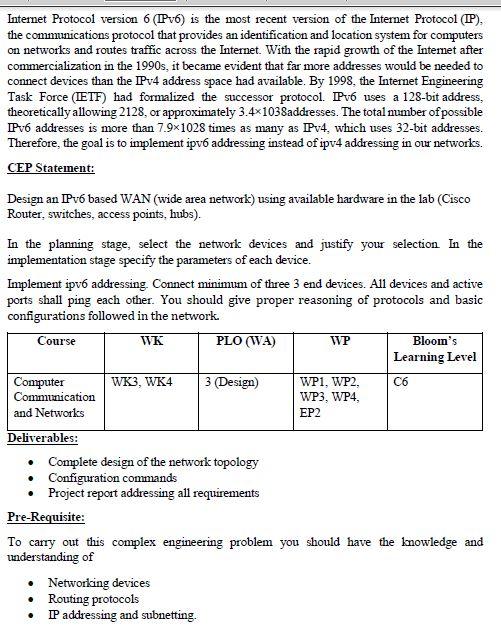
Internet Protocol version 6 (IPv6) is the most recent version of the Internet Protocol (IP). the communications protocol that provides an identification and location system for computers on networks and routes traffic across the Internet. With the rapid growth of the Intemet after commercialization in the 1990s, it became evident that far more addresses would be needed to connect devices than the IPv4 address space had available. By 1998, the Internet Engineering Task Force (IETF) had formalized the successor protocol. IPv6 uses a 128-bit address, theoretically allowing 2128. or approximately 3.41038addresses. The total number of possible IPv6 addresses is more than 7.9x1028 times as many as IPv4, which uses 32-bit addresses. Therefore, the goal is to implement ipv6 addressing instead of ipv4 addressing in our networks. CEP Statement: Design an IPv6 based WAN (wide area network) using available hardware in the lab (Cisco Router, switches, access points, hubs). In the planning stage, select the network devices and justify your selection. In the implementation stage specify the parameters of each device. Implement ipv6 addressing. Connect minimum of three 3 end devices. All devices and active ports shall ping each other. You should give proper reasoning of protocols and basic configurations followed in the network. Course WK PLO (WA) WP Bloom's Learning Level Computer WK3, WK4 3 (Design) WP1, WP2, C6 Communication WP3, WP4, and Networks EP2 Deliverables: Complete design of the network topology Configuration commands Project report addressing all requirements Pre-Requisite: To carry out this complex engineering problem you should have the knowledge and understanding of Networking devices Routing protocols IP addressing and subnetting. Internet Protocol version 6 (IPv6) is the most recent version of the Internet Protocol (IP). the communications protocol that provides an identification and location system for computers on networks and routes traffic across the Internet. With the rapid growth of the Intemet after commercialization in the 1990s, it became evident that far more addresses would be needed to connect devices than the IPv4 address space had available. By 1998, the Internet Engineering Task Force (IETF) had formalized the successor protocol. IPv6 uses a 128-bit address, theoretically allowing 2128. or approximately 3.41038addresses. The total number of possible IPv6 addresses is more than 7.9x1028 times as many as IPv4, which uses 32-bit addresses. Therefore, the goal is to implement ipv6 addressing instead of ipv4 addressing in our networks. CEP Statement: Design an IPv6 based WAN (wide area network) using available hardware in the lab (Cisco Router, switches, access points, hubs). In the planning stage, select the network devices and justify your selection. In the implementation stage specify the parameters of each device. Implement ipv6 addressing. Connect minimum of three 3 end devices. All devices and active ports shall ping each other. You should give proper reasoning of protocols and basic configurations followed in the network. Course WK PLO (WA) WP Bloom's Learning Level Computer WK3, WK4 3 (Design) WP1, WP2, C6 Communication WP3, WP4, and Networks EP2 Deliverables: Complete design of the network topology Configuration commands Project report addressing all requirements Pre-Requisite: To carry out this complex engineering problem you should have the knowledge and understanding of Networking devices Routing protocols IP addressing and subnetting
Step by Step Solution
There are 3 Steps involved in it

Get step-by-step solutions from verified subject matter experts
 Study Help