Question: . Introduce the organization: basic facts and brief history Chapter 1 2. Specifically identify the industry, life-cycle stage and the competitors see IBIS World database
. Introduce the organization: basic facts and brief history
Chapter 1
2. Specifically identify the industry, life-cycle stage and the competitors see IBIS World database
Chapter 2
3. Who has succeeded and failed in the industry? What are the Critical Success Factors (or Key Success Factors)?
Chapter 2
4. What political/legal forces affect the industry?
Ch. 3
5. What economic forces affect the industry? What is the market structure?
Ch. 3
6. What social forces affect the industry?
Ch. 4 & p. 75-81
7. What technological forces affect the industry?
Ch. 4
8. What is the current firm-level or corporate-level strategy?
Ch. 6
9. What is the current business-level [generic] strategy?
Ch. 7 & p. 172
10. What is the organizations financial position and financial strategy how do they make and invest their money?
Ch. 8 & p. 207
11./12. What are the organizations Strengths and Weaknesses? On what competencies should they build?
Ch. 9, SWOT
13./14. What are the organizations Opportunities and Threats? How should they address or overcome them?
Ch. 9, SWOT
15. What strategic alternatives are available to the organization?
Ch. 9
16. Our Good to Great book provides timeless principles. As the case describes, the Home Depot history and story shows many changes. Do you think any of these demonstrate practices, such as leadership, attaining sustainablity or other factors, from Collins? Why?
Case Study Below in the two pictures
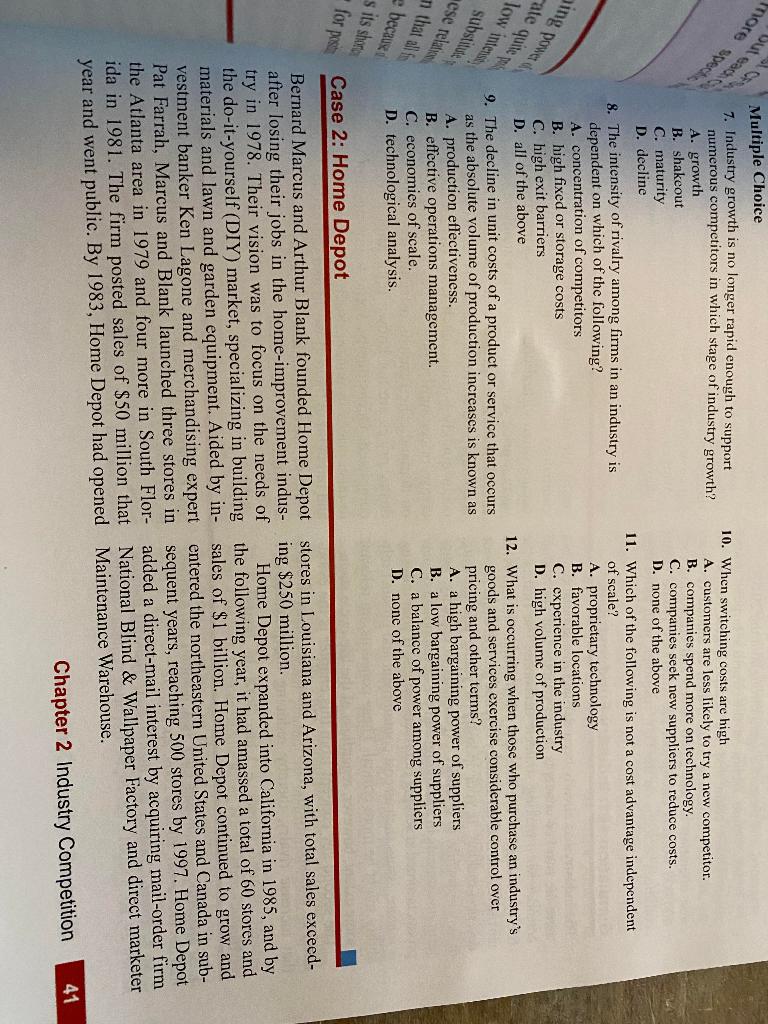
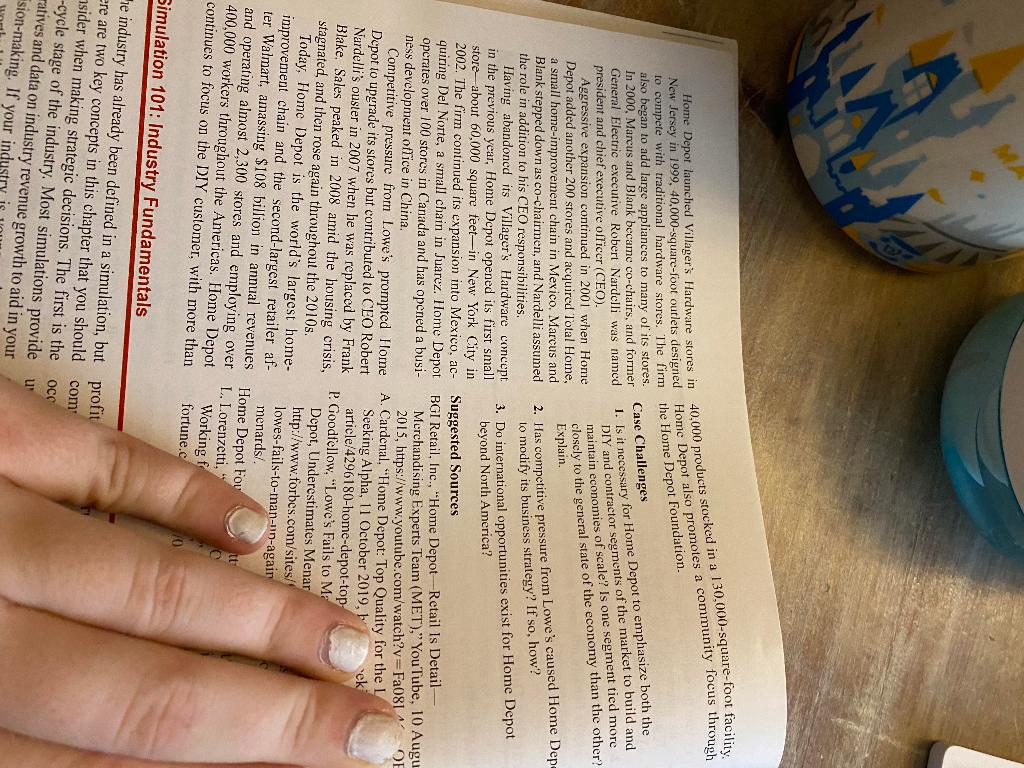
7. Industry growth is no longer rapid enough to support 10. When switching costs are high numerous competitors in which stage of industry growth? A. growth A. customers are less likely to try a new competitor. B. companies spend more on technology. B. shakeout C. companies seek new suppliers to reduce costs. C. maturity D. none of the above D. decline 11. Which of the following is not a cost advantage independent 8. The intensity of rivalry among firms in an industry is of scale? dependent on which of the following? A. concentration of competitors A. proprietary technology B. favorable locations B. high fixed or storage costs C. experience in the industry C. high exit barriers D. high volume of production D. all of the above 12. What is occurring when those who purchase an industry's goods and services exercise considerable control over 9. The decline in unit costs of a product or service that occurs pricing and other terms? as the absolute volume of pro A. production effectiveness. B. a low bargaining power of suppliers B. effective operations management. C. a balance of power among suppliers C. economies of scale. D. none of the above D. technological analysis. Case 2: Home Depot Bernard Marcus and Arthur Blank founded Home Depot stores in Louisiana and Arizona, with total sales exceedafter losing their jobs in the home-improvement indus- ing $250 million. try in 1978. Their vision was to focus on the needs of Home Depot expanded into California in 1985 , and by the do-it-yourself (DIY) market, specializing in building the following year, it had amassed a total of 60 stores and materials and lawn and garden equipment. Aided by in- sales of $1 billion. Home Depot continued to grow and vestment banker Ken Lagone and merchandising expert entered the northeastern United States and Canada in subPat Farrah, Marcus and Blank launched three stores in sequent years, reaching 500 stores by 1997. Home Depot the Atlanta area in 1979 and four more in South Flor- added a direct-mail interest by acquiring mail-order firm ida in 1981. The firm posted sales of $50 million that National Blind \& Wallpaper Factory and direct marketer year and went public. By 1983 , Home Depot had opened Maintenance Warehouse. Chapter 2 Industry Competition Home Depot launched Villager:s Hardware stores in 40,000 products stocked in a 130,000 -square-foot facility. New Jersey in 1999,40,000-square-foot outlets designed Home Depot also promotes a community focus through to compete with traditional hardware stores. The firm the Home Depot Foundation. afso began to add large appliances to many of its stores. In 2000, Marcus and Blank became co-chairs, and former Case Challenges General Electric executive Robert Nardelli was named 1. Is it necessary for Home Depot to emptorize both the build and president and chief executive officer (CEO). DIY and contractor segments of the market to build and Aggressive expansion continued in 2001 when Home maintain economies of scale? Is one segment tied more 2. Has competitive pressure from Lowe caused to modify its business strategy? If so, how? the role in addition to his CEO responsibilities. Having abandoned its Villager's Hardware concept: in the previous year, Home Depot opened its first small 3. Do international opportunities exist for Home Depot beyond North America? store-about 60,000 square teet-in New York City in 2002. The firm continued its expansion into Mexico, ac- Suggested Sources quiring Del Norte, a small chain in Juarez. Home Depot BGI Retail, Inc.," "Home Depot-Retail Is Detailness development office in China. Competitive pressure from Lowe's prompted Home A. Cardenal. "Home Depot: Top Quality for the I improvement chain and the second-largest retailer af- lowes-fails-t. menards. ter Walmart, amassing \$108 billion in annual revenues Home Depot Fou and operating almost 2,300 stores and employing over L. Lorenzetti, 400,000 workers throughout the Americas. Home Depot Working f









 Study Help