







Question: Introduction: This case study analyzes the check - out processes at a large retail store with the objective of determining the most efficient queue system.
Introduction: This case study analyzes the checkout processes at a large retail store with the objective of determining the most efficient queue system. The two queue models under consideration are:
A single queue system where the first person in line goes to the first available cashier eg Marshalls and that has five cashiers available;
Five separate queues with one cashier assigned to each line eg Walmart
Store Background: The store has a total of five cashiers on duty. The rate of customer arrivals for checkout is people per hour, while each cashier can serve an average of people per hour. Both interarrival times and service times are assumed to follow an exponential distribution.
At first, let us assume a system with one single line leading to the five cashiers.
What type of queue is this? Points
MG
MG
What is the expected number of people in the system including people waiting in line and beirtg served Points
The value must be a number
What is the expected time people need to wait between the time they join the line and the time they leave the store in minutes? Points
What proportion of the time are the cashiers idle? provide your answer as a number between and Points
The value must be a number
Now what if we have a different layout. We now have lines, each with one cashier. Each line of what type? Points
MG
MG
In this case, the rate of arrivals for each queue will be different than before. We shall assume that a person arriving to checkout will choose one of the five queues randomly. What should be the rate of arrival lambda for each one of the five queues? Points
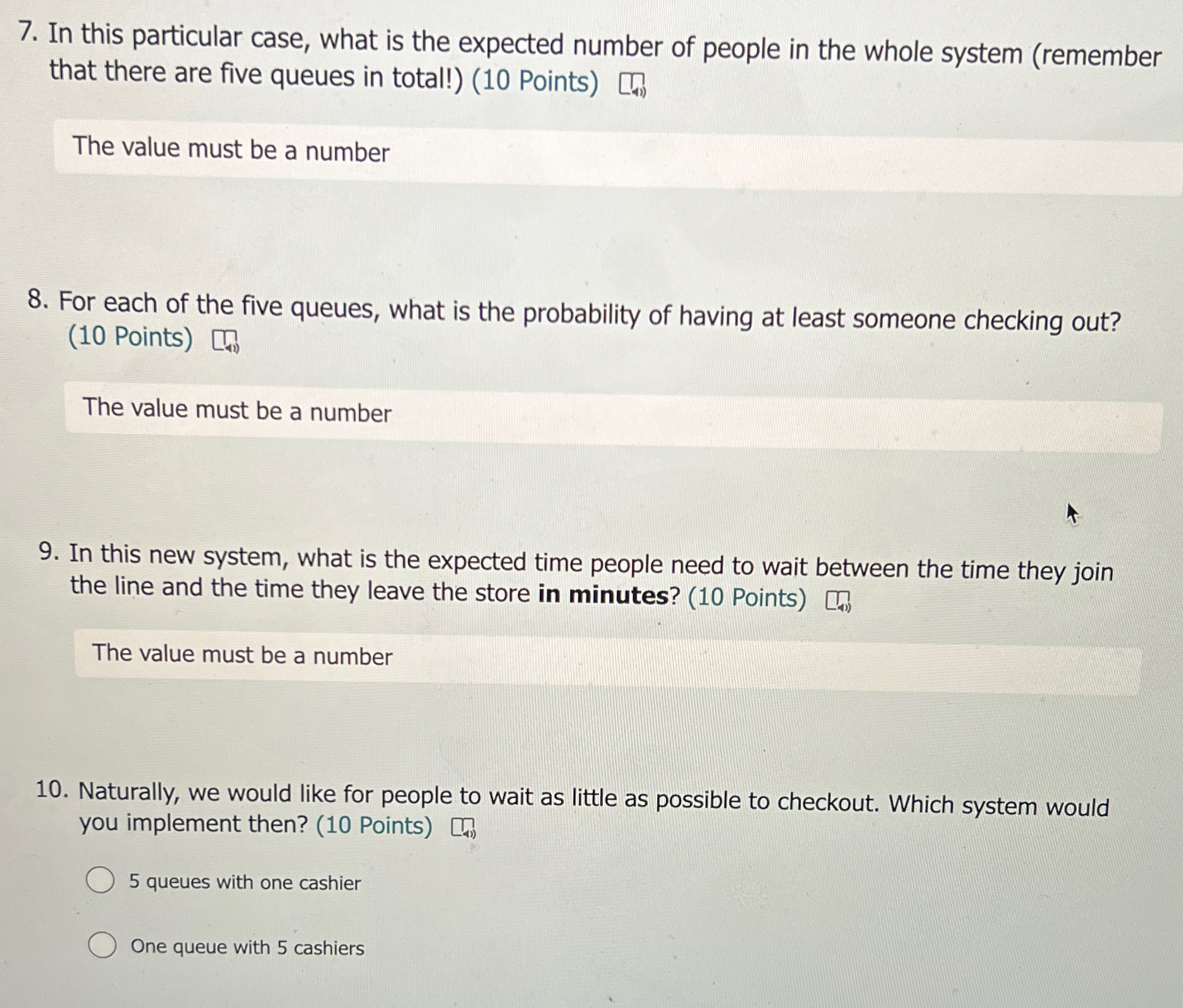
In this particular case, what is the expected number of people in the whole system remember that there are five queues in total! Points
For each of the five queues, what is the probability of having at least someone checking out? Points
In this new system, what is the expected time people need to wait between the time they join the line and the time they leave the store in minutes? Points
The value must be a number
Naturally, we would like for people to wait as little as possible to checkout. Which system would you implement then? Points
queues with one cashier
One queue with cashiers
Step by Step Solution
There are 3 Steps involved in it
1 Expert Approved Answer
Step: 1 Unlock

Question Has Been Solved by an Expert!
Get step-by-step solutions from verified subject matter experts
Step: 2 Unlock
Step: 3 Unlock
 Study Help