







Question: Introduction to adjustment calculus: Please solve with clear procedure.Reference: Introduction Adjustment Calculus GGE 3111 INTRODUCTION TO ADJUSTMENT CALCULUS W2023 ASSIGNMENT 6 LINEAR PARAMETRIC & CONDITIONAL
Introduction to adjustment calculus: Please solve with clear procedure.Reference: Introduction Adjustment Calculus
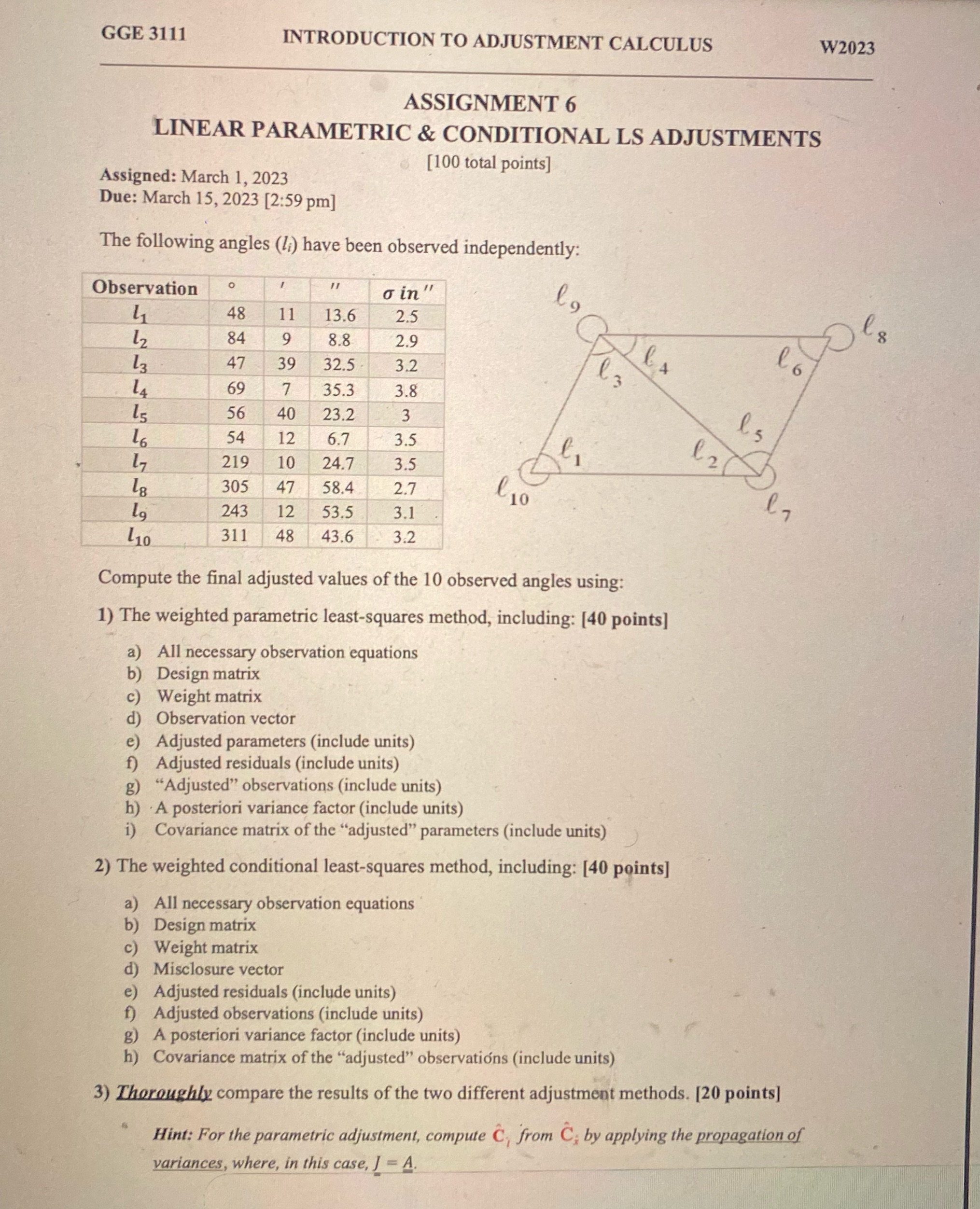
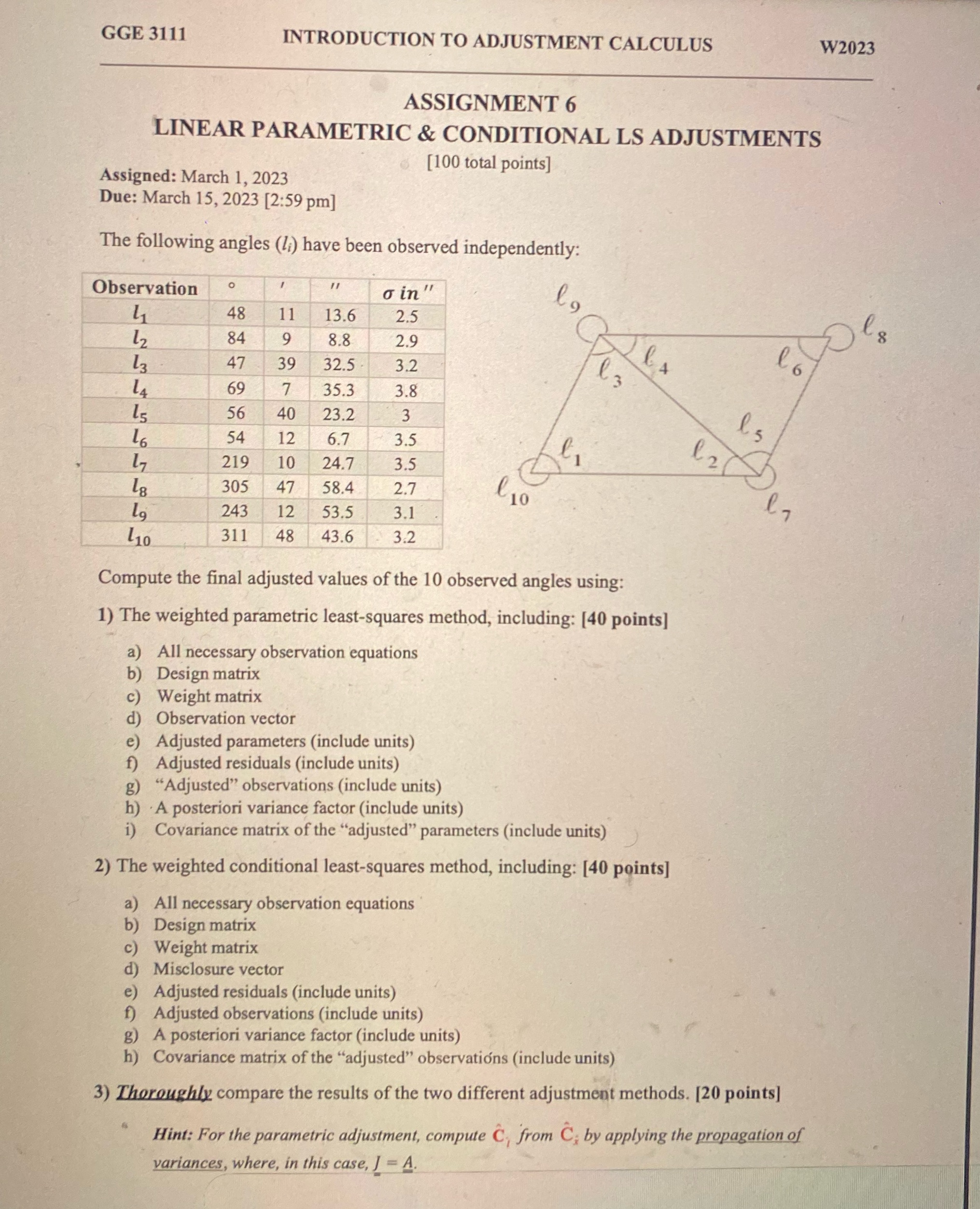
GGE 3111 INTRODUCTION TO ADJUSTMENT CALCULUS W2023 ASSIGNMENT 6 LINEAR PARAMETRIC & CONDITIONAL LS ADJUSTMENTS [100 total points] Assigned: March 1, 2023 Due: March 15, 2023 [2:59 pm] The following angles (1) have been observed independently: Observation " in" 48 11 13.6 2.5 84 9 8.8 2.9 L3 47 39 32.5 3.2 LA 69 7 35.3 3.8 56 40 23.2 3 2 5 16 54 12 6.7 3.5 219 10 24.7 3.5 l8 305 47 58.4 2.7 10 e - 243 12 53.5 3.1 L10 311 48 43.6 3.2 Compute the final adjusted values of the 10 observed angles using: 1) The weighted parametric least-squares method, including: [40 points] a) All necessary observation equations b) Design matrix c) Weight matrix d) Observation vector e) Adjusted parameters (include units) f) Adjusted residuals (include units) g) "Adjusted" observations (include units) h) . A posteriori variance factor (include units) i) Covariance matrix of the "adjusted" parameters (include units) 2) The weighted conditional least-squares method, including: [40 points] a) All necessary observation equations b) Design matrix c) Weight matrix d) Misclosure vector e) Adjusted residuals (include units) f) Adjusted observations (include units) g) A posteriori variance factor (include units) h) Covariance matrix of the "adjusted" observations (include units) 3) Thoroughly compare the results of the two different adjustment methods. [20 points] Hint: For the parametric adjustment, compute C, from C; by applying the propagation of variances, where, in this case, J = A
Step by Step Solution
There are 3 Steps involved in it

Get step-by-step solutions from verified subject matter experts
 Study Help