







Question: Introduction to Integration - The Exercise Bicycle Problem, Part 2 HELP Show divisions 16 miles Number of divisions: per hour 6 13 12 11 10
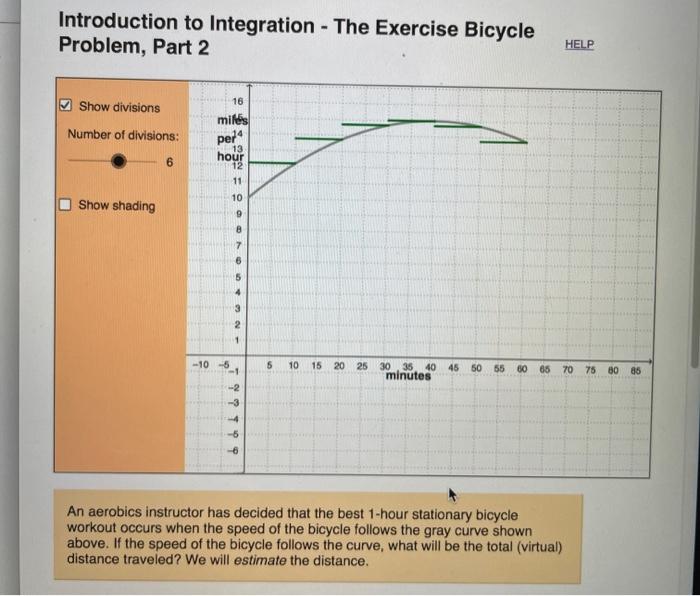
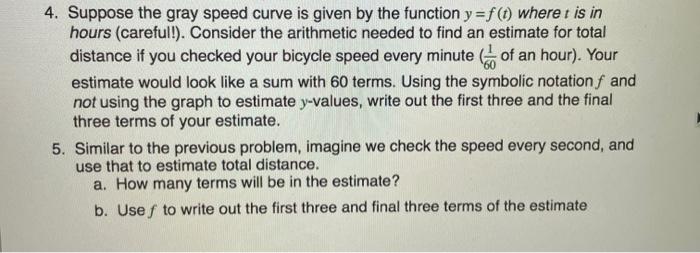
Introduction to Integration - The Exercise Bicycle Problem, Part 2 HELP Show divisions 16 miles Number of divisions: per" hour 6 13 12 11 10 Show shading 9 3 2 1 -10 -5 -1 6 10 15 20 25 30 35 40 45 minutes 50 55 60 65 70 75 80 85 -2 -3 -6 An aerobics instructor has decided that the best 1-hour stationary bicycle workout occurs when the speed of the bicycle follows the gray curve shown above. If the speed of the bicycle follows the curve, what will be the total (virtual) distance traveled? We will estimate the distance, 4. Suppose the gray speed curve is given by the function y=fo where t is in hours (careful!). Consider the arithmetic needed to find an estimate for total distance if you checked your bicycle speed every minute ( of an hour). Your estimate would look like a sum with 60 terms. Using the symbolic notation f and not using the graph to estimate y-values, write out the first three and the final three terms of your estimate. 5. Similar to the previous problem, imagine we check the speed every second, and use that to estimate total distance. a. How many terms will be in the estimate? b. Usef to write out the first three and final three terms of the estimate
Step by Step Solution
There are 3 Steps involved in it

Get step-by-step solutions from verified subject matter experts
 Study Help