



Question: Introduction to Operations Research Book Please Answer e,f and g 7.1-1.* Consider the following problem. Maximize Z=3x1+x2+4x3, subject to 6x1+3x2+5x3253x1+4x2+5x320 and x10,x20,x30. The corresponding final
Introduction to Operations Research Book
Please Answer e,f and g
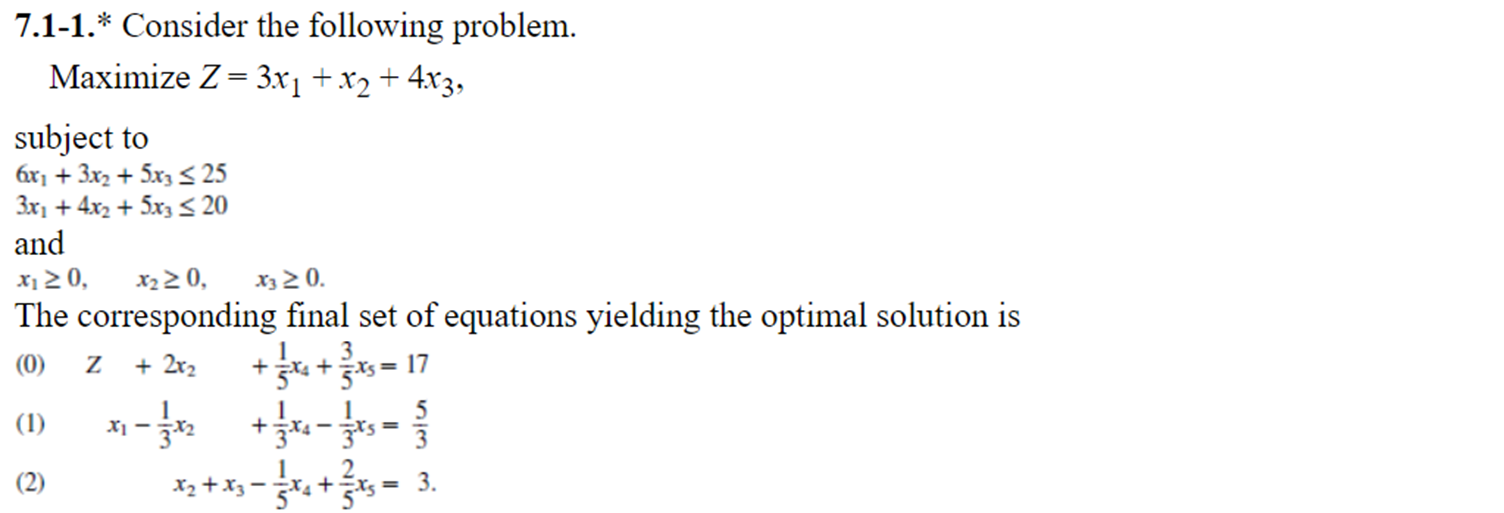
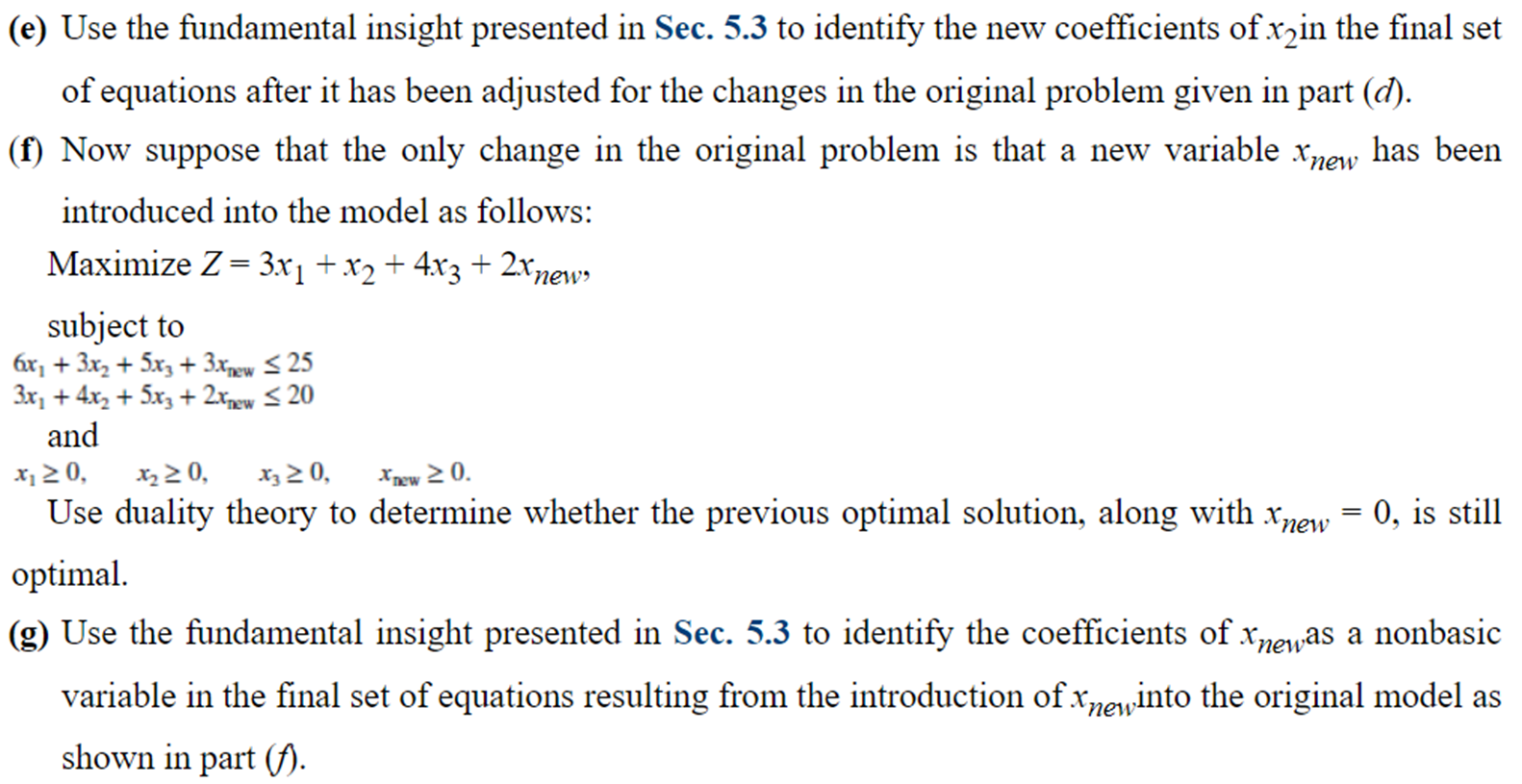
7.1-1.* Consider the following problem. Maximize Z=3x1+x2+4x3, subject to 6x1+3x2+5x3253x1+4x2+5x320 and x10,x20,x30. The corresponding final set of equations yielding the optimal solution is (0) Z+2x2+51x4+53x5=17 (1) x131x2+31x431x5=35 (2) x2+x351x4+52x5=3. (e) Use the fundamental insight presented in Sec. 5.3 to identify the new coefficients of x2 in the final set of equations after it has been adjusted for the changes in the original problem given in part (d). (f) Now suppose that the only change in the original problem is that a new variable xnew has been introduced into the model as follows: Maximize Z=3x1+x2+4x3+2xnew, subject to 6x1+3x2+5x3+3xnew25 3x1+4x2+5x3+2xnew20 and x10,x20,x30,xrew0. Use duality theory to determine whether the previous optimal solution, along with xnew=0, is still optimal. (g) Use the fundamental insight presented in Sec. 5.3 to identify the coefficients of xnew as a nonbasic variable in the final set of equations resulting from the introduction of xnew into the original model as shown in part (f)
Step by Step Solution
There are 3 Steps involved in it

Get step-by-step solutions from verified subject matter experts