







Question: INTRODUCTION TO PROBABILITY AND HYPOTHESIS TESTING and CALCULATING PROBABILITIES MODULE-3-INTRODUCTION-TO-PROBABILITY-AND-HYPOTHESIS-TESTING [Compatibility Mode] - Word nanettesoralde@gmail.com N X File Home Insert Draw Design Layout References Mailings
INTRODUCTION TO PROBABILITY AND HYPOTHESIS TESTING and CALCULATING PROBABILITIES
![INTRODUCTION TO PROBABILITY AND HYPOTHESIS TESTING and CALCULATING PROBABILITIES MODULE-3-INTRODUCTION-TO-PROBABILITY-AND-HYPOTHESIS-TESTING [Compatibility Mode]](https://s3.amazonaws.com/si.experts.images/answers/2024/06/667963374a6a9_2876679633726fcb.jpg)
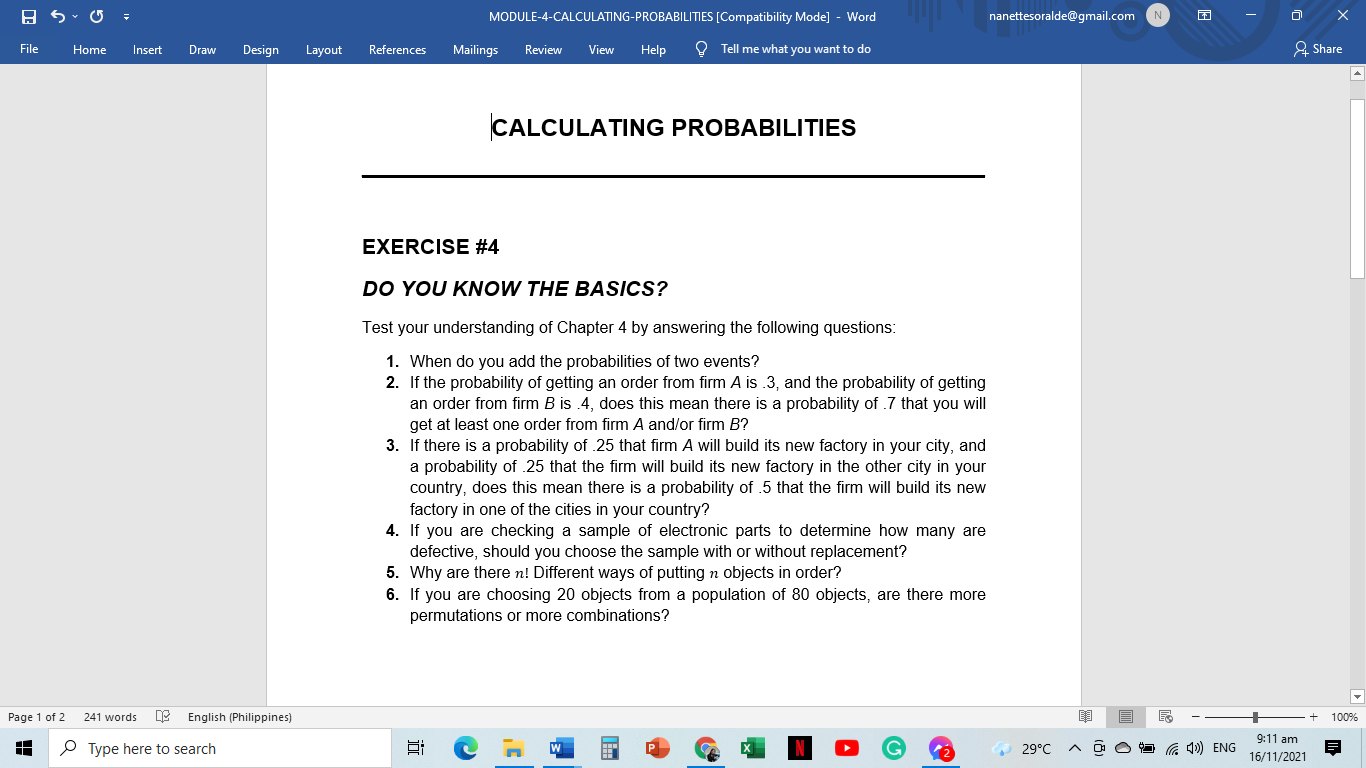
MODULE-3-INTRODUCTION-TO-PROBABILITY-AND-HYPOTHESIS-TESTING [Compatibility Mode] - Word nanettesoralde@gmail.com N X File Home Insert Draw Design Layout References Mailings Review View Help Tell me what you want to do Share INTRODUCTION TO PROBABILITY AND HYPOTHESIS TESTING EXERCISE #3 DO YOU KNOW THE BASICS? Test your understanding of Chapter 3 by answering the following questions: 1. Why do statisticians study coin tossing? 2. If you want to determine for sure whether a coin is fair, why don't you flip the coin a few thousand times? 3. If you flip a coin eight times, which of these patterns is more likely: HTHTHTHT or HHHHHHHH? 4. Why is the probability of getting h heads the same as the probability of getting n - h heads? 5. Suppose you have 100 coins that actually are fair, but you don't know whether they are fair. You will flip each coin 20 times as described in the chapter. Will your investigation lead you to conclude that all 100 coins are fair? 6. Should you make the zone of acceptance very wide in order to minimize the chance of a type 1 error? 7. In a practical hypothesis testing situation, how should you decide on the maximum probability of a type 1 error that you are willing to tolerate? Page 1 of 1 180 words [ English (Philippines) + 100% Type here to search X D G 9:09 am W P N 290C A D ( 4 ( 1)) ENG 16/11/2021 EMODULE-4-CALCULATING-PROBABILITIES [Compatibility Mode] - Word nanettesoralde@gmail.com N X File Home Insert Draw Design Layout References Mailings Review View Help Tell me what you want to do Share CALCULATING PROBABILITIES EXERCISE #4 DO YOU KNOW THE BASICS? Test your understanding of Chapter 4 by answering the following questions: 1. When do you add the probabilities of two events? 2. If the probability of getting an order from firm A is .3, and the probability of getting an order from firm B is .4, does this mean there is a probability of .7 that you will get at least one order from firm A and/or firm B? 3. If there is a probability of 25 that firm A will build its new factory in your city, and a probability of 25 that the firm will build its new factory in the other city in your country, does this mean there is a probability of .5 that the firm will build its new factory in one of the cities in your country? 4. If you are checking a sample of electronic parts to determine how many are defective, should you choose the sample with or without replacement? 5. Why are there n! Different ways of putting n objects in order? 6. If you are choosing 20 objects from a population of 80 objects, are there more permutations or more combinations? Page 1 of 2 241 words [ English (Philippines) . + 100% Type here to search W P X N G 9:11 am 12 290C ~ D3 0 4 ( 1) ENG 16/11/2021 S
Step by Step Solution
There are 3 Steps involved in it

Get step-by-step solutions from verified subject matter experts
 Study Help