



Question: Introduction to Scheduling every info writing there 1. (75 points) Consider the 17Lmer problem with 3 jobs. Let ri, r2 and r; represent the release
Introduction to Scheduling
every info writing there
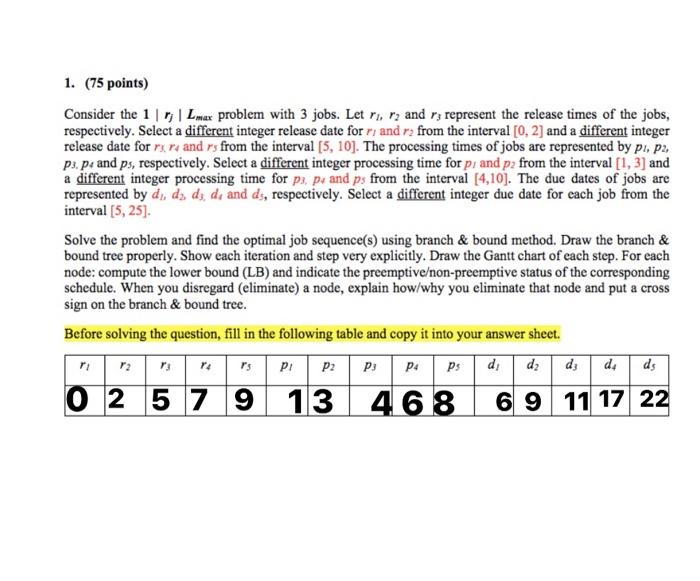
1. (75 points) Consider the 17Lmer problem with 3 jobs. Let ri, r2 and r; represent the release times of the jobs, respectively. Select a different integer release date for r and r2 from the interval [0, 2) and a different integer release date for rir and rs from the interval (5, 10). The processing times of jobs are represented by p, P2, p3.pe and ps, respectively. Select a different integer processing time for p and pa from the interval [1, 3) and a different integer processing time for p. p and ps from the interval [4,10). The due dates of jobs are represented by d, da d; d, and ds, respectively. Select a different integer due date for each job from the interval [5, 25). Solve the problem and find the optimal job sequence(s) using branch & bound method. Draw the branch & bound tree properly. Show each iteration and step very explicitly. Draw the Gantt chart of each step. For each node: compute the lower bound (LB) and indicate the preemptiveon-preemptive status of the corresponding schedule. When you disregard (eliminate) a node, explain how/why you eliminate that node and put a cross sign on the branch & bound tree. Before solving the question, fill in the following table and copy it into your answer sheet. PI p4 Ps dt ds 0 2 5 7 9 5 7 9 13 13 468 6 9 11 17 22 P2 66 1. (75 points) Consider the 17Lmer problem with 3 jobs. Let ri, r2 and r; represent the release times of the jobs, respectively. Select a different integer release date for r and r2 from the interval [0, 2) and a different integer release date for rir and rs from the interval (5, 10). The processing times of jobs are represented by p, P2, p3.pe and ps, respectively. Select a different integer processing time for p and pa from the interval [1, 3) and a different integer processing time for p. p and ps from the interval [4,10). The due dates of jobs are represented by d, da d; d, and ds, respectively. Select a different integer due date for each job from the interval [5, 25). Solve the problem and find the optimal job sequence(s) using branch & bound method. Draw the branch & bound tree properly. Show each iteration and step very explicitly. Draw the Gantt chart of each step. For each node: compute the lower bound (LB) and indicate the preemptiveon-preemptive status of the corresponding schedule. When you disregard (eliminate) a node, explain how/why you eliminate that node and put a cross sign on the branch & bound tree. Before solving the question, fill in the following table and copy it into your answer sheet. PI p4 Ps dt ds 0 2 5 7 9 5 7 9 13 13 468 6 9 11 17 22 P2 66 Step by Step Solution
There are 3 Steps involved in it
1 Expert Approved Answer
Step: 1 Unlock

Question Has Been Solved by an Expert!
Get step-by-step solutions from verified subject matter experts
Step: 2 Unlock
Step: 3 Unlock