



Question: INTRODUCTIONChemical equilibrium represents a balance between the forward and reverse reactions. Changes in experimental conditions can disturb the balance and shift the equilibrium so that
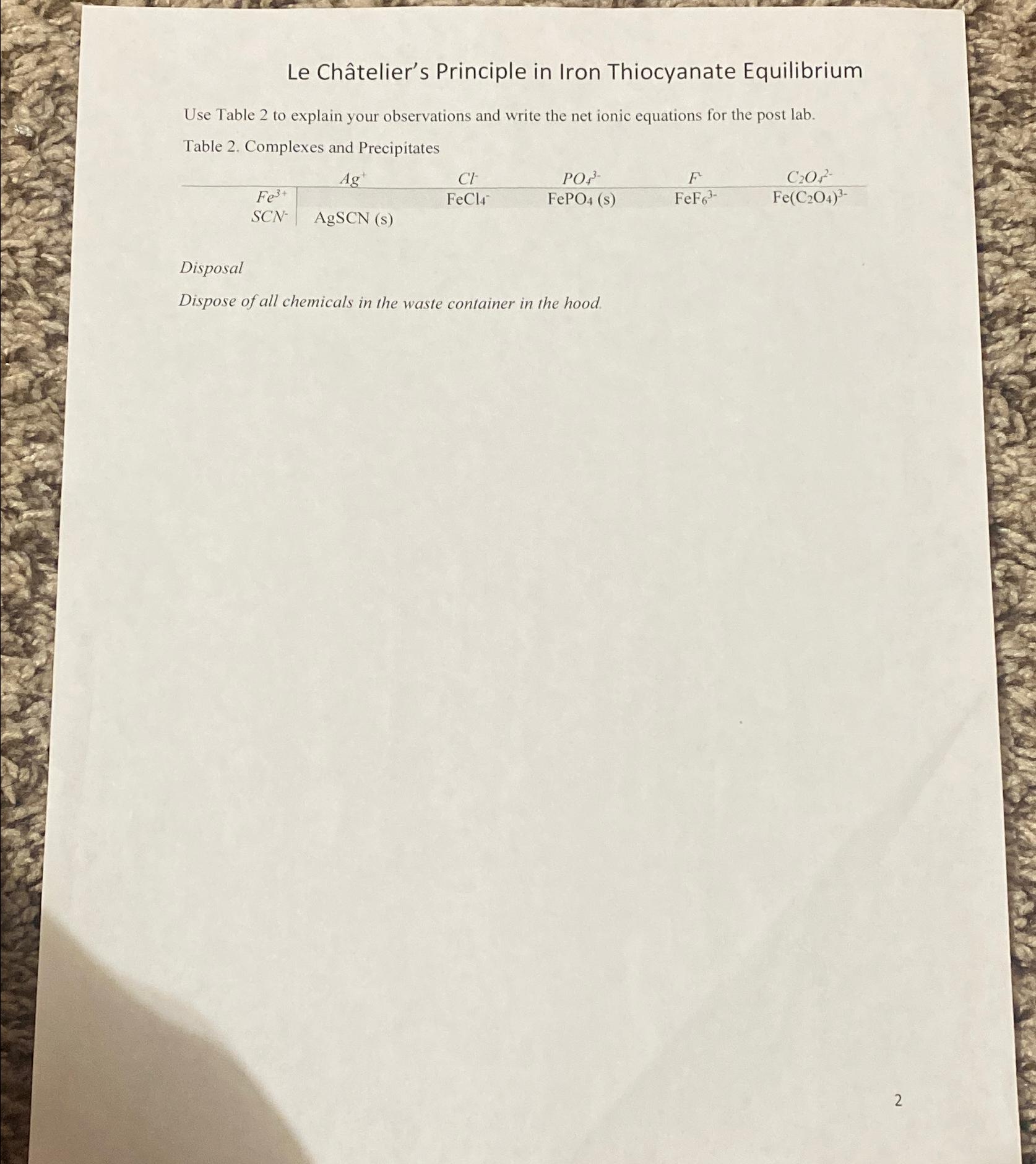
INTRODUCTIONChemical equilibrium represents a balance between the forward and reverse reactions. Changes in experimental conditions can disturb the balance and shift the equilibrium so that more or less product is formed. Conditions that can change the experimental conditions are: Change in concentration Change in pressure Change in volume Change in temperatureLe Chteliers principle helps predict the direction forward or back a reaction will shift when an external stress change in concentration, pressure, volume, or temperature is applied to a system in equilibrium.In this experiment we will be using the reaction:Feaq SCNaq FeSCNaq Equation We will study the response of this system to various stresses and explain these results in terms of Le Chteliers Principle.PROCEDUREInto a clean mL beaker add mL deionized water, mL of M KSCN and mL of M FeNO solution. This is the stock solution and can be shared between two groups. The stock solution will have an intense red color due to the formation of the complex FeSCN Obtain clean medium sized test tubes and label Add mL of the stock solution into each test tube. Test Tube is the control. Add the following reagents to test tubes Table Test tube preparationTest TubeReagent added and amountNo reagent added, this is the control mL of M FeNO mL of M KSCN mL or drops of M AgNONote: this can stain your skin mL of M HCl mL of M NaPO mL of M NaCOSeveral crystals of NaFNo reagent added. Heat test tube in a hot water bath Cover each test tube with parafilm and mix. Compare the color intensity of test tubes with the control, test tube Record observations in terms of Le Chteliers principle. The darkest test tube will have a higher concentration of FeSCNUse Table to explain your observations and write the net ionic equations for the post lab.Table Complexes and Precipitates AgClPOFCOFe FeClFePOsFeFFeCOSCNAgSCN s DisposalDispose of all chemicals in the waste container in the hood. Le Chteliers Principle in Iron Thiocyanate Equilibrium OBSERVATIONSDATATest Tube NumberReagent AddedObservationExplanation Heat added Le Chteliers Principle in Iron Thiocyanate Equilibrium POSTLAB Write the equilibrium constant expression K for the reaction between Fe and SCN Based on your observation in test tube is the reaction between Fe and SCN exothermic or endothermic? Write the net ionic equations of any reaction that occurred in test tubes use Table
Step by Step Solution
There are 3 Steps involved in it
1 Expert Approved Answer
Step: 1 Unlock

Question Has Been Solved by an Expert!
Get step-by-step solutions from verified subject matter experts
Step: 2 Unlock
Step: 3 Unlock