







Question: IntroductionIntroduction The Internet can be viewed from both physical and logical perspectives. From a physical point of view, the Internet is a collection of web
IntroductionIntroduction
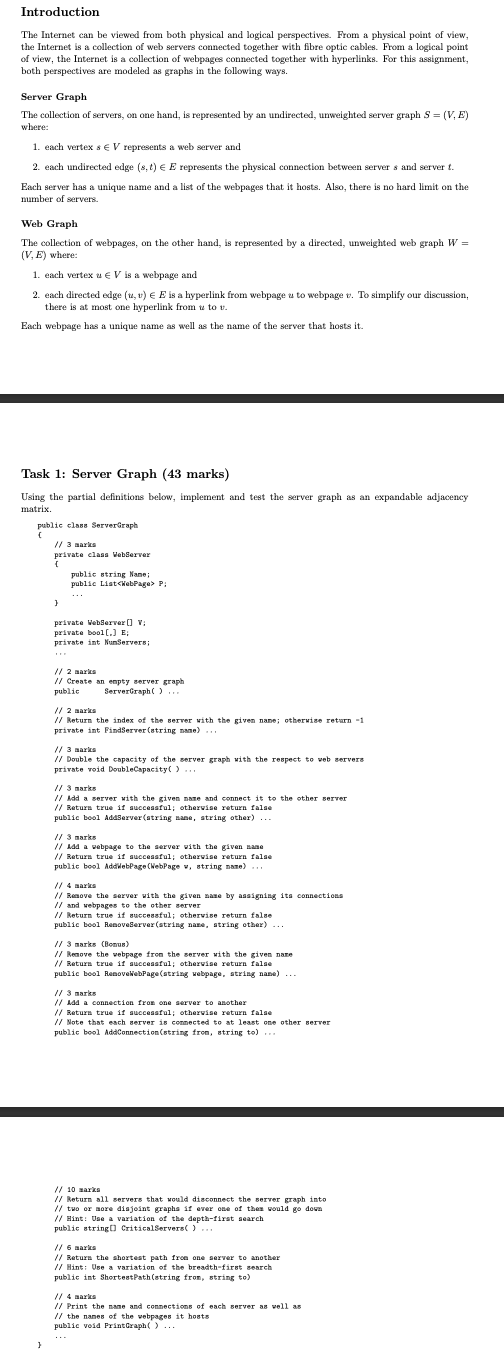
The Internet can be viewed from both physical and logical perspectives. From a physical point of view,
the Internet is a collection of web servers connected together with fibre optic cables. From a logical point
of view, the Internet is a collection of webpages connected together with hyperlinks. For this assignment,
both perspectives are modeled as graphs in the following ways.
Server Graph
The collection of servers, on one hand, is represented by an undirected, unweighted server graph
where:
each vertex represents a web server and
each undirected edge represents the physical connection between server s and server
Each server has a unique name and a list of the webpages that it hosts. Also, there is no hard limit on the
number of servers.
Web Graph
The collection of webpages, on the other hand, is represented by a directed, unweighted web graph
where:
each vertex uinV is a webpage and
each directed edge is a hyperlink from webpage to webpage To simplify our discussion,
there is at most one hyperlink from to
Each webpage has a unique name as well as the name of the server that hosts it
Task : Server Graph marks
Using the partial definitions below, implement and test the server graph as an expandable adjacency
matrix.
public claso ServerGraph
aaric
private clasa vebserver
public string Nane;
public Liatv
The Internet can be viewed from both physical and logical perspectives. From a physical point of view,
the Internet is a collection of web servers connected together with fibre optic cables. From a logical point
of view, the Internet is a collection of webpages connected together with hyperlinks. For this assignment,
both perspectives are modeled as graphs in the following ways.
Server Graph
The collection of servers, on one hand, is represented by an undirected, unweighted server graph
where:
each vertex represents a web server and
each undirected edge represents the physical connection between server and server
Each server has a unique name and a list of the webpages that it hosts. Also, there is no hard limit on the
number of servers.
Web Graph
The collection of webpages, on the other hand, is represented by a directed, unweighted web graph
where:
each vertex uinV is a webpage and
each directed edge is a hyperlink from webpage to webpage To simplify our discussion,
there is at most one hyperlink from to
Each webpage has a unique name as well as the name of the server that hosts it
Step by Step Solution
There are 3 Steps involved in it
1 Expert Approved Answer
Step: 1 Unlock

Question Has Been Solved by an Expert!
Get step-by-step solutions from verified subject matter experts
Step: 2 Unlock
Step: 3 Unlock
 Study Help