



Question: Introductory assignment to locate the key financial statements within a company's annual report/Form 10-K FSA Project to find a variety of items and calculate financial
Introductory assignment to locate the key financial statements within a company's annual report/Form 10-K
FSA Project to find a variety of items and calculate financial ratios using a company's annual report/Form 10-K All class members will use the same company, Mattel, Inc., which was used for the introductory assignment. Use Mattel's 2016 annual report/Form 10-K that is available here: http://www.annualreports.com/HostedData/AnnualReports/PDF/NASDAQ_MAT_2016.pdf
Here are the instructions for this project: UPLOADED AS IMAGES
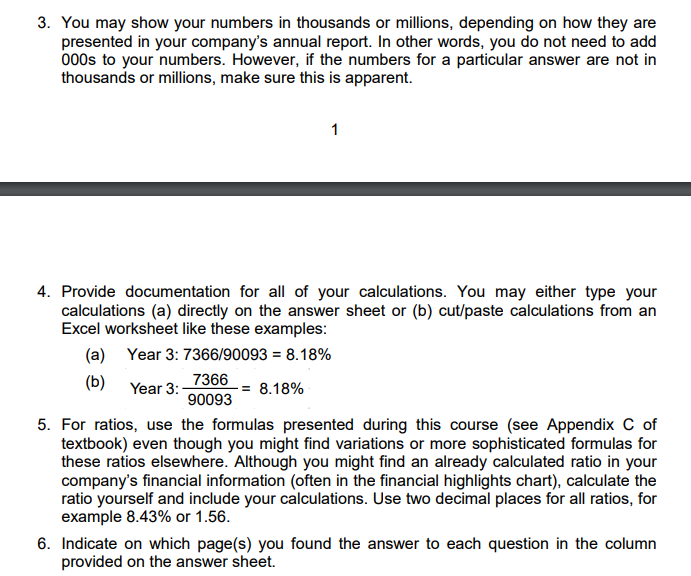
Complete and submit this DOCUMENT BELOW, after converting it to a PDF document, to obtain full or partial credit for this project. On your answer sheet, use the page numbers of the actual report (not the PDF page numbers).
Here is the document we must put our answers on and submit.
Financial Statement Analysis Project
ANSWER SHEET
| Name(s): | |
| No. | Question | Page Number |
|---|---|---|
| Determine the average days to collect accounts receivable for Year 3. Do you feel this is reasonable considering your company's operations? Why or why not? | ||
| What is the allowance for uncollectible receivables for Year 2 and Year 3? What percent of the gross receivables portfolio is reserved for each of those years? Does this tell you anything about the companys concern for bad debts? | ||
| Calculate the inventory turnover for Year 3 and also the average days in inventory ratio. Is this reasonable considering your company's line of business? Explain. | ||
| What is the cost of property, plant, and equipment held by your company as of the end of Year 3? | ||
| What is the net book value of property, plant, and equipment as of the end of Year 3? | ||
| What method of depreciation (e.g., units of production, declining balance, straight line) is used for property, plant and equipment? | ||
| What is the amount of intangible assets owned by the company as of the end of Year 3? What kind are they (i.e., identify them)? | ||
| Calculate the current ratio for Year 2 and for Year 3. Explain the ratio and what the trend is telling you. | ||
| Compute the debt-to-assets ratio for Year 2 and Year 3. Explain whether debt is financing a larger or smaller proportion of the companys assets in Year 3 compared to Year 2. Is the company more or less risky from Year 2 to Year 3? Explain. | ||
| Prepare a schedule that reconciles retained earnings at the beginning of Year 3 with retained earnings at the end of Year 3. Use these three captions to reconcile Net Income/(Loss), Dividends, and Other. | ||
| What is the par value of the common stock? | ||
| How many shares of common stock are authorized at the end of Year 3? | ||
| How many shares of common stock are outstanding at the end of Year 3? | ||
| What is the total amount of cash dividends declared on common stock during Year 3? What is the total amount of cash dividends paid on common stock during Year 3? [Hint: They may not be the same amount.] | ||
| What percentage of net income did the company pay out in cash dividends? If the company did not pay cash dividends, why do you think it did not? | ||
| What is the amount of difference between net income and net cash provided (used) by operating activities for Year 3? What one or two items are most responsible for the difference? | ||
| How much cash did your company pay to purchase property, plant, and equipment during Year 3? | ||
| Did cash and cash equivalents increase or decrease from Year 2 to Year 3? By how much? |
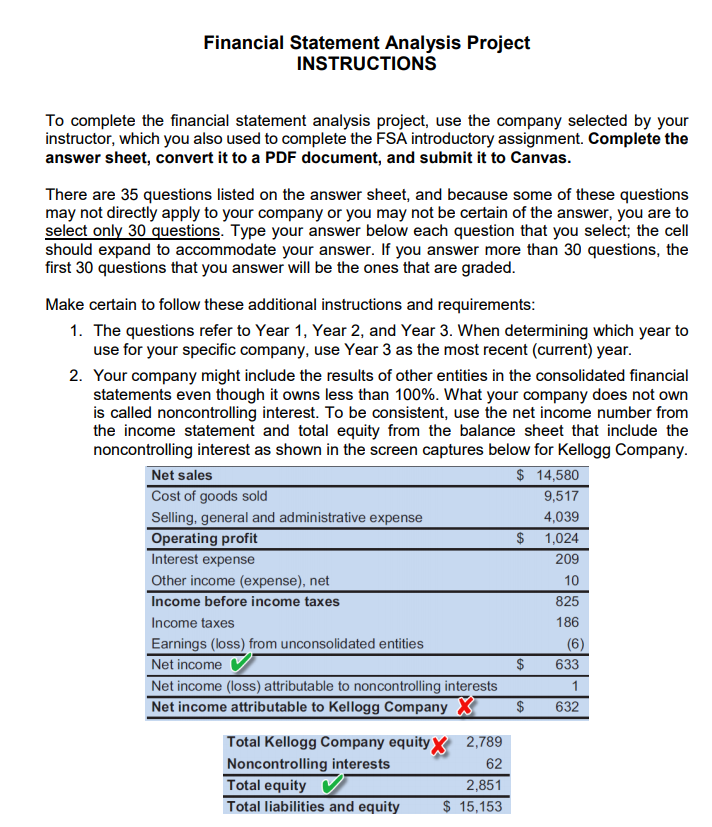
Financial Statement Analysis Project INSTRUCTIONS To complete the financial statement analysis project, use the company selected by your instructor, which you also used to complete the FSA introductory assignment. Complete the answer sheet, convert it to a PDF document, and submit it to Canvas There are 35 questions listed on the answer sheet, and because some of these questions may not directly apply to your company or you may not be certain of the answer, you are to select only 30 questions. Type your answer below each question that you select; the cell should expand to accommodate your answer. If you answer more than 30 questions, the first 30 questions that you answer will be the ones that are graded Make certain to follow these additional instructions and requirements 1. The questions refer to Year 1, Year 2, and Year 3. When determining which year to use for your specific company, use Year 3 as the most recent (current) year 2. Your company might include the results of other entities in the consolidated financial statements even though it owns less than 100%. What your company does not own is called noncontrolling interest. To be consistent, use the net income number from the income statement and total equity from the balance sheet that include the noncontrolling interest as shown in the screen captures below for Kellogg Company Net sales Cost of goods sold Selling, general and administrative expense Operating profit Interest expense Other income (expense), net Income before income taxes Income taxes Earnings (loss) from unconsolidated entities Net income Net income (loss) attributable to noncontrolling interests Net income attributable to Kellogg Company $ 14,580 9,517 4,039 $ 1,024 209 10 825 186 $ 633 $ 632 Total Kellogg Company equityX Noncontrolling interests Total equity Total liabilities and equity 2,789 62 2,851 S 15,153 Financial Statement Analysis Project INSTRUCTIONS To complete the financial statement analysis project, use the company selected by your instructor, which you also used to complete the FSA introductory assignment. Complete the answer sheet, convert it to a PDF document, and submit it to Canvas There are 35 questions listed on the answer sheet, and because some of these questions may not directly apply to your company or you may not be certain of the answer, you are to select only 30 questions. Type your answer below each question that you select; the cell should expand to accommodate your answer. If you answer more than 30 questions, the first 30 questions that you answer will be the ones that are graded Make certain to follow these additional instructions and requirements 1. The questions refer to Year 1, Year 2, and Year 3. When determining which year to use for your specific company, use Year 3 as the most recent (current) year 2. Your company might include the results of other entities in the consolidated financial statements even though it owns less than 100%. What your company does not own is called noncontrolling interest. To be consistent, use the net income number from the income statement and total equity from the balance sheet that include the noncontrolling interest as shown in the screen captures below for Kellogg Company Net sales Cost of goods sold Selling, general and administrative expense Operating profit Interest expense Other income (expense), net Income before income taxes Income taxes Earnings (loss) from unconsolidated entities Net income Net income (loss) attributable to noncontrolling interests Net income attributable to Kellogg Company $ 14,580 9,517 4,039 $ 1,024 209 10 825 186 $ 633 $ 632 Total Kellogg Company equityX Noncontrolling interests Total equity Total liabilities and equity 2,789 62 2,851 S 15,153
Step by Step Solution
There are 3 Steps involved in it

Get step-by-step solutions from verified subject matter experts