Question: Introductory to Physics: LAB 2 Instructions: Compllete this entire assignment efficiently, make sure each of your answers are 100% correct but also well-explained and clear.
Introductory to Physics: LAB 2
Instructions:
Compllete this entire assignment efficiently, make sure each of your answers are 100% correct but also well-explained and clear. You have to do the work on a google doc then upload your document on course hero.
You are required to compllete all the assigned questions on the lab report by following the provided instructions:
Any unanswered questions will count against your lab score.
Your lab will be graded according to proper use of physical theories. This means that often the hard numbers of the lab will not necessarily be graded but whether or not you followed the guidelines and achieved a result in a physically meaningful way.
Include any open questions you have regarding what you think should be answered using appropriate physics terminology and applied theories.
IMPORTANT NOTE:IF EACH QUESTION OF THE LAB IS NOT 100% CORRECT, AND WELL ANSWERED (WITH SMART-DEVELOPED ANSWERS, NOT Al GENERATED) AND FOLLOWS THE INSTRUCTIONS I WILL NOT BE RATING YOUR WORK.
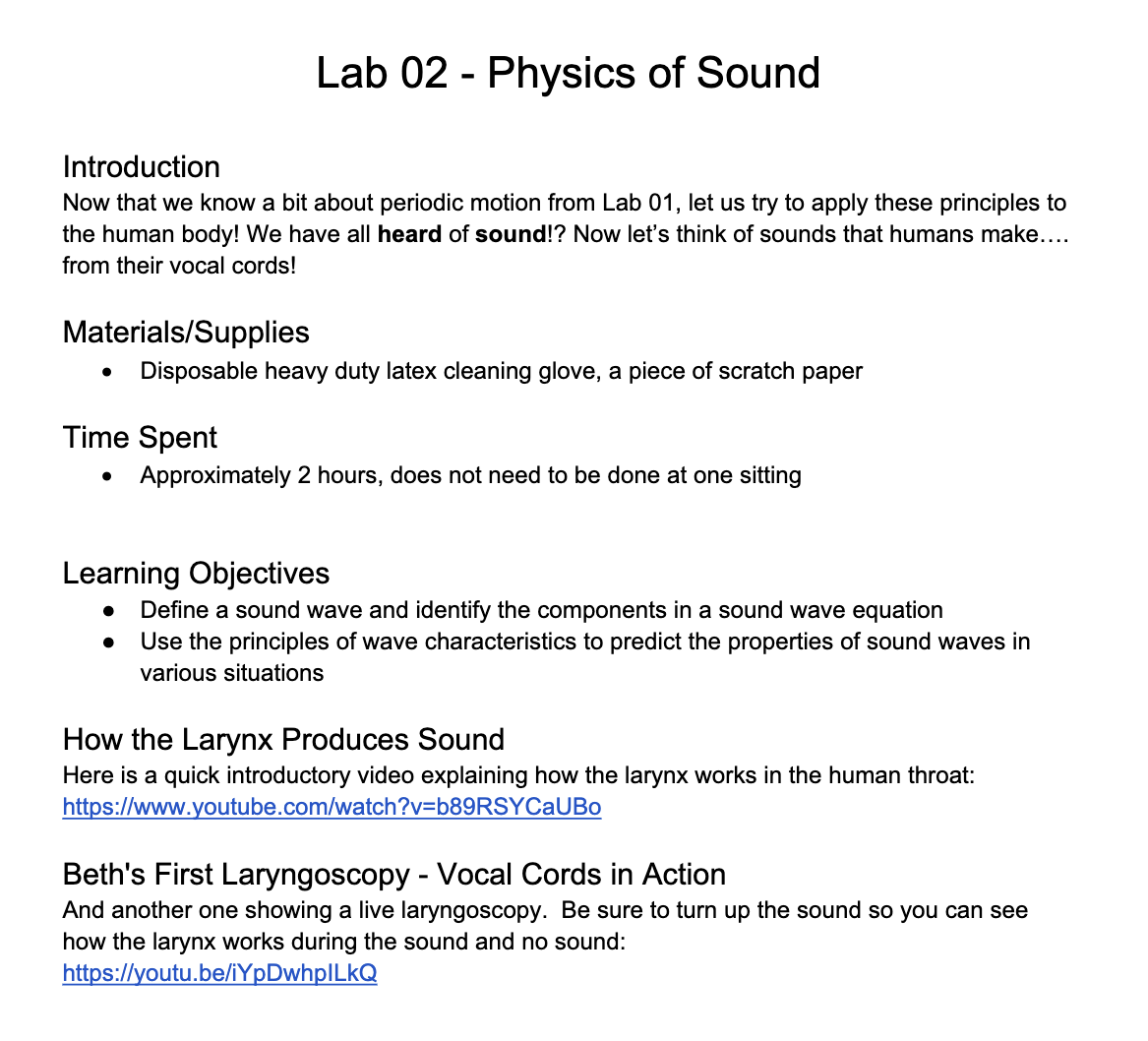
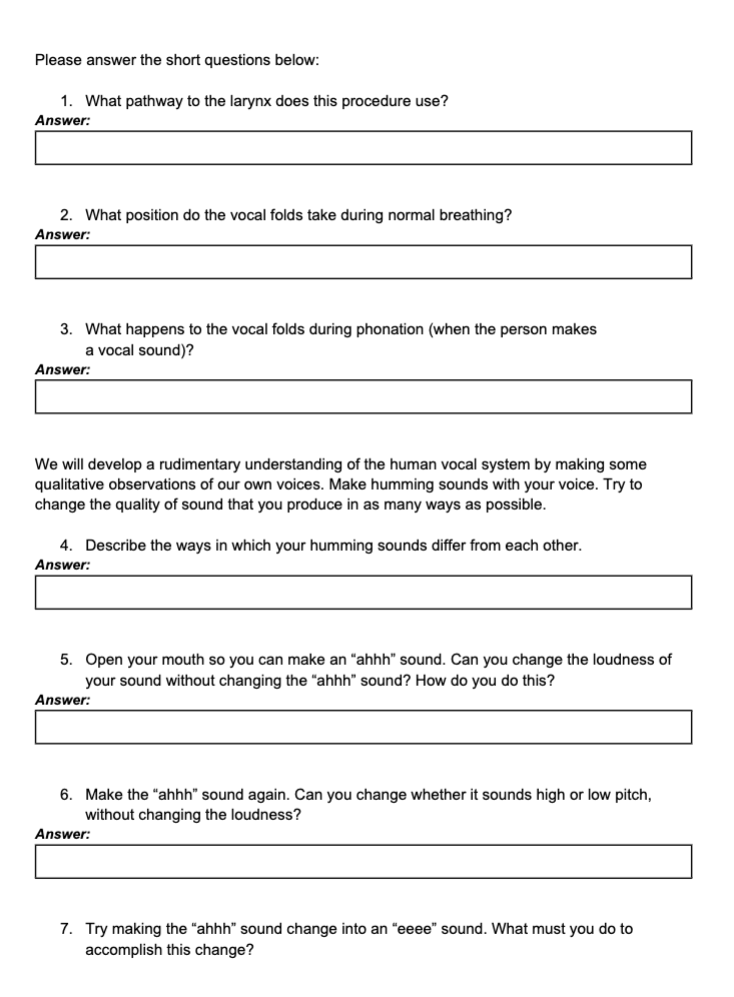
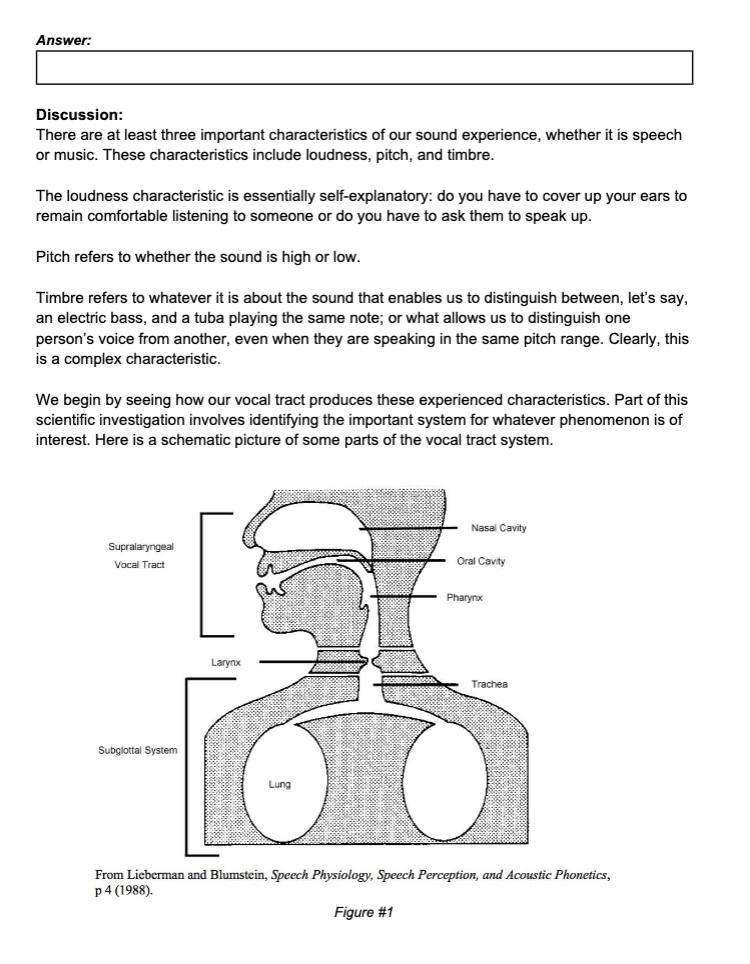
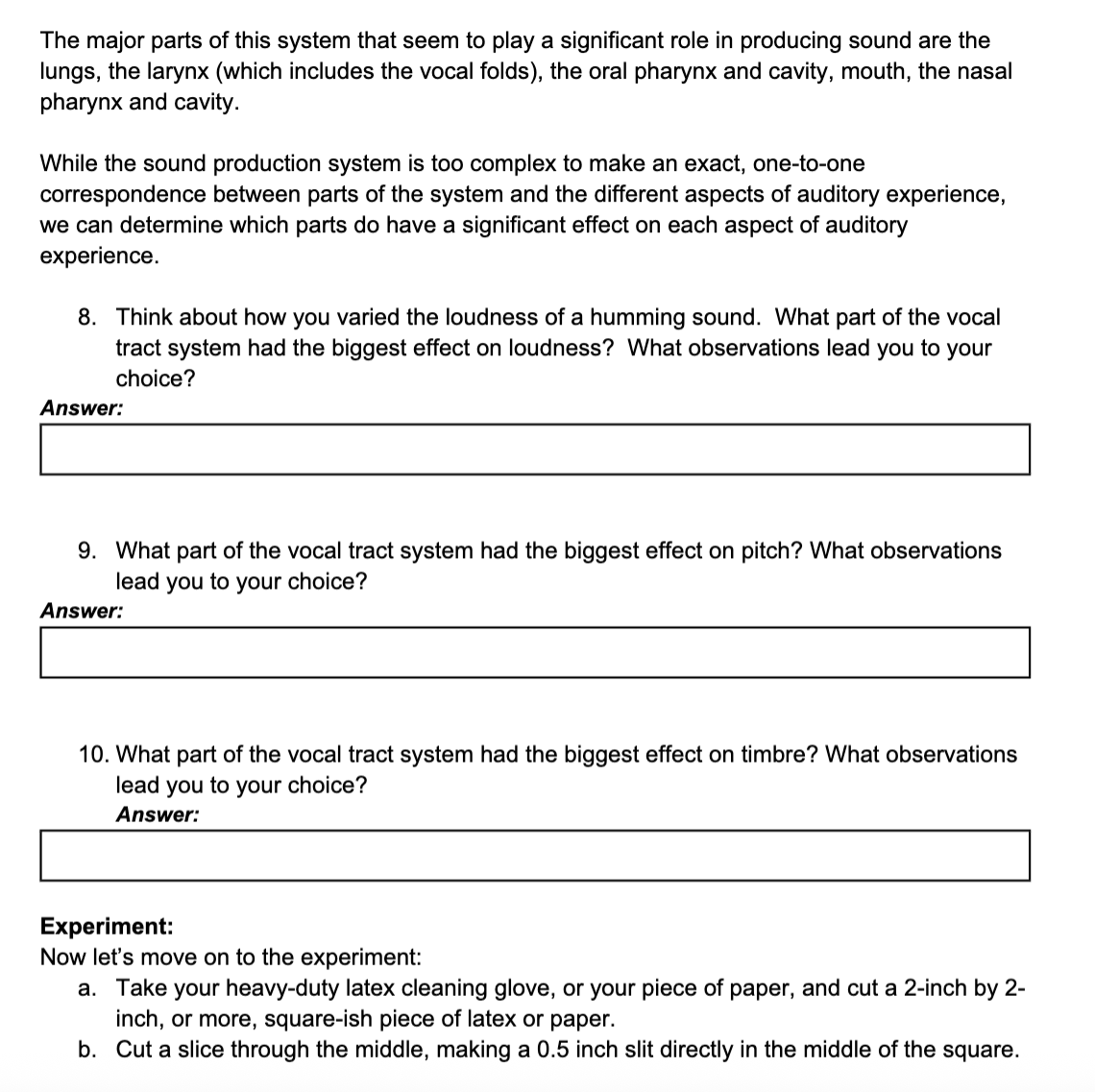
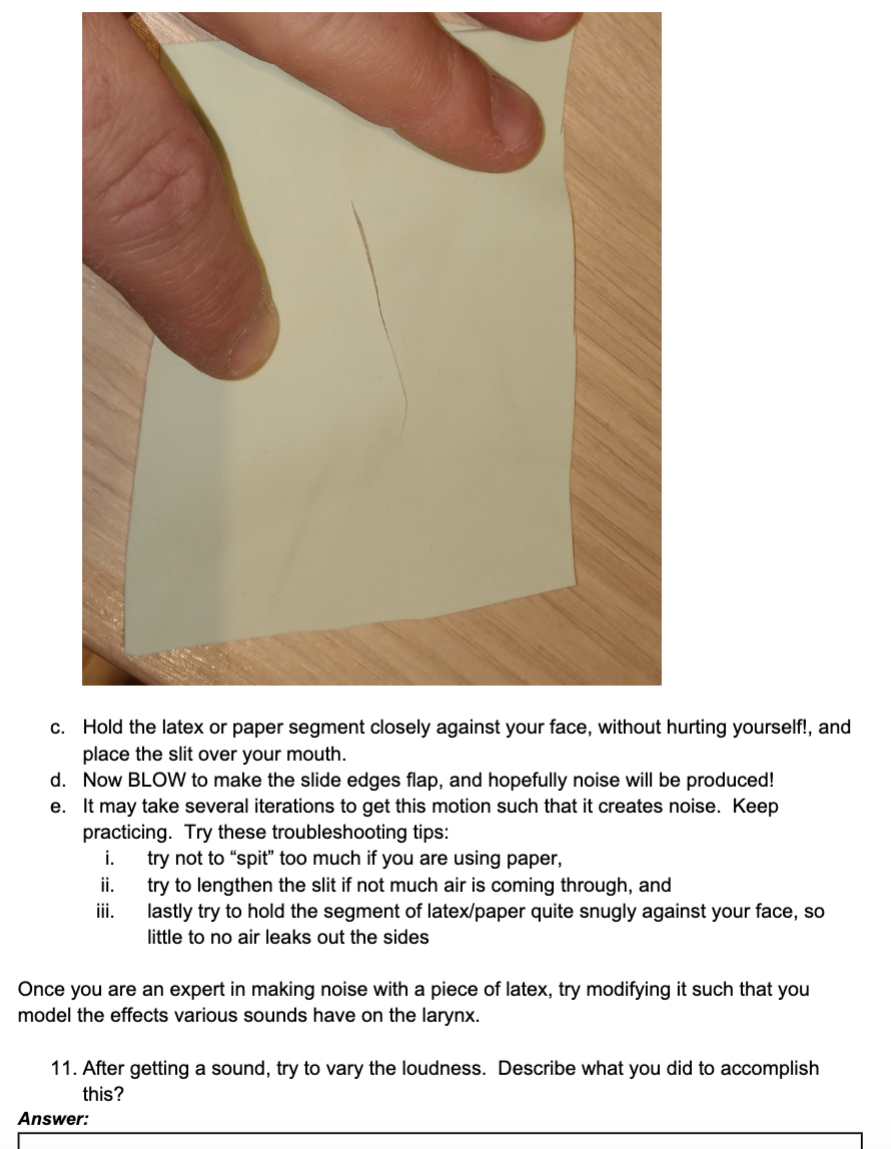
Lab 02 - Physics of Sound Introduction Now that we know a bit about periodic motion from Lab 01, let us try to apply these principles to the human body! We have all heard of sound!? Now let's think of sounds that humans make.... from their vocal cords! Materials/Supplies e Disposable heavy duty latex cleaning glove, a piece of scratch paper Time Spent e Approximately 2 hours, does not need to be done at one sitting Learning Objectives e Define a sound wave and identify the components in a sound wave equation e Use the principles of wave characteristics to predict the properties of sound waves in various situations How the Larynx Produces Sound Here is a quick introductory video explaining how the larynx works in the human throat: https://Awww.youtube.com/watch?v=b89RSYCaUBo Beth's First Laryngoscopy - Vocal Cords in Action And another one showing a live laryngoscopy. Be sure to turn up the sound so you can see how the larynx works during the sound and no sound: https://youtu.be/iYpDwhpILkQ Please answer the short questions below: 1. What pathway to the larynx does this procedure use? Answer: PT 2. What position do the vocal folds take during normal breathing? Answer: PT 3. What happens to the vocal folds during phonation (when the person makes a vocal sound)? Answer: PO We will develop a rudimentary understanding of the human vocal system by making some qualitative observations of our own voices. Make humming sounds with your voice. Try to change the quality of sound that you produce in as many ways as possible. 4. Describe the ways in which your humming sounds differ from each other. Answer: Po 5. Open your mouth so you can make an \"ahhh\" sound. Can you change the loudness of your sound without changing the \"ahhh\" sound? How do you do this? Answer: PT 6. Make the \"ahhh\" sound again. Can you change whether it sounds high or low pitch, without changing the loudness? Answer: PO 7. Try making the \"ahhh\" sound change into an \"eeee\" sound. What must you do to accomplish this change? Answer: PT Discussion: There are at least three important characteristics of our sound experience, whether it is speech or music. These characteristics include loudness, pitch, and timbre. The loudness characteristic is essentially self-explanatory: do you have to cover up your ears to remain comfortable listening to someone or do you have to ask them to speak up. Pitch refers to whether the sound is high or low. Timbre refers to whatever it is about the sound that enables us to distinguish between, let's say, an electric bass, and a tuba playing the same note; or what allows us to distinguish one person's voice from another, even when they are speaking in the same pitch range. Clearly, this is a complex characteristic. We begin by seeing how our vocal tract produces these experienced characteristics. Part of this scientific investigation involves identifying the important system for whatever phenomenon is of interest. Here is a schematic picture of some parts of the vocal tract system. Supralaryyngeal Vocal Tract Subgiottal System From Lieberman and Blumstein, Speech Physiology, Speech Perception, and Acoustic Phonetics, p 4 (1988). Figure #1 The major parts of this system that seem to play a significant role in producing sound are the lungs, the larynx (which includes the vocal folds), the oral pharynx and cavity, mouth, the nasal pharynx and cavity. While the sound production system is too complex to make an exact, one-to-one correspondence between parts of the system and the different aspects of auditory experience, we can determine which parts do have a significant effect on each aspect of auditory experience. 8. Think about how you varied the loudness of a humming sound. What part of the vocal tract system had the biggest effect on loudness? What observations lead you to your choice? Answer: Pt 9. What part of the vocal tract system had the biggest effect on pitch? What observations lead you to your choice? Answer: PO 10. What part of the vocal tract system had the biggest effect on timbre? What observations lead you to your choice? Answer: Pn Experiment: Now let's move on to the experiment: a. Take your heavy-duty latex cleaning glove, or your piece of paper, and cut a 2-inch by 2- inch, or more, square-ish piece of latex or paper. b. Cuta slice through the middle, making a 0.5 inch slit directly in the middle of the square. c. Hold the latex or paper segment closely against your face, without hurting yourself!, and place the slit over your mouth. d. Now BLOW to make the slide edges flap, and hopefully noise will be produced! e. It may take several iterations to get this motion such that it creates noise. Keep practicing. Try these troubleshooting tips: i. try not to \"spit\" too much if you are using paper, ii. try to lengthen the slit if not much air is coming through, and iii. lastly try to hold the segment of latex/paper quite snugly against your face, so little to no air leaks out the sides Once you are an expert in making noise with a piece of latex, try modifying it such that you model the effects various sounds have on the larynx. 11. After getting a sound, try to vary the loudness. Describe what you did to accomplish this? Answer: EE 12. Can you vary the pitch of the sound produced? Describe what you did to accomplish this. Answer: PO 13. How is the larynx model similar to the real human larynx? Answer: PT 14. How is the larynx model different from the real human larynx? Answer: PO Once you have completed all lab questions, save the file using your name. For example: o yourname_lab2.docx Submit to the Module 2 Lab: Physics of Sound assignment in Canvas for grading
Step by Step Solution
There are 3 Steps involved in it
1 Expert Approved Answer
Step: 1 Unlock
Question Has Been Solved by an Expert!
Get step-by-step solutions from verified subject matter experts
Step: 2 Unlock
Step: 3 Unlock
Students Have Also Explored These Related Accounting Questions!









 Study Help