







Question: IRAC method for these 4 cases CASE EXAMPLE 5-6 Hudechek v. Novi Hotel Fund Limited Partnership 2007 WL 466108 (Mi. 2007). Plaintiff slipped and fell
IRAC method for these 4 cases 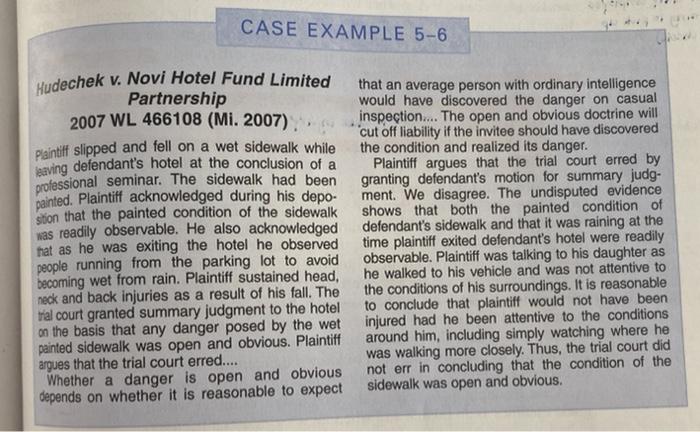
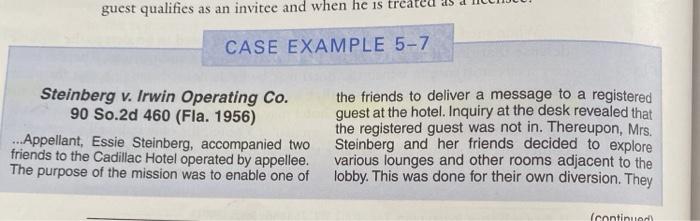
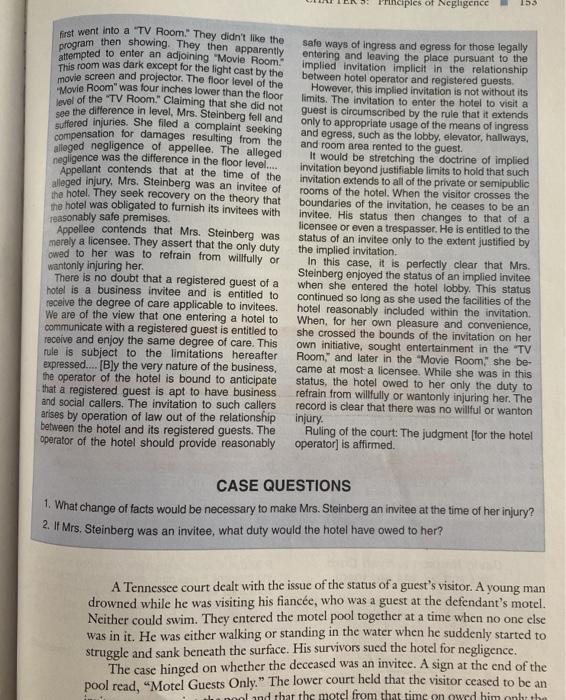
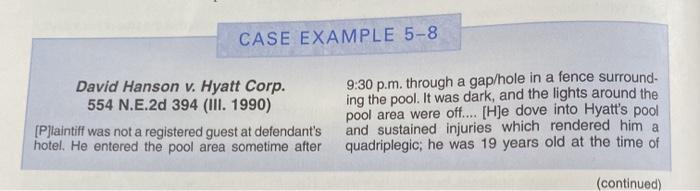
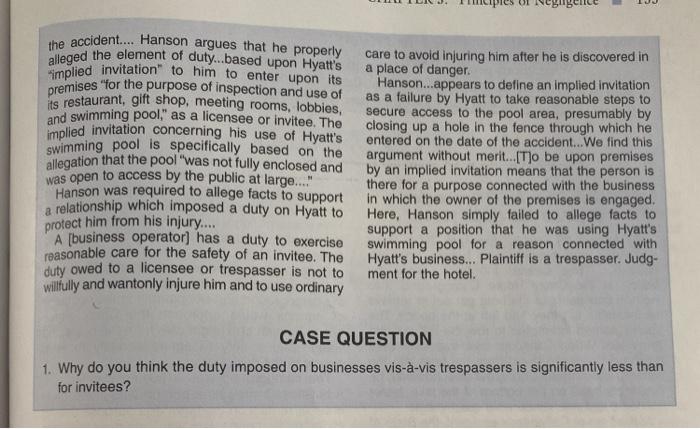
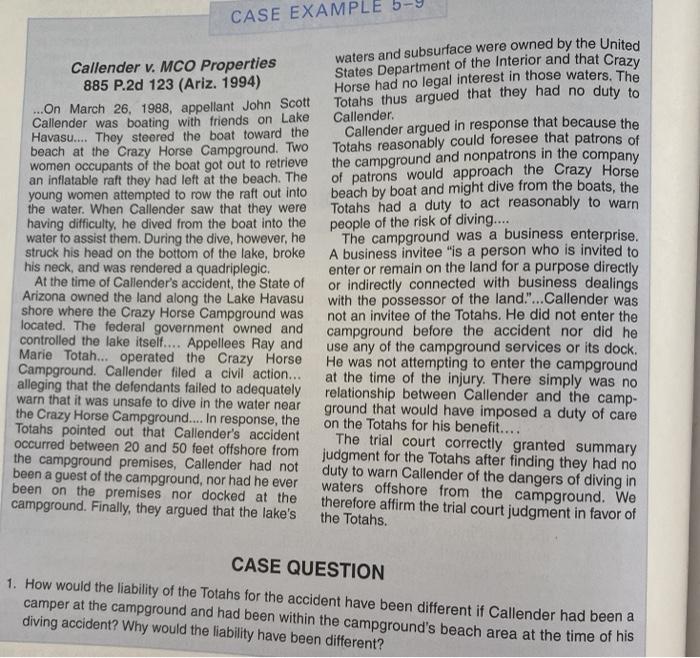
CASE EXAMPLE 5-6 Hudechek v. Novi Hotel Fund Limited Partnership 2007 WL 466108 (Mi. 2007). Plaintiff slipped and fell on a wet sidewalk while leaving defendant's hotel at the conclusion of a professional seminar. The sidewalk had been painted. Plaintiff acknowledged during his depo- stion that the painted condition of the sidewalk was readily observable. He also acknowledged hat as he was exiting the hotel he observed people running from the parking lot to avoid becoming wet from rain. Plaintiff sustained head, neck and back injuries as a result of his fall. The rial court granted summary judgment to the hotel on the basis that any danger posed by the wet painted sidewalk was open and obvious. Plaintiff argues that the trial court erred.... Whether a danger is open and obvious depends on whether it is reasonable to expect that an average person with ordinary intelligence would have discovered the danger on casual inspection.... The open and obvious doctrine will cut off liability if the invitee should have discovered the condition and realized its danger. Plaintiff argues that the trial court erred by granting defendant's motion for summary judg- ment. We disagree. The undisputed evidence shows that both the painted condition of defendant's sidewalk and that it was raining at the time plaintiff exited defendant's hotel were readily observable. Plaintiff was talking to his daughter as he walked to his vehicle and was not attentive to the conditions of his surroundings. It is reasonable to conclude that plaintiff would not have been injured had he been attentive to the conditions around him, including simply watching where he was walking more closely. Thus, the trial court did not err in concluding that the condition of the sidewalk was open and obvious. guest qualifies as an invitee and when he is treate CASE EXAMPLE 5-7 Steinberg v. Irwin Operating Co. 90 So.2d 460 (Fla. 1956) ... Appellant, Essie Steinberg, accompanied two friends to the Cadillac Hotel operated by appellee. The purpose of the mission was to enable one of the friends to deliver a message to a registered guest at the hotel. Inquiry at the desk revealed that the registered guest was not in. Thereupon, Mrs. Steinberg and her friends decided to explore various lounges and other rooms adjacent to the lobby. This was done for their own diversion. They continued Principles of Negligence 153 first went into a "TV Room. They didn't like the program then showing. They then apparently attempted to enter an adjoining "Movie Room." This room was dark except for the light cast by the movie screen and projector. The floor level of the Movie Room" was four inches lower than the floor level of the TV Room." claiming that she did not see the difference in level, Mrs. Steinberg fell and suffered injuries. She filed a complaint seeking compensation for damages resulting from the alleged negligence of appellee. The alleged negligence was the difference in the floor level.... Appellant contends that at the time of the alleged injury, Mrs. Steinberg was an invitee of the hotel. They seek recovery on the theory that the hotel was obligated to furnish its invitees with reasonably safe premises. Appellee contends that Mrs. Steinberg was merely a licensee. They assert that the only duty owed to her was to refrain from willfully or wantonly injuring her There is no doubt that a registered guest of a hotel is a business invitee and is entitled to receive the degree of care applicable to invitees. We are of the view that one entering a hotel to communicate with a registered guest is entitled to receive and enjoy the same degree of care. This rule is subject to the limitations hereafter expressed.... [Bly the very nature of the business, the operator of the hotel is bound to anticipate that a registered guest is apt to have business and social callers. The invitation to such callers arises by operation of law out of the relationship between the hotel and its registered guests. The operator of the hotel should provide reasonably safe ways of ingress and egress for those legally entoring and leaving the place pursuant to the implied invitation Implicit in the relationship between hotel operator and registered guests However, this implied invitation is not without its limits. The invitation to enter the hotel to visit a guest is circumscribed by the rule that it extends only to appropriate usage of the means of ingress and egress, such as the lobby, elevator, hallways, and room area rented to the guest. It would be stretching the doctrine of implied invitation beyond justifiable limits to hold that such invitation extends to all of the private or semipublic rooms of the hotel. When the visitor crosses the boundaries of the invitation, he ceases to be an invitee. His status then changes to that of a licensee or even a trespasser. He is entitled to the status of an invitee only to the extent justified by the implied invitation. In this case, it is perfectly clear that Mrs. Steinberg enjoyed the status of an implied invitee when she entered the hotel lobby. This status continued so long as she used the facilities of the hotel reasonably included within the invitation When, for her own pleasure and convenience, she crossed the bounds of the invitation on her own initiative, sought entertainment in the "TV Room," and later in the "Movie Room," she be- came at most a licensee. While she was in this status, the hotel owed to her only the duty to refrain from willfully or wantonly injuring her. The record is clear that there was no willful or wanton injury Ruling of the court: The judgment [for the hotel operator] is affirmed CASE QUESTIONS 1. What change of facts would be necessary to make Mrs. Steinberg an invitee at the time of her injury? 2. If Mrs. Steinberg was an invitee, what duty would the hotel have owed to her? A Tennessee court dealt with the issue of the status of a guest's visitor. A young man drowned while he was visiting his fiance, who was a guest at the defendant's motel. Neither could swim. They entered the motel pool together at a time when no one else was in it. He was either walking or standing in the water when he suddenly started to struggle and sank beneath the surface. His survivors sued the hotel for negligence. The case hinged on whether the deceased was an invitee. A sign at the end of the pool read, "Motel Guests Only." The lower court held that the visitor ceased to be an lind that the motel from that time on owed him onlab CASE EXAMPLE 5-8 David Hanson v. Hyatt Corp. 554 N.E.2d 394 (III. 1990) [P]iaintiff was not a registered guest at defendant's hotel. He entered the pool area sometime after 9:30 p.m. through a gap/hole in a fence surround- ing the pool. It was dark, and the lights around the pool area were off.... [Hje dove into Hyatt's pool and sustained injuries which rendered him a quadriplegic; he was 19 years old at the time of (continued) the accident.... Hanson argues that he properly alleged the element of duty...based upon Hyatt's implied invitation to him to enter upon its premises "for the purpose of inspection and use of its restaurant, gift shop, meeting rooms, lobbies, and swimming pool as a licensee or invitee. The implied invitation concerning his use of Hyatt's swimming pool is specifically based on the allegation that the pool "was not fully enclosed and was open to access by the public at large...." Hanson was required to allege facts to support a relationship which imposed a duty on Hyatt to protect him from his injury.... A [business operator] has a duty to exercise reasonable care for the safety of an invitee. The duty owed to a licensee or trespasser is not to willfully and wantonly injure him and to use ordinary care to avoid injuring him after he is discovered in a place of danger. Hanson...appears to define an implied invitation as a failure by Hyatt to take reasonable steps to secure access to the pool area, presumably by closing up a hole in the fence through which he entered on the date of the accident... We find this argument without merit...(To be upon premises by an implied invitation means that the person is there for a purpose connected with the business in which the owner of the premises is engaged. Here, Hanson simply failed to allege facts to support a position that he was using Hyatt's swimming pool for a reason connected with Hyatt's business... Plaintiff is a trespasser. Judg- ment for the hotel. CASE QUESTION 1. Why do you think the duty imposed on businesses vis--vis trespassers is significantly less than for invitees? CASE EXAMPLE Callender v. MCO Properties 885 P.2d 123 (Ariz. 1994) ...On March 26, 1988, appellant John Scott Callender was boating with friends on Lake Havasu.... They steered the boat toward the beach at the Crazy Horse Campground. Two women occupants of the boat got out to retrieve an inflatable raft they had left at the beach. The young women attempted to row the raft out into the water. When Callender saw that they were having difficulty, he dived from the boat into the water to assist them. During the dive, however, he struck his head on the bottom of the lake, broke his neck, and was rendered a quadriplegic, At the time of Callender's accident, the State of Arizona owned the land along the Lake Havasu shore where the Crazy Horse Campground was located. The federal government owned and controlled the lake itself.... Appellees Ray and Marie Totah... operated the Crazy Horse Campground. Callender filed a civil action... alleging that the defendants failed to adequately warn that it was unsafe to dive in the water near the Crazy Horse Campground.... In response, the Totahs pointed out that Callender's accident occurred between 20 and 50 feet offshore from the campground premises, Callender had not been a guest of the campground, nor had he ever been on the premises nor docked at the campground. Finally, they argued that the lake's waters and subsurface were owned by the United States Department of the Interior and that Crazy Horse had no legal interest in those waters. The Totahs thus argued that they had no duty to Callender Callender argued in response that because the Totahs reasonably could foresee that patrons of the campground and nonpatrons in the company of patrons would approach the Crazy Horse beach by boat and might dive from the boats, the Totahs had a duty to act reasonably to warn people of the risk of diving.... The campground was a business enterprise. A business invitee "is a person who is invited to enter or remain on the land for a purpose directly or indirectly connected with business dealings with the possessor of the land."...Callender was not an invitee of the Totahs. He did not enter the campground before the accident nor did he use any of the campground services or its dock. He was not attempting to enter the campground at the time of the injury. There simply was no relationship between Callender and the camp- ground that would have imposed a duty of care on the Totahs for his benefit.... The trial court correctly granted summary judgment for the Totahs after finding they had no duty to warn Callender of the dangers of diving in waters offshore from the campground. We therefore affirm the trial court judgment in favor of the Totahs. CASE QUESTION 1. How would the liability of the Totahs for the accident have been different if Callender had been a camper at the campground and had been within the campground's beach area at the time of his diving accident? Why would the liability have been different? CASE EXAMPLE 5-6 Hudechek v. Novi Hotel Fund Limited Partnership 2007 WL 466108 (Mi. 2007). Plaintiff slipped and fell on a wet sidewalk while leaving defendant's hotel at the conclusion of a professional seminar. The sidewalk had been painted. Plaintiff acknowledged during his depo- stion that the painted condition of the sidewalk was readily observable. He also acknowledged hat as he was exiting the hotel he observed people running from the parking lot to avoid becoming wet from rain. Plaintiff sustained head, neck and back injuries as a result of his fall. The rial court granted summary judgment to the hotel on the basis that any danger posed by the wet painted sidewalk was open and obvious. Plaintiff argues that the trial court erred.... Whether a danger is open and obvious depends on whether it is reasonable to expect that an average person with ordinary intelligence would have discovered the danger on casual inspection.... The open and obvious doctrine will cut off liability if the invitee should have discovered the condition and realized its danger. Plaintiff argues that the trial court erred by granting defendant's motion for summary judg- ment. We disagree. The undisputed evidence shows that both the painted condition of defendant's sidewalk and that it was raining at the time plaintiff exited defendant's hotel were readily observable. Plaintiff was talking to his daughter as he walked to his vehicle and was not attentive to the conditions of his surroundings. It is reasonable to conclude that plaintiff would not have been injured had he been attentive to the conditions around him, including simply watching where he was walking more closely. Thus, the trial court did not err in concluding that the condition of the sidewalk was open and obvious. guest qualifies as an invitee and when he is treate CASE EXAMPLE 5-7 Steinberg v. Irwin Operating Co. 90 So.2d 460 (Fla. 1956) ... Appellant, Essie Steinberg, accompanied two friends to the Cadillac Hotel operated by appellee. The purpose of the mission was to enable one of the friends to deliver a message to a registered guest at the hotel. Inquiry at the desk revealed that the registered guest was not in. Thereupon, Mrs. Steinberg and her friends decided to explore various lounges and other rooms adjacent to the lobby. This was done for their own diversion. They continued Principles of Negligence 153 first went into a "TV Room. They didn't like the program then showing. They then apparently attempted to enter an adjoining "Movie Room." This room was dark except for the light cast by the movie screen and projector. The floor level of the Movie Room" was four inches lower than the floor level of the TV Room." claiming that she did not see the difference in level, Mrs. Steinberg fell and suffered injuries. She filed a complaint seeking compensation for damages resulting from the alleged negligence of appellee. The alleged negligence was the difference in the floor level.... Appellant contends that at the time of the alleged injury, Mrs. Steinberg was an invitee of the hotel. They seek recovery on the theory that the hotel was obligated to furnish its invitees with reasonably safe premises. Appellee contends that Mrs. Steinberg was merely a licensee. They assert that the only duty owed to her was to refrain from willfully or wantonly injuring her There is no doubt that a registered guest of a hotel is a business invitee and is entitled to receive the degree of care applicable to invitees. We are of the view that one entering a hotel to communicate with a registered guest is entitled to receive and enjoy the same degree of care. This rule is subject to the limitations hereafter expressed.... [Bly the very nature of the business, the operator of the hotel is bound to anticipate that a registered guest is apt to have business and social callers. The invitation to such callers arises by operation of law out of the relationship between the hotel and its registered guests. The operator of the hotel should provide reasonably safe ways of ingress and egress for those legally entoring and leaving the place pursuant to the implied invitation Implicit in the relationship between hotel operator and registered guests However, this implied invitation is not without its limits. The invitation to enter the hotel to visit a guest is circumscribed by the rule that it extends only to appropriate usage of the means of ingress and egress, such as the lobby, elevator, hallways, and room area rented to the guest. It would be stretching the doctrine of implied invitation beyond justifiable limits to hold that such invitation extends to all of the private or semipublic rooms of the hotel. When the visitor crosses the boundaries of the invitation, he ceases to be an invitee. His status then changes to that of a licensee or even a trespasser. He is entitled to the status of an invitee only to the extent justified by the implied invitation. In this case, it is perfectly clear that Mrs. Steinberg enjoyed the status of an implied invitee when she entered the hotel lobby. This status continued so long as she used the facilities of the hotel reasonably included within the invitation When, for her own pleasure and convenience, she crossed the bounds of the invitation on her own initiative, sought entertainment in the "TV Room," and later in the "Movie Room," she be- came at most a licensee. While she was in this status, the hotel owed to her only the duty to refrain from willfully or wantonly injuring her. The record is clear that there was no willful or wanton injury Ruling of the court: The judgment [for the hotel operator] is affirmed CASE QUESTIONS 1. What change of facts would be necessary to make Mrs. Steinberg an invitee at the time of her injury? 2. If Mrs. Steinberg was an invitee, what duty would the hotel have owed to her? A Tennessee court dealt with the issue of the status of a guest's visitor. A young man drowned while he was visiting his fiance, who was a guest at the defendant's motel. Neither could swim. They entered the motel pool together at a time when no one else was in it. He was either walking or standing in the water when he suddenly started to struggle and sank beneath the surface. His survivors sued the hotel for negligence. The case hinged on whether the deceased was an invitee. A sign at the end of the pool read, "Motel Guests Only." The lower court held that the visitor ceased to be an lind that the motel from that time on owed him onlab CASE EXAMPLE 5-8 David Hanson v. Hyatt Corp. 554 N.E.2d 394 (III. 1990) [P]iaintiff was not a registered guest at defendant's hotel. He entered the pool area sometime after 9:30 p.m. through a gap/hole in a fence surround- ing the pool. It was dark, and the lights around the pool area were off.... [Hje dove into Hyatt's pool and sustained injuries which rendered him a quadriplegic; he was 19 years old at the time of (continued) the accident.... Hanson argues that he properly alleged the element of duty...based upon Hyatt's implied invitation to him to enter upon its premises "for the purpose of inspection and use of its restaurant, gift shop, meeting rooms, lobbies, and swimming pool as a licensee or invitee. The implied invitation concerning his use of Hyatt's swimming pool is specifically based on the allegation that the pool "was not fully enclosed and was open to access by the public at large...." Hanson was required to allege facts to support a relationship which imposed a duty on Hyatt to protect him from his injury.... A [business operator] has a duty to exercise reasonable care for the safety of an invitee. The duty owed to a licensee or trespasser is not to willfully and wantonly injure him and to use ordinary care to avoid injuring him after he is discovered in a place of danger. Hanson...appears to define an implied invitation as a failure by Hyatt to take reasonable steps to secure access to the pool area, presumably by closing up a hole in the fence through which he entered on the date of the accident... We find this argument without merit...(To be upon premises by an implied invitation means that the person is there for a purpose connected with the business in which the owner of the premises is engaged. Here, Hanson simply failed to allege facts to support a position that he was using Hyatt's swimming pool for a reason connected with Hyatt's business... Plaintiff is a trespasser. Judg- ment for the hotel. CASE QUESTION 1. Why do you think the duty imposed on businesses vis--vis trespassers is significantly less than for invitees? CASE EXAMPLE Callender v. MCO Properties 885 P.2d 123 (Ariz. 1994) ...On March 26, 1988, appellant John Scott Callender was boating with friends on Lake Havasu.... They steered the boat toward the beach at the Crazy Horse Campground. Two women occupants of the boat got out to retrieve an inflatable raft they had left at the beach. The young women attempted to row the raft out into the water. When Callender saw that they were having difficulty, he dived from the boat into the water to assist them. During the dive, however, he struck his head on the bottom of the lake, broke his neck, and was rendered a quadriplegic, At the time of Callender's accident, the State of Arizona owned the land along the Lake Havasu shore where the Crazy Horse Campground was located. The federal government owned and controlled the lake itself.... Appellees Ray and Marie Totah... operated the Crazy Horse Campground. Callender filed a civil action... alleging that the defendants failed to adequately warn that it was unsafe to dive in the water near the Crazy Horse Campground.... In response, the Totahs pointed out that Callender's accident occurred between 20 and 50 feet offshore from the campground premises, Callender had not been a guest of the campground, nor had he ever been on the premises nor docked at the campground. Finally, they argued that the lake's waters and subsurface were owned by the United States Department of the Interior and that Crazy Horse had no legal interest in those waters. The Totahs thus argued that they had no duty to Callender Callender argued in response that because the Totahs reasonably could foresee that patrons of the campground and nonpatrons in the company of patrons would approach the Crazy Horse beach by boat and might dive from the boats, the Totahs had a duty to act reasonably to warn people of the risk of diving.... The campground was a business enterprise. A business invitee "is a person who is invited to enter or remain on the land for a purpose directly or indirectly connected with business dealings with the possessor of the land."...Callender was not an invitee of the Totahs. He did not enter the campground before the accident nor did he use any of the campground services or its dock. He was not attempting to enter the campground at the time of the injury. There simply was no relationship between Callender and the camp- ground that would have imposed a duty of care on the Totahs for his benefit.... The trial court correctly granted summary judgment for the Totahs after finding they had no duty to warn Callender of the dangers of diving in waters offshore from the campground. We therefore affirm the trial court judgment in favor of the Totahs. CASE QUESTION 1. How would the liability of the Totahs for the accident have been different if Callender had been a camper at the campground and had been within the campground's beach area at the time of his diving accident? Why would the liability have been different Step by Step Solution
There are 3 Steps involved in it
1 Expert Approved Answer
Step: 1 Unlock

Question Has Been Solved by an Expert!
Get step-by-step solutions from verified subject matter experts
Step: 2 Unlock
Step: 3 Unlock
 Study Help