Question: Is it possible for a passenger's variable cost to be zero? Referring specifically to traditional and low-cost carriers? BM5211: ACCOUNTING AND FINANCE FOR MANAGERS Online
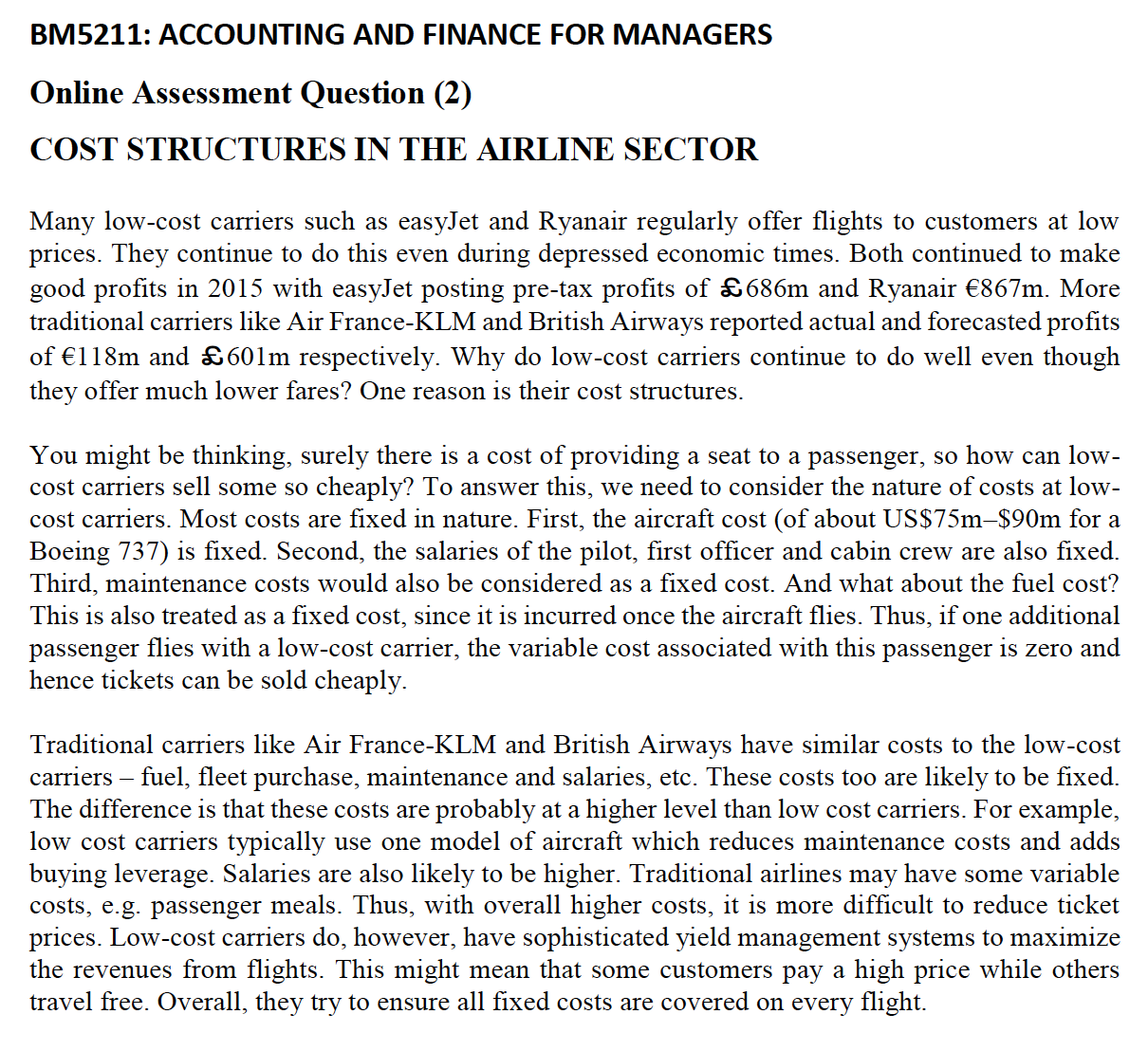
Is it possible for a passenger's variable cost to be zero? Referring specifically to traditional and low-cost carriers?
BM5211: ACCOUNTING AND FINANCE FOR MANAGERS Online Assessment Question (2) COST STRUCTURES IN THE AIRLINE SECTOR Many low-cost carriers such as easyJet and Ryanair regularly offer flights to customers at low prices. They continue to do this even during depressed economic times. Both continued to make good profits in 2015 with easyJet posting pre-tax profits of & 686m and Ryanair 6867m. More traditional carriers like Air France-KLM and British Airways reported actual and forecasted profits of El18m and & 601m respectively. Why do low-cost carriers continue to do well even though they offer much lower fares? One reason is their cost structures. You might be thinking, surely there is a cost of providing a seat to a passenger, so how can low- cost carriers sell some so cheaply? To answer this, we need to consider the nature of costs at low- cost carriers. Most costs are fixed in nature. First, the aircraft cost (of about US$75m-$90m for a Boeing 737) is fixed. Second, the salaries of the pilot, first officer and cabin crew are also fixed. Third, maintenance costs would also be considered as a fixed cost. And what about the fuel cost? This is also treated as a fixed cost, since it is incurred once the aircraft flies. Thus, if one additional passenger flies with a low-cost carrier, the variable cost associated with this passenger is zero and hence tickets can be sold cheaply. Traditional carriers like Air France-KLM and British Airways have similar costs to the low-cost carriers - fuel, fleet purchase, maintenance and salaries, etc. These costs too are likely to be fixed. The difference is that these costs are probably at a higher level than low cost carriers. For example, low cost carriers typically use one model of aircraft which reduces maintenance costs and adds buying leverage. Salaries are also likely to be higher. Traditional airlines may have some variable costs, e.g. passenger meals. Thus, with overall higher costs, it is more difficult to reduce ticket prices. Low-cost carriers do, however, have sophisticated yield management systems to maximize the revenues from flights. This might mean that some customers pay a high price while others travel free. Overall, they try to ensure all fixed costs are covered on every flight
Step by Step Solution
There are 3 Steps involved in it
1 Expert Approved Answer
Step: 1 Unlock
Question Has Been Solved by an Expert!
Get step-by-step solutions from verified subject matter experts
Step: 2 Unlock
Step: 3 Unlock
Students Have Also Explored These Related Accounting Questions!









 Study Help