







Question: Is my answer correct to this question? QUESTION: There are 5 students; Ani, Leon, Linh, Liam, and Abdul with scores in computer science as 75,
Is my answer correct to this question? QUESTION:
- There are 5 students; Ani, Leon, Linh, Liam, and Abdul with scores in computer science as 75, 60, 85, 95, and 60 respectively. They are graded by the University as B, C, B+, A, and C respectively. Define the mappings from students to marks and marks to grades explicitly.
- What are the domains and ranges of the functions?
- Can you make a composite function out of this? If yes, make the composite function and find if the composition of functions is commutative. Explain the reason.
THIS IS MY ANSWER:
Mapping from students to marks:
Ani -> 75
Leon -> 60
Linh -> 85
Liam -> 95
Abdul -> 60
Mapping from marks to grades:
75 -> B
60 -> C
85 -> B+
95 -> A
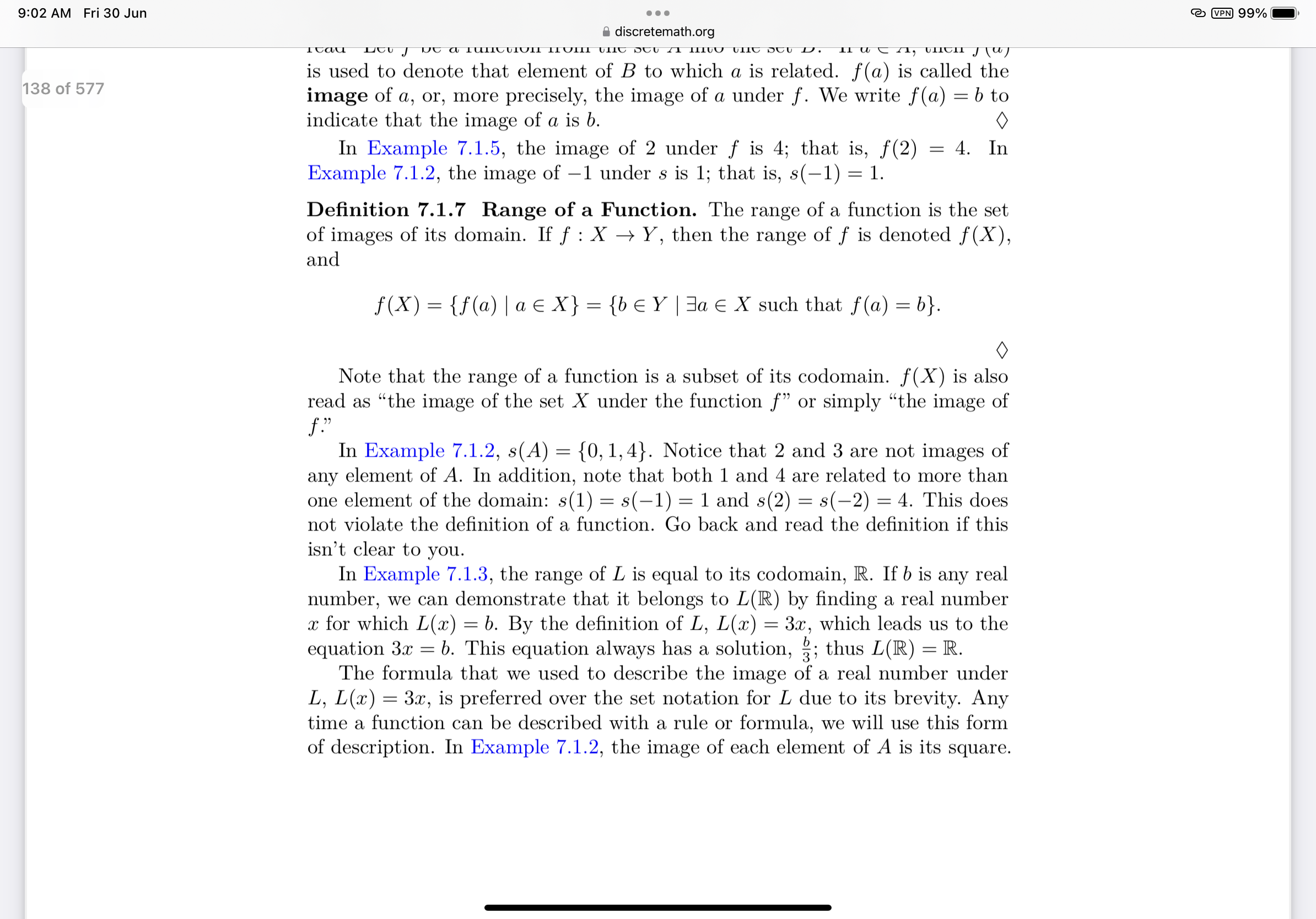
The domain of the function from students to marks is the set of students: {Ani, Leon, Linh, Liam, Abdul}.
The range of the function from students to marks is the set of marks: {75, 60, 85, 95}.
The domain of the function from marks to grades is the set of marks: {75, 60, 85, 95}.
The range of the function from marks to grades is the set of grades: {B, C, B+, A}.
A composite function is made by combining the mapping from students to marks and the mapping from marks to grades. The composite function will map each student directly to their corresponding grade.
Composite function: "Grades" composed of "Marks" composed of "Students"
Grades(Students(x)) = Marks(x)
For example, Grades(Ani) = Marks(Ani) = 75, which corresponds to the grade B.
To check if the composition of functions is commutative, we need to verify if the order of composition affects the result. In this case, if we first apply the function "Students" and then the function "Marks", or if we first apply the function "Marks" and then the function "Students", do we get the same result?
In our case, applying "Students" and then "Marks" means finding the grade for a given student's mark. Applying "Marks" and then "Students" means finding the student for a given grade.
Since there is a one-to-one correspondence between marks and grades, and each mark is uniquely associated with a student, and vice versa, the composition of functions is commutative. The order of applying the functions does not change the final result.
Step by Step Solution
There are 3 Steps involved in it

Get step-by-step solutions from verified subject matter experts
 Study Help