







Question: is playing A with probability .1, does player 1 prefer to play A or B? What about .9? (d) Now consider the general version of
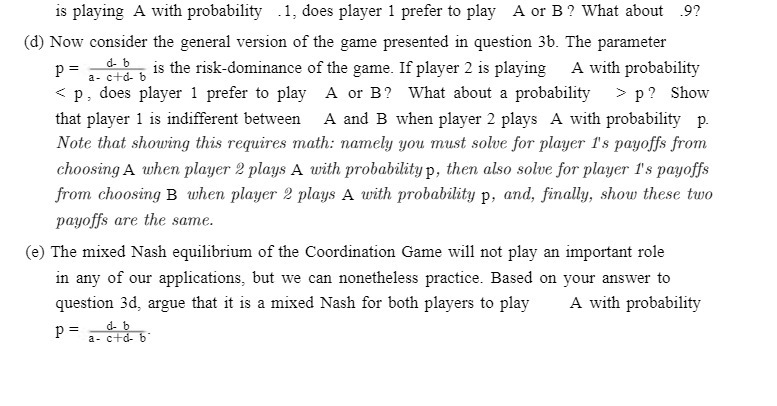
is playing A with probability .1, does player 1 prefer to play A or B? What about .9? (d) Now consider the general version of the game presented in question 3b. The parameter P= d- b a- ctd- b is the risk-dominance of the game. If player 2 is playing A with probability p? Show that player 1 is indifferent between A and B when player 2 plays A with probability p. Note that showing this requires math: namely you must solve for player I's payoffs from choosing A when player 2 plays A with probability p, then also solve for player I's payoffs from choosing B when player 2 plays A with probability p, and, finally, show these two payoffs are the same. (e) The mixed Nash equilibrium of the Coordination Game will not play an important role in any of our applications, but we can nonetheless practice. Based on your answer to question 3d, argue that it is a mixed Nash for both players to play A with probability P = - d- b a- ctd- b
Step by Step Solution
There are 3 Steps involved in it

Get step-by-step solutions from verified subject matter experts
 Study Help