







Question: Is the answer to these two questions the same with just a difference in the year? I am assuming the answer is C on both
Is the answer to these two questions the same with just a difference in the year? I am assuming the answer is C on both of these questions, but I wondering if I am wrong.
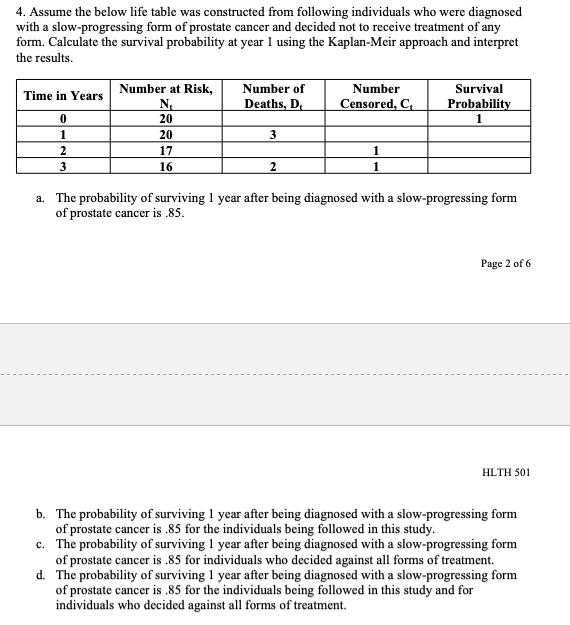
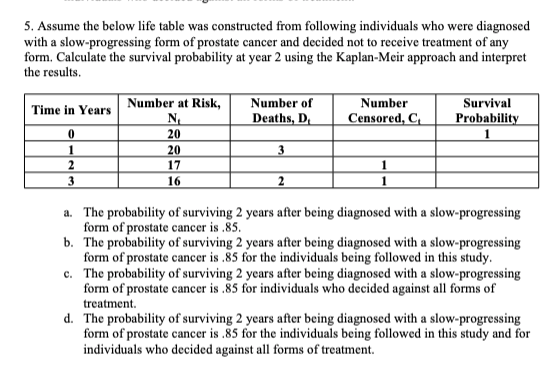
4. Assume the below life table was constructed from following individuals who were diagnosed with a slow-progressing form of prostate cancer and decided not to receive treatment of any form. Calculate the survival probability at year 1 using the Kaplan-Meir approach and interpret the results. Time in Years Number at Risk, Number of Number Survival N Deaths, D. Censored, C Probability 0 20 20 3 17 3 16 2 a. The probability of surviving 1 year after being diagnosed with a slow-progressing form of prostate cancer is .85. Page 2 of 6 HLTH 501 b. The probability of surviving 1 year after being diagnosed with a slow-progressing form of prostate cancer is .85 for the individuals being followed in this study. c. The probability of surviving 1 year after being diagnosed with a slow-progressing form of prostate cancer is .85 for individuals who decided against all forms of treatment. d. The probability of surviving 1 year after being diagnosed with a slow-progressing form of prostate cancer is .85 for the individuals being followed in this study and for individuals who decided against all forms of treatment.5. Assume the below life table was constructed from following individuals who were diagnosed with a slow-progressing form of prostate cancer and decided not to receive treatment of any form. Calculate the survival probability at year 2 using the Kaplan-Meir approach and interpret the results. Time in Years Number at Risk, Number of Number Survival N Deaths, D Censored, C Probability 20 1 20 3 2 17 3 16 2 a. The probability of surviving 2 years after being diagnosed with a slow-progressing form of prostate cancer is .85. b. The probability of surviving 2 years after being diagnosed with a slow-progressing form of prostate cancer is .85 for the individuals being followed in this study. c. The probability of surviving 2 years after being diagnosed with a slow-progressing form of prostate cancer is .85 for individuals who decided against all forms of treatment. d. The probability of surviving 2 years after being diagnosed with a slow-progressing form of prostate cancer is .85 for the individuals being followed in this study and for individuals who decided against all forms of treatment
Step by Step Solution
There are 3 Steps involved in it

Get step-by-step solutions from verified subject matter experts
 Study Help