







Question: is the density estimate with bandwidth h using all the observations except Xi. Now suppose we replaced fr (Xi) by fr(X:) in the formula for
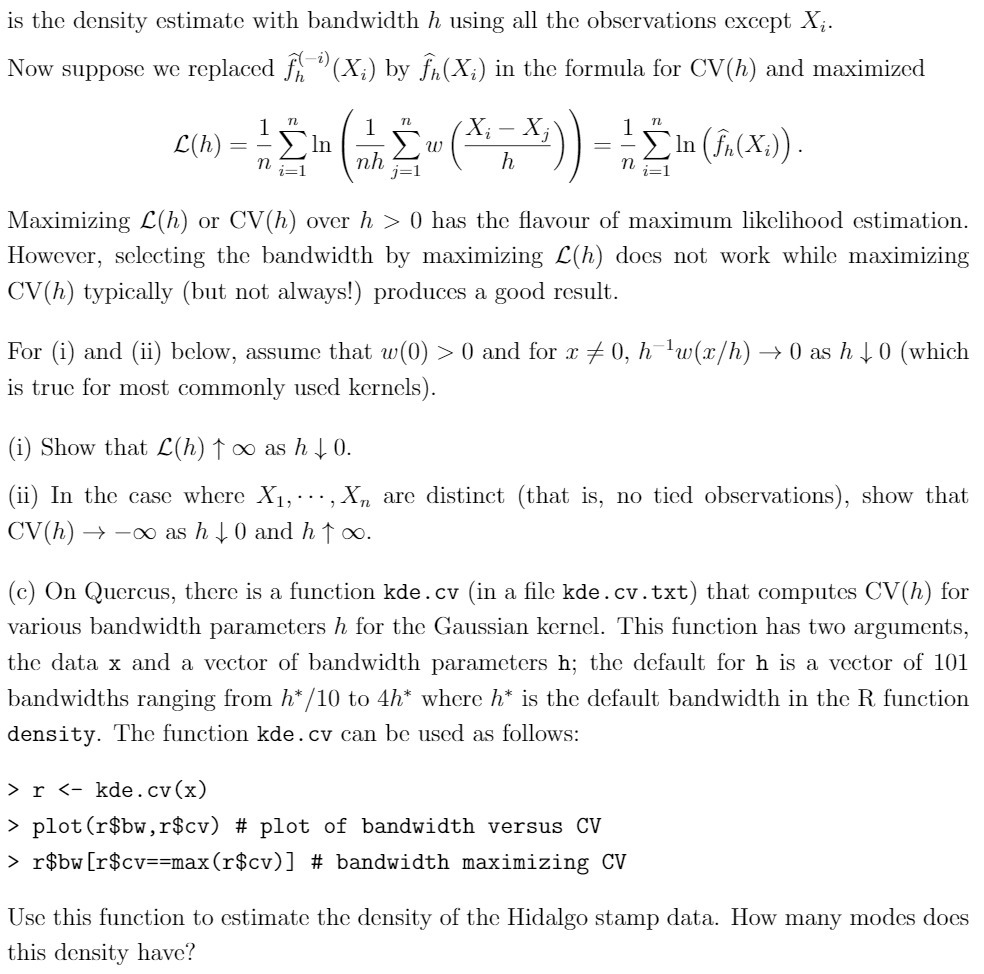
is the density estimate with bandwidth h using all the observations except Xi. Now suppose we replaced fr "(Xi) by fr(X:) in the formula for CV(h) and maximized L (h ) = In nil nh h = 1 In (fn(Xi)). Maximizing L(h) or CV(h) over h > 0 has the flavour of maximum likelihood estimation. However, selecting the bandwidth by maximizing C(h) does not work while maximizing CV(h) typically (but not always!) produces a good result. For (i) and (ii) below, assume that w(0) > 0 and for x * 0, h 'w(x/h) -> 0 as h | 0 (which is true for most commonly used kernels). (i) Show that L(h) too as h 4 0. (ii) In the case where X1, . .., Xn are distinct (that is, no tied observations), show that CV(h) -> -co as h 4 0 and h I co. (c) On Quercus, there is a function kde . cv (in a file kde . cv. txt) that computes CV(h) for various bandwidth parameters h for the Gaussian kernel. This function has two arguments, the data x and a vector of bandwidth parameters h; the default for h is a vector of 101 bandwidths ranging from h*/10 to 4h* where h* is the default bandwidth in the R function density. The function kde. cv can be used as follows: > r plot (r$bw, r$cv) # plot of bandwidth versus CV > r$bw [r$cv==max (r$cv)] # bandwidth maximizing CV Use this function to estimate the density of the Hidalgo stamp data. How many modes docs this density have
Step by Step Solution
There are 3 Steps involved in it

Get step-by-step solutions from verified subject matter experts
 Study Help