Question: Is the information ( batch records ) that was sent to BSIs competitor legally protected from appropriation or infringement under intellectual property law? Explain which,
- Is the information (batch records) that was sent to BSIs competitor legally protected from appropriation or infringement under intellectual property law? Explain which, i.e., Copyright, Trade secrets, or Patents, and why it was or was not protected.
- The formula for the drug (as opposed to the batch records) would be protected under what intellectual property law?
- What changes in controls should BSI implement to make its intellectual property more secure?
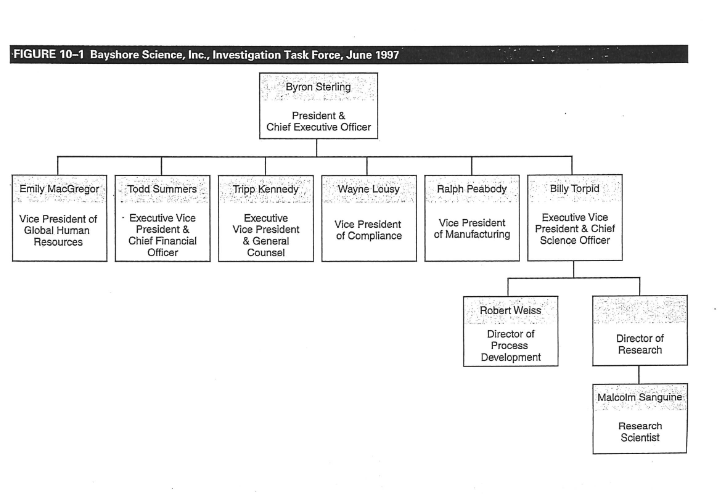
Byron Sterling, president and CEO of Bayshore Science, Inc. (BSI), walked into Emily's office and tossed a file folder on her desk. "What do you think of this, Em," he gruffed. Emily MacGregor, vice president of global human resources, thumbed through the folder. "It's a BS-52 batch record, she stated. "It looks in order." "Oh yes," Byron responded. It was a perfect run. You'll never guess where this copy came from. Emily was having a bad day already and was in no mood for Byron's little cat and mouse games. She took from him the envelope he had tucked under his arm. When she saw the return address, her jaw dropped. It was from one of their biggest competitors, Marais Scientific Corporation (MSC). A batch record is the official record of how each lot of any drug is prepared. It lists in detail the quantity of each raw material used, how the raw materials are com- pounded, and the steps of the manufacturing process, temperatures, and timing. In ad- dition, it lists any deviations from the approved preparation process that may have oc- curred. Also included are the results of all quality control testing. In short, it is the recipe for the pharmaceutical drug. The Food and Drug Administration (FDA) re- quires this record to be kept on each and every manufacturing run as a check and bal- ance for quality control. Pharmaceutical companies closely guard these records. Only a few people at BSI had access. How the product is manufactured is a trade secret and many times gives a com- pany a valuable competitive edge. This was the case with the patented manufacturing process of BS-52. Bayshore was currently in litigation with MSC over its manufactur- ing patent. Marais had sued BSI claiming that the patent held by BSI was invalid be- cause it duplicated a process covered in an earlier patent owned by MSC. The second part of MSC's litigation was that BSI's manufacturing process was infringing on MSC's patent. Patent litigation is always a little bit like walking on eggshells. You need to pre- sent enough information to prove that there is no infringement, while at the same time protecting the specifics of the patent. The BSI batch record gave MSC far too much information. "Who would do such a thing to us?" asked Emily. "It's your job to find out!" exclaimed Byron. In April 1986, Bayshore Science, Inc. was first incorporated as Bayshore Research, Inc., a California corporation. In 1990, in anticipation of an initial public offering (IPO), the company reincorporated as Bayshore Science, Inc., a Delaware corpora- tion. The new name more accurately reflected the path the company was on-moving from a research-based organization to a fully integrated pharmaceutical company. Bayshore Science's proprietary technology, an oligonucleotide-based pharmaceu- tical, was developed by a group of scientists at Stanford University. Recognizing the commercial potential, in 1982 with private funding, the scientists bought the rights to the technology from the school. Included with the technology transfer were several patents that covered the drug research as well as manufacturing processes. The company remained largely staffed by scientists until 1987, when it had devel- oped the technology to the point where it could start preclinical studies. The first product, BS-52, inhibits the growth and metastases of cancerous tumors. Early in 1989, the company obtained a second round of private funding. This infu- sion of capital allowed the company to hire a skeleton staff of clinical and regulatory individuals to initiate the preclinical studies. Later that year, an investigational new drug (IND) application was filed. With promising preliminary results from the clinical trials, the company was poising itself for its next stage of growth. An emphasis was placed on developing the process engineering department, which was the bridge be- tween the research bench and manufacturing. The compliance department was ex- panded and charged with establishing and maintaining the quality standards of the re- search, process engineering, and manufacturing laboratories. Applications for approval of BS-52 were filed in various foreign countries in 1993. BSI received a Christmas present from the United Kingdom in 1995-approval of BS-52. Several other European countries approved the drug in 1996. Approval in the United States came in 1999. With worldwide approval, BS-52, marketed under the trade name Canc-X, be- came the main stream of revenue for BSI. It put the company ahead of its competi- tion, both in scientific and financial terms. It also made BSI a prime target for the "also rans" to try and rain on its parade through costly patent litigation. ORDER IN THE COURT Although MSC filed its patent infringement case almost one year earlier, the initial discovery phase, when each side makes demands on the other for responses to written questions and for documents relevant to the case, had just recently concluded. The next step in the process would include deposing key witnesses. Biff Allen, se- nior partner in Winch and Sophism, had his team interviewing the scientific and man- ufacturing personnel, as well as those in finance and accounting. Bayshore was also laying the groundwork for the expert witness reports. BSI knew full well that MSC was doing the same. Concurrent with the deposition process, the federal court in Delaware was about to conduct the Markman hearing to determine the proper construction of the claims. This phase of the litigation process was critical to both sides, but especially to BSI. The terms in a claim are given their common definition, unless one side or the other can demonstrate that the inventor of the patent had a different meaning in mind. The technology involved in BSI's patent was groundbreaking, and many of the terms used required definitive clarification. It is the job of the judge to make the determination about which meaning will be used. In many cases, the meaning of the terms can be the determining factor in the question of infringement The information contained in the batch record could very likely give MSC an edge in both its preparation of witnesses to be deposed, as well as in persuading the court as to how terms should be defined. IT'S IN THE MAIL Byron put together a task force to investigate the batch record incident and to do damage assessment. The team consisted of Tripp Kennedy, vice president and general counsel; Wayne Lousy, vice president of compliance; Robert Weiss, director of process development; Ralph Peabody, vice president of manufacturing; and Emily. (See Figure 10-1.) Wayne, Robert, and Ralph were to assess the scientific value of the batch records to MSC. Based on that, finance could make estimates of the financial impact. Tripp would do an analysis of the patent litigation position, determining if it had been com- promised. Emily was charged with the responsibility of trying to find out who had sent the document. Tripp called his counterpart at MSC, Philip Liveneau. "Que pasa, Phil. What's happening in La-La Land?" asked Tripp. MSC is located in Los Angeles, and there is quite a rivalry between northern and southern California. "Not much to report at this end," responded Mr. Liveneau. "That's not what I hear, pal. I hear you got yourself a proven manufacturing process now. One that might actually make your product viable. Oh wait! I remember now-that manufacturing process is ours!" chided Tripp. Predictably, Phil went on the defensive. "Hey," he said. "We sent that stuff back to you the moment we got it!" Based on the postmark of the envelope in which the records were initially sent to MSC, the competitor had the documents for over three weeks! Obviously, they were in no hurry to send them back to BSI, Where they had been during that time was of importance to BSI. It is entirely possible that MSC had tried to duplicate the process. "Define immediately," requested Tripp. Phil gave Tripp some song and dance about how the documents had been sitting in the mailroom for a couple of weeks because no one knew quite who should get them. Meanwhile, Byron was having a similar conversation with Mark Magisterial, the president of MSC. The two had a history working together at big pharmaceutical com- panies prior to their respective start-up companies. "Mark," started Byron. "I got your little package today. You could have called and given me a heads-up, you know." "I thought it would be more fun this way," said Mark. "Sure wish I could have been a fly on your wall when you opened the envelope. I think you got a problem em- ployee or two there Byron." FIGURE 10-1 Bayshore Science, Inc., Investigation Task Force, June 1997 Byron Sterling President & Chief Executive Officer Emily MacGregor Todd Summers Tripp Kennedy Wayne Lousy Ralph Peabody Billy Torpid Vice President of Global Human Resources Executive Vice President & Chief Financial Officer Executive Vice President & General Counsel Vice President of Compliance Vice President of Manufacturing Executive Vice President & Chief Science Officer Robert Weiss Director of Process Development Director of Research Malcolm Sanguine Research Scientist 98 CHAPTER 10 Patently Offensive Condu Byron hated it when Mark was right. "I'm thinking I got someone on your pay- roll!" Byron replied. "I am a bit curious as to why it took you so long to return it. Having trouble duplicating the process? Shall I send someone up to help you guys out?" Marais's president told Byron that the mailing had arrived while he was out of town, so it sat on his desk for one week. In the two weeks since, Mark claimed that he was addressing the issue with his legal counsel to determine if MSC should re- turn the records or just pretend it never received them. "Ultimately, as you can see, we felt we should return them. We figured you should know there is a leak in your organization." Suddenly a cold sensation went over Byron. He realized that if MSC had received the records, any number of BSI's competitors could have too, Maybe the competitors decided to just hang onto them and not tell BSI! "Damn," Byron thought to himself. "This could be devastating!" THE SPY WHO SAVED ME Emily got in touch with her old friend Boomer Griner. Boomer was formerly with the Drug Enforcement Agency (DEA). Emily relied on him for her more sticky investiga- tions. "Got an interesting one for you this time, buddy." She then told Boomer all she had learned to date. Boomer recommended bringing in a handwriting analyst to compare the writing on the envelope with employee records. He also suggested sending the document and label to the FBI lab to lift fingerprints off the document for cross-referencing against fingerprints of BSI employees. "That would be a great idea, Boomer. Except we don't fingerprint our employeesl" said Emily. They talked further and decided that they could lift prints from the confidentiality statements each and every associate had signed on hire. In this way, they could get the prints of all associ- ates, past and present "There is a downside, Em," said Boomer. "The documents from which we lift the prints will be marred." He went on to explain that the only way to lift prints off porous materials such as paper was to treat it with a chemical called ninhydrin. Hu- midity chambers then can lift the prints off the paper. This would leave the documents permanently marked with a raspberry colored stain. Because there were only a couple of federal labs available to do this kind of work, it would be expensive. And BSI's job would be low on the priority list. "Well," said Emily, "there does not seem to be much else we can do!" To minimize the testing costs, they decided to start with the list of disgruntled employees. If there was no match there, they would move on to lifting prints of other associates. It had been decided early on that this investigation would be held very close, so Emily had to retrieve the files herself late at night so as not to arouse suspicion. Fol- lowing Boomer's instructions, she used surgical gloves to keep from adding additional prints. Then she carefully copied all the confidentiality agreements, placed them in separate plastic evidence envelopes, and forwarded them to Boomer for delivery to the lab. WOWI M.O.M. Emily had noticed that the person who addressed the envelope used a somewhat un- usual abbreviation for California. Most people use "CA" or "CA," but the author used "Ca." and the period after the "a" was not common. She went through the employ. ment applications of all associates. Only two used that abbreviation. One was an em- ployee who had recently left the company, Malcolm Sanguine. Mal was a trouble- maker and in the throws of corrective counseling when he tendered his resignation. He claimed to have a new job out of state. His departure was the week before the doc- uments were sent. One of his last assignments was to do quality checks on the produc- tion run the batch records covered. Means and motive. The envelope had been sent anonymously, with a San Diego postmark. Surrepti- tiously, Emily inquired around the labs to see if anyone had visited San Diego re- cently. Through these casual conversations she found out that Mal had celebrated his departure from BSI with a surfing trip to Ensenada. San Diego is the border town. Opportunity Emily called Boomer with what she had learned. "Well, it does look like you have something here, Emily," said Boomer upon hearing the story. "Means, opportunity, and motive. It fits!" The federal lab was instructed to focus on Mal's confidentiality agreement. Three other agreements were selected at random, just as a precaution. Four months later the report came back. There was a match on the fingerprint from the envelope and a par- tial print on Mal's agreement. TO BOULDERLY GO... After six full months of investigation, the task force met to discuss all its findings and to determine where to go from there. "Isn't it interesting that Mark and Phil couldn't get straight on the story of where the records had been for three weeks?" asked Tripp. "Yeah," said Wayne. "You would have thought they would have drummed up the story before they ever mailed 'em back. Poor quality control there!" Although there were obvious holes in the story of where the document had been during its three-week journey from San Diego through MSC to BSI, there was no evidence thus far that MSC had used the information gained from the batch record "The depositions of their key witnesses were unremarkable," stated Tripp. "If they were trying to use the information, they didn't do a very good job." "That does not surprise me," opined Robert. "MSC is not known for their scien- tific expertise. They have no products in the pipeline. Their only revenue is from patents they own and license. That's why winning this is so important to them. If they can get royalties from us, that's just more money for them!" "Okay, so it looks like we can't get them for using the information, but just what is the legal requirement for MSC to give up the documents?" asked Ted. "Because of the pending litigation, isn't there something wrong with keeping the proprietary infor- mation three full weeks?" 106 CHAPTER 10 Patently Offensive Conduct "Well, at least we have Mal," sighed Emily. Bayshore had learned that Mal had joined a small pharmaceutical rescarch company in Boulder, Colorado. "So where do we go from here?" asked Wayne. "You know," said Emily, "it's been awhile since I've skied Colorado. I think a trip would do me good









 Study Help