







Question: Is there a difference in the average time spent reading for fun between males and females? A random sample of 213 adults was taken. The
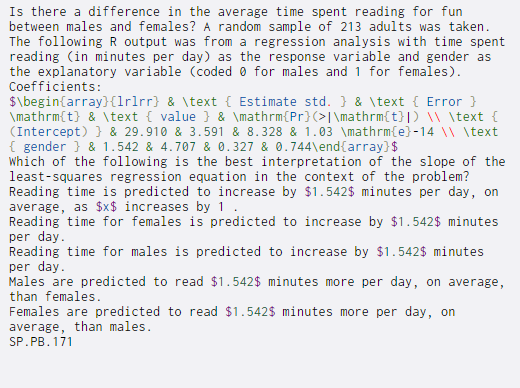
Is there a difference in the average time spent reading for fun between males and females? A random sample of 213 adults was taken. The following R output was from a regression analysis with time spent reading (in minutes per day) as the response variable and gender as the explanatory variable (coded o for males and 1 for females). Coefficients: $\begin{array}{ lrr} & \text { Estimate std. } & \text { Error } \mathrm{t} & \text { value } & \mathrm{Pr}>|\mathrm{t}| \ \text { (Intercept) } & 29.910 & 3.591 & 8.328 & 1.03 \mathrm{e}-14 \ \text { gender } & 1.542 & 4.707 & 0.327 & 0.744\end{array} $ Which of the following is the best interpretation of the slope of the least-squares regression equation in the context of the problem? Reading time is predicted to increase by $1.542$ minutes per day, on average, as $X$ increases by 1. Reading time for females is predicted to increase by $1.542$ minutes per day. Reading time for males is predicted to increase by $1.542$ minutes per day. Males are predicted to read $1.542$ minutes more per day, on average, than females. Females are predicted to read $1.542$ minutes more per day, on average, than males. SP.PB. 171
Step by Step Solution
There are 3 Steps involved in it

Get step-by-step solutions from verified subject matter experts
 Study Help