







Question: Is there a trick for the knowing the differences between these associations? A randomized controlled study was performed to assess the efficacy of financial incentives
Is there a trick for the knowing the differences between these associations?
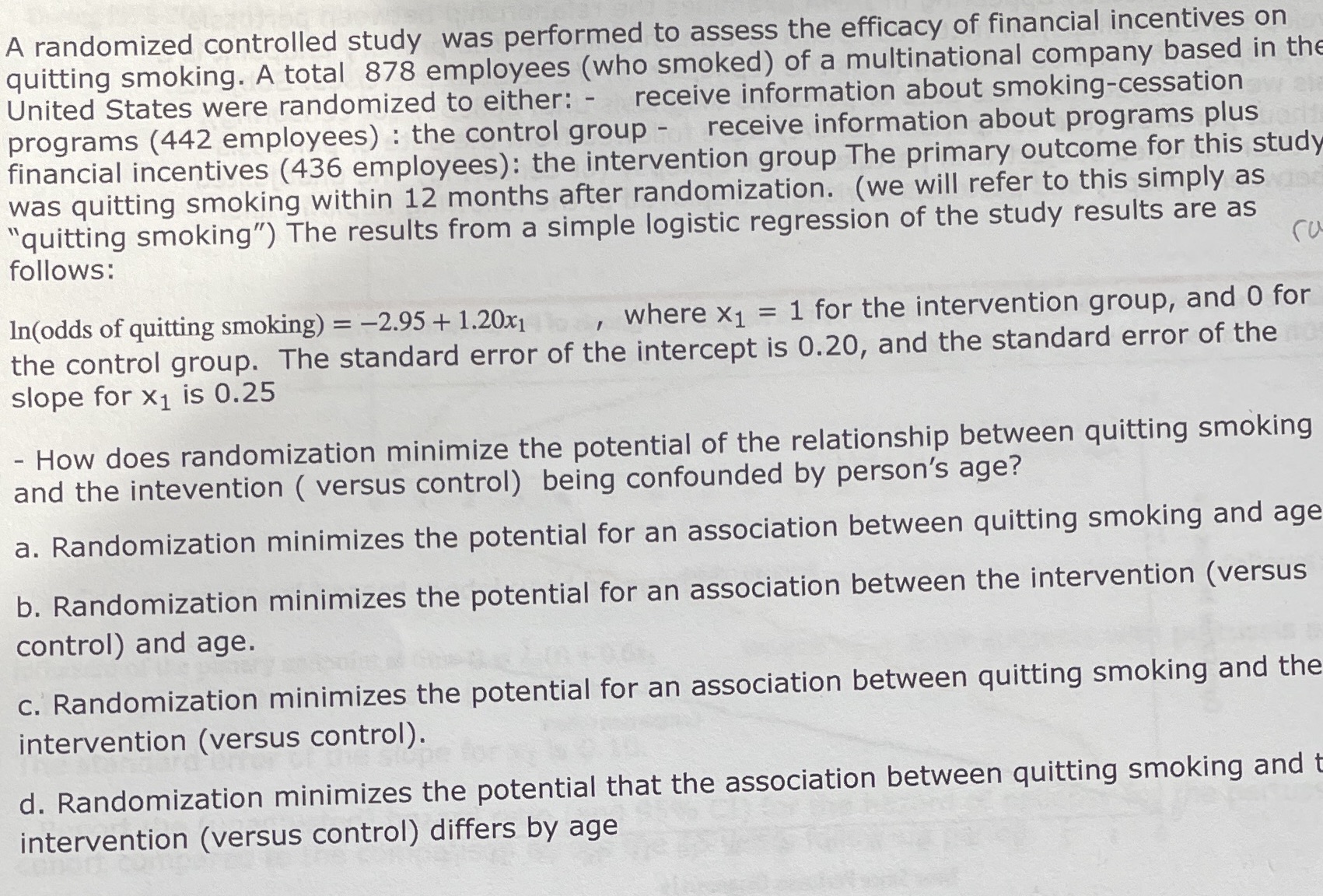
A randomized controlled study was performed to assess the efficacy of financial incentives on quitting smoking. A total 878 employees (who smoked) of a multinational company based in the United States were randomized to either: - receive information about smoking-cessation programs (442 employees) : the control group - receive information about programs plus financial incentives (436 employees): the intervention group The primary outcome for this study was quitting smoking within 12 months after randomization. (we will refer to this simply as "quitting smoking") The results from a simple logistic regression of the study results are as follows: ru In(odds of quitting smoking) = -2.95 + 1.20x1 , where x1 = 1 for the intervention group, and 0 for the control group. The standard error of the intercept is 0.20, and the standard error of the slope for x1 is 0.25 How does randomization minimize the potential of the relationship between quitting smoking and the intevention ( versus control) being confounded by person's age? a. Randomization minimizes the potential for an association between quitting smoking and age b. Randomization minimizes the potential for an association between the intervention (versus control) and age. c. Randomization minimizes the potential for an association between quitting smoking and the intervention (versus control). d. Randomization minimizes the potential that the association between quitting smoking and intervention (versus control) differs by age
Step by Step Solution
There are 3 Steps involved in it

Get step-by-step solutions from verified subject matter experts
 Study Help