







Question: is this better ? Project: Develop a Computer Program for Thermal Oxidation . You have derived the Deal-Grove equation for oxidation. You have studied the
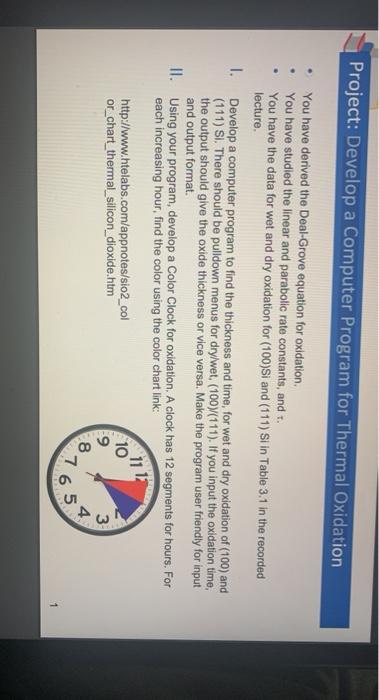
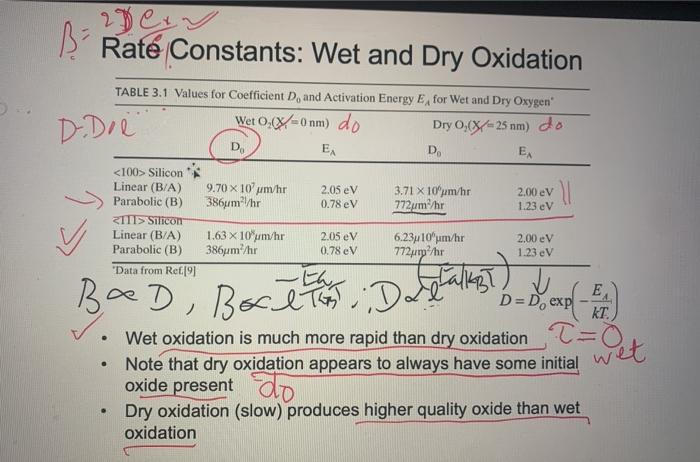
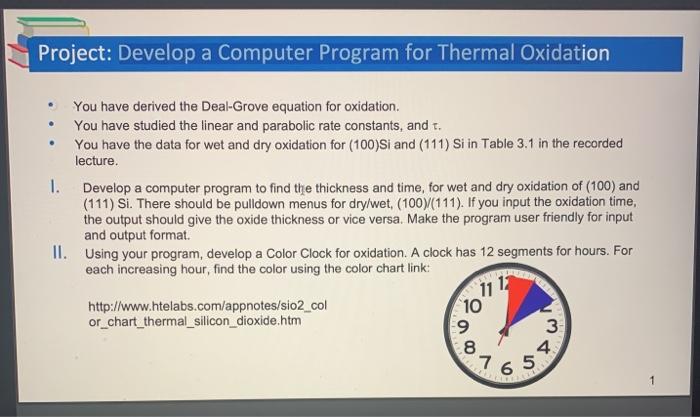
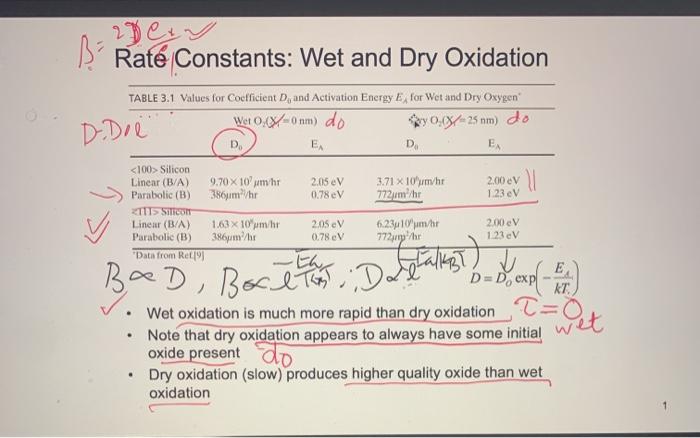
Project: Develop a Computer Program for Thermal Oxidation . You have derived the Deal-Grove equation for oxidation. You have studied the linear and parabolic rate constants, and t. You have the data for wet and dry oxidation for (100)Si and (111) Si in Table 3.1 in the recorded lecture 1. Develop a computer program to find the thickness and time, for wet and dry oxidation of (100) and (111) Si. There should be pulldown menus for dry/wet. (100y(111). If you input the oxidation time, the output should give the oxide thickness or vice versa. Make the program user friendly for input and output format. II. Using your program, develop a Color Clock for oxidation. A clock has 12 segments for hours. For each increasing hour, find the color using the color chart link: 11 http://www.htelabs.com/appnotes/sio2_col or_chart_thermal_silicon_dioxide.htm 10 9 18 4 7 6 :5 1 2DC B Rate Constants: Wet and Dry Oxidation D.Die TABLE 3.1 Values for Coefficient D, and Activation Energy Efor Wet and Dry Oxygen Wet OX=0nm) do Dry X=25 nm) do D EM D 9.70 x 10 m/hr 386um Vhr 2.05 eV 0.78 eV 3.71 X 10'um/hr 772 um/hr 2.00 eV 1.23 eV Silicon Linear (B/A) Parabolic (B) 111> Silicon Linear (B/A) Parabolic (B) "Data from Ret191 1.63 X 10'um/hr 386um/hr 2.05 eV 0.78 eV 6.2310'um/hr 772/hr 2.00 eV 1.23 eV KT. BAD, Boce this De betalker) D=D, exp E Wet oxidation is much more rapid than dry oxidation T=0 Note that dry oxidation appears to always have some initial oxide present do Dry oxidation (slow) produces higher quality oxide than wet oxidation wet . . Project: Develop a Computer Program for Thermal Oxidation You have derived the Deal-Grove equation for oxidation. You have studied the linear and parabolic rate constants, and t. You have the data for wet and dry oxidation for (100)Si and (111) Si in Table 3.1 in the recorded lecture. 1. Develop a computer program to find the thickness and time, for wet and dry oxidation of (100) and (111) Si. There should be pulldown menus for dry/wet, (100)/(111). If you input the oxidation time, the output should give the oxide thickness or vice versa. Make the program user friendly for input and output format II. Using your program, develop a Color Clock for oxidation. A clock has 12 segments for hours. For each increasing hour, find the color using the color chart link: http://www.ntelabs.com/appnotes/sio2_col or_chart_thermal_silicon_dioxide.htm 11 12 10 9 3 4 8 165 1 2DC B Rate Constants: Wet and Dry Oxidation D-Doe TABLE 3.1 Values for Coefficient D, and Activation Energy E for Wet and Dry Oxygen Wet o X-Onm) do y 0XX-25 nm) do E D. EA 2.05 V 0.78 eV 3.71 10 IMr 772 m/hr 2.00 eV 1.23 eV Silicon Linear (B/A) 9.70x 10 mhr Parabolic (B) 386mVhr 21115 SITCOM Linear (B/A) 1.63 x 10'umhr Parabolic (3) 386m/h "Data from Ret 191 205 eV 0.78 eV 6.23410"ht 772/hr 2.00 eV 1.23 V Bad, Bocil this :D E D=D, exp KT Wet oxidation is much more rapid than dry oxidation.T=0 Note that dry oxidation appears to always have some initial wet oxide present do Dry oxidation (slow) produces higher quality oxide than wet oxidation . Project: Develop a Computer Program for Thermal Oxidation . You have derived the Deal-Grove equation for oxidation. You have studied the linear and parabolic rate constants, and t. You have the data for wet and dry oxidation for (100)Si and (111) Si in Table 3.1 in the recorded lecture 1. Develop a computer program to find the thickness and time, for wet and dry oxidation of (100) and (111) Si. There should be pulldown menus for dry/wet. (100y(111). If you input the oxidation time, the output should give the oxide thickness or vice versa. Make the program user friendly for input and output format. II. Using your program, develop a Color Clock for oxidation. A clock has 12 segments for hours. For each increasing hour, find the color using the color chart link: 11 http://www.htelabs.com/appnotes/sio2_col or_chart_thermal_silicon_dioxide.htm 10 9 18 4 7 6 :5 1 2DC B Rate Constants: Wet and Dry Oxidation D.Die TABLE 3.1 Values for Coefficient D, and Activation Energy Efor Wet and Dry Oxygen Wet OX=0nm) do Dry X=25 nm) do D EM D 9.70 x 10 m/hr 386um Vhr 2.05 eV 0.78 eV 3.71 X 10'um/hr 772 um/hr 2.00 eV 1.23 eV Silicon Linear (B/A) Parabolic (B) 111> Silicon Linear (B/A) Parabolic (B) "Data from Ret191 1.63 X 10'um/hr 386um/hr 2.05 eV 0.78 eV 6.2310'um/hr 772/hr 2.00 eV 1.23 eV KT. BAD, Boce this De betalker) D=D, exp E Wet oxidation is much more rapid than dry oxidation T=0 Note that dry oxidation appears to always have some initial oxide present do Dry oxidation (slow) produces higher quality oxide than wet oxidation wet . . Project: Develop a Computer Program for Thermal Oxidation You have derived the Deal-Grove equation for oxidation. You have studied the linear and parabolic rate constants, and t. You have the data for wet and dry oxidation for (100)Si and (111) Si in Table 3.1 in the recorded lecture. 1. Develop a computer program to find the thickness and time, for wet and dry oxidation of (100) and (111) Si. There should be pulldown menus for dry/wet, (100)/(111). If you input the oxidation time, the output should give the oxide thickness or vice versa. Make the program user friendly for input and output format II. Using your program, develop a Color Clock for oxidation. A clock has 12 segments for hours. For each increasing hour, find the color using the color chart link: http://www.ntelabs.com/appnotes/sio2_col or_chart_thermal_silicon_dioxide.htm 11 12 10 9 3 4 8 165 1 2DC B Rate Constants: Wet and Dry Oxidation D-Doe TABLE 3.1 Values for Coefficient D, and Activation Energy E for Wet and Dry Oxygen Wet o X-Onm) do y 0XX-25 nm) do E D. EA 2.05 V 0.78 eV 3.71 10 IMr 772 m/hr 2.00 eV 1.23 eV Silicon Linear (B/A) 9.70x 10 mhr Parabolic (B) 386mVhr 21115 SITCOM Linear (B/A) 1.63 x 10'umhr Parabolic (3) 386m/h "Data from Ret 191 205 eV 0.78 eV 6.23410"ht 772/hr 2.00 eV 1.23 V Bad, Bocil this :D E D=D, exp KT Wet oxidation is much more rapid than dry oxidation.T=0 Note that dry oxidation appears to always have some initial wet oxide present do Dry oxidation (slow) produces higher quality oxide than wet oxidation
Step by Step Solution
There are 3 Steps involved in it

Get step-by-step solutions from verified subject matter experts
 Study Help