







Question: ISSUE FOR DEBATE 2. Do you think the decision was well received by the employees? What factors, changes in events, and so on, do you
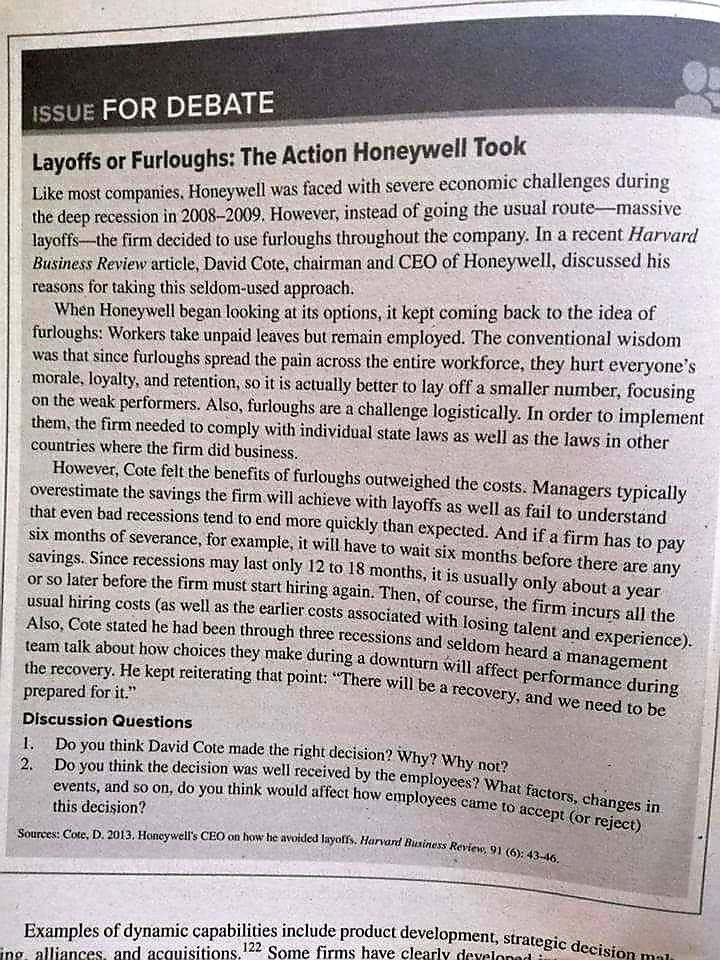
ISSUE FOR DEBATE 2. Do you think the decision was well received by the employees? What factors, changes in events, and so on, do you think would affect how employees came to accept for reject) Examples of dynamic capabilities include product development, strategic decision mal Layoffs or Furloughs: The Action Honeywell Took Like most companies, Honeywell was faced with severe economic challenges during the deep recession in 2008-2009. However, instead of going the usual route-massive layoffs--the firm decided to use furloughs throughout the company. In a recent Harvard Business Review article, David Cote, chairman and CEO of Honeywell, discussed his reasons for taking this seldom-used approach. When Honeywell began looking at its options, it kept coming back to the idea of furloughs: Workers take unpaid leaves but remain employed. The conventional wisdom was that since furloughs spread the pain across the entire workforce, they hurt everyone's morale, loyalty, and retention, so it is actually better to lay off a smaller number, focusing on the weak performers. Also, furloughs are a challenge logistically. In order to implement them, the firm needed to comply with individual state laws as well as the laws in other countries where the firm did business. However, Cote felt the benefits of furloughs outweighed the costs. Managers typically overestimate the savings the firm will achieve with layoffs as well as fail to understand that even had recessions tend to end more quickly than expected. And if a firm has to pay six months of severance, for example, it will have to wait six months before there are any savings. Since recessions may last only 12 to 18 months, it is usually only about a year or so later before the firm must start hiring again. Then, of course, the firm incurs all the usual hiring costs (as well as the earlier costs associated with losing talent and experience). Also, Cote stated he had been through three recessions and seldom heard a management team talk about how choices they make during a downturn will affect performance during the recovery. He kept reiterating that point: "There will be a recovery, and we need to be prepared for it." Discussion Questions 1. Do you think David Cote made the right decision? Why? Why not? this decision? Sources: Cote, D. 2013. Homeywell's CEO on how be avoided layoffs. Harvard Business Review, 91(6): 43-46 ing alliances and acquisitions. 122 Some firms have clearly develor
Step by Step Solution
There are 3 Steps involved in it
1 Expert Approved Answer
Step: 1 Unlock

Question Has Been Solved by an Expert!
Get step-by-step solutions from verified subject matter experts
Step: 2 Unlock
Step: 3 Unlock
 Study Help