







Question: It can be shown that if a, b, and c are distinct real numbers, then (p(x), q(x)) = p(a)q(a) + p(b)q(b) + p(c)q(c) defines an
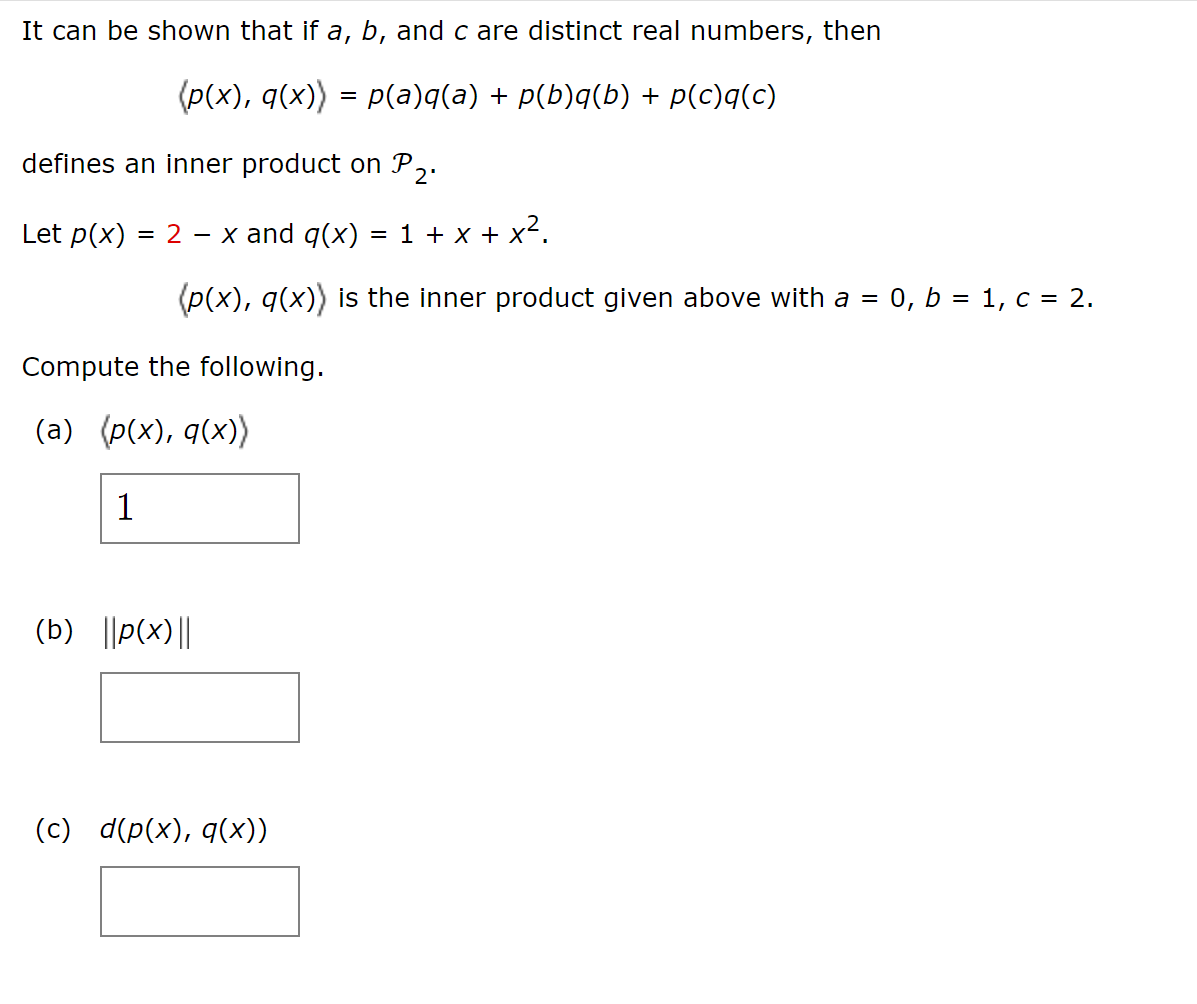
It can be shown that if a, b, and c are distinct real numbers, then (p(x), q(x)) = p(a)q(a) + p(b)q(b) + p(c)q(c) defines an inner product on P2. Let p(x) = 2 - x and q(x) = 1+ x+ x2. (p(x), q(x)) is the inner product given above with a = 0, b = 1, c = 2. Compute the following. (a) (p(x), q(x)) 1 (b) |/p(x) 11 (c) d(p(x), q(x))
Step by Step Solution
There are 3 Steps involved in it
1 Expert Approved Answer
Step: 1 Unlock

Question Has Been Solved by an Expert!
Get step-by-step solutions from verified subject matter experts
Step: 2 Unlock
Step: 3 Unlock
 Study Help