







Question: it does not require more information 1. (60%) There are two countries in the world - Canada and US. Based on the World Bank data,
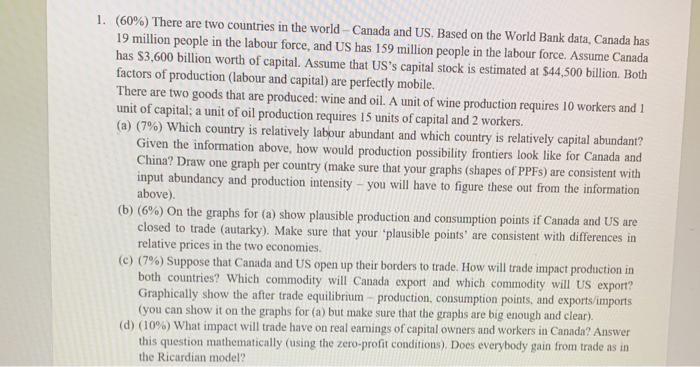
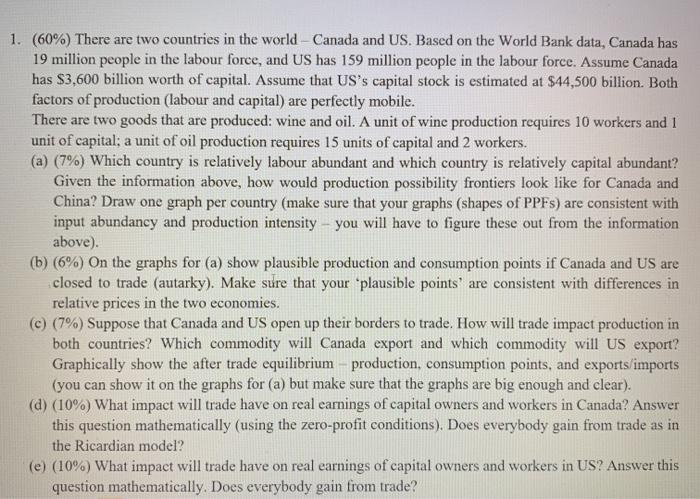
1. (60%) There are two countries in the world - Canada and US. Based on the World Bank data, Canada has 19 million people in the labour force, and US has 159 million people in the labour force. Assume Canada has $3,600 billion worth of capital. Assume that US's capital stock is estimated at $44,500 billion. Both factors of production (labour and capital) are perfectly mobile. There are two goods that are produced: wine and oil. A unit of wine production requires 10 workers and 1 unit of capital; a unit of oil production requires 15 units of capital and 2 workers. (a) (7%) Which country is relatively labour abundant and which country is relatively capital abundant? Given the information above, how would production possibility frontiers look like for Canada and China? Draw one graph per country (make sure that your graphs (shapes of PPFs) are consistent with input abundancy and production intensity - you will have to figure these out from the information above). (b) (6%) On the graphs for (a) show plausible production and consumption points if Canada and US are closed to trade (autarky). Make sure that your "plausible points are consistent with differences in relative prices in the two economies. (e) (7%) Suppose that Canada and US open up their borders to trade. How will trade impact production in both countries? Which commodity will Canada export and which commodity will US export? Graphically show the after trade equilibrium production, consumption points, and exports/imports (you can show it on the graphs for (a) but make sure that the graphs are big enough and clear). (d) (10%) What impact will trade have on real earings of capital owners and workers in Canada? Answer this question mathematically (using the zero-profit conditions). Does everybody gain from trade as in the Ricardian model? 1. (60%) There are two countries in the world - Canada and US. Based on the World Bank data, Canada has 19 million people in the labour force, and US has 159 million people in the labour force. Assume Canada has $3,600 billion worth of capital. Assume that US's capital stock is estimated at $44,500 billion. Both factors of production (labour and capital) are perfectly mobile. There are two goods that are produced: wine and oil. A unit of wine production requires 10 workers and 1 unit of capital; a unit of oil production requires 15 units of capital and 2 workers. (a) (7%) Which country is relatively labour abundant and which country is relatively capital abundant? Given the information above, how would production possibility frontiers look like for Canada and China? Draw one graph per country (make sure that your graphs (shapes of PPFs) are consistent with input abundancy and production intensity - you will have to figure these out from the information above). (b) (6%) On the graphs for (a) show plausible production and consumption points if Canada and US are closed to trade (autarky). Make sure that your plausible points' are consistent with differences in relative prices in the two economies. (c) (7%) Suppose that Canada and US open up their borders to trade. How will trade impact production in both countries? Which commodity will Canada export and which commodity will US export? Graphically show the after trade equilibrium production, consumption points, and exports/imports (you can show it on the graphs for (a) but make sure that the graphs are big enough and clear). (d) (10%) What impact will trade have on real earnings of capital owners and workers in Canada? Answer this question mathematically (using the zero-profit conditions). Does everybody gain from trade as in the Ricardian model? (e) (10%) What impact will trade have on real earnings of capital owners and workers in US? Answer this question mathematically. Does everybody gain from trade? 1. (60%) There are two countries in the world - Canada and US. Based on the World Bank data, Canada has 19 million people in the labour force, and US has 159 million people in the labour force. Assume Canada has $3,600 billion worth of capital. Assume that US's capital stock is estimated at $44,500 billion. Both factors of production (labour and capital) are perfectly mobile. There are two goods that are produced: wine and oil. A unit of wine production requires 10 workers and 1 unit of capital; a unit of oil production requires 15 units of capital and 2 workers. (a) (7%) Which country is relatively labour abundant and which country is relatively capital abundant? Given the information above, how would production possibility frontiers look like for Canada and China? Draw one graph per country (make sure that your graphs (shapes of PPFs) are consistent with input abundancy and production intensity - you will have to figure these out from the information above). (b) (6%) On the graphs for (a) show plausible production and consumption points if Canada and US are closed to trade (autarky). Make sure that your "plausible points are consistent with differences in relative prices in the two economies. (e) (7%) Suppose that Canada and US open up their borders to trade. How will trade impact production in both countries? Which commodity will Canada export and which commodity will US export? Graphically show the after trade equilibrium production, consumption points, and exports/imports (you can show it on the graphs for (a) but make sure that the graphs are big enough and clear). (d) (10%) What impact will trade have on real earings of capital owners and workers in Canada? Answer this question mathematically (using the zero-profit conditions). Does everybody gain from trade as in the Ricardian model? 1. (60%) There are two countries in the world - Canada and US. Based on the World Bank data, Canada has 19 million people in the labour force, and US has 159 million people in the labour force. Assume Canada has $3,600 billion worth of capital. Assume that US's capital stock is estimated at $44,500 billion. Both factors of production (labour and capital) are perfectly mobile. There are two goods that are produced: wine and oil. A unit of wine production requires 10 workers and 1 unit of capital; a unit of oil production requires 15 units of capital and 2 workers. (a) (7%) Which country is relatively labour abundant and which country is relatively capital abundant? Given the information above, how would production possibility frontiers look like for Canada and China? Draw one graph per country (make sure that your graphs (shapes of PPFs) are consistent with input abundancy and production intensity - you will have to figure these out from the information above). (b) (6%) On the graphs for (a) show plausible production and consumption points if Canada and US are closed to trade (autarky). Make sure that your plausible points' are consistent with differences in relative prices in the two economies. (c) (7%) Suppose that Canada and US open up their borders to trade. How will trade impact production in both countries? Which commodity will Canada export and which commodity will US export? Graphically show the after trade equilibrium production, consumption points, and exports/imports (you can show it on the graphs for (a) but make sure that the graphs are big enough and clear). (d) (10%) What impact will trade have on real earnings of capital owners and workers in Canada? Answer this question mathematically (using the zero-profit conditions). Does everybody gain from trade as in the Ricardian model? (e) (10%) What impact will trade have on real earnings of capital owners and workers in US? Answer this question mathematically. Does everybody gain from trade
Step by Step Solution
There are 3 Steps involved in it

Get step-by-step solutions from verified subject matter experts
 Study Help