







Question: It is a Complex analysis problem, which requirers fourier transformation to solve it. let u(r, t) be an unknown function with Fourier transform u(w, t)
It is a Complex analysis problem, which requirers fourier transformation to solve it.
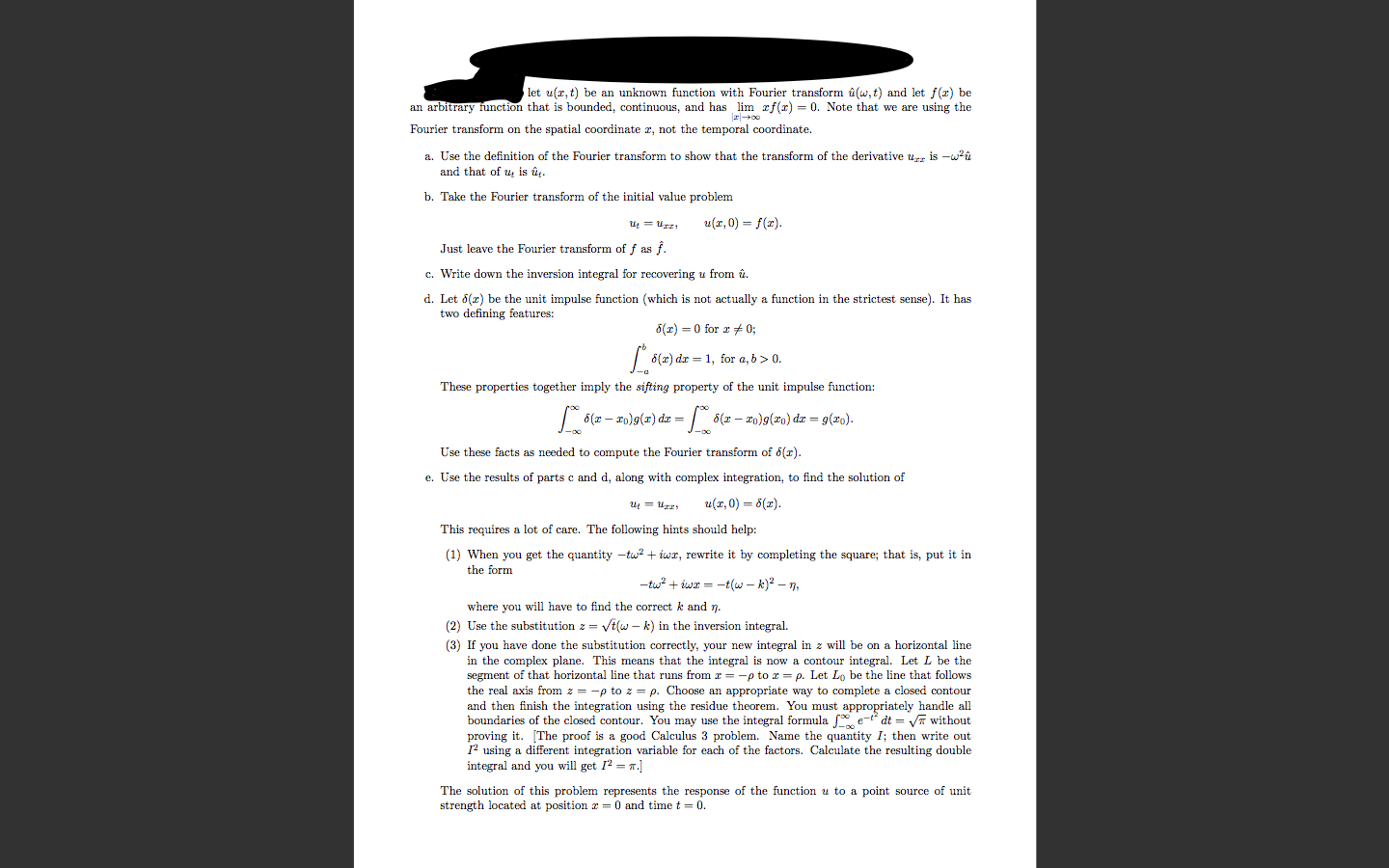
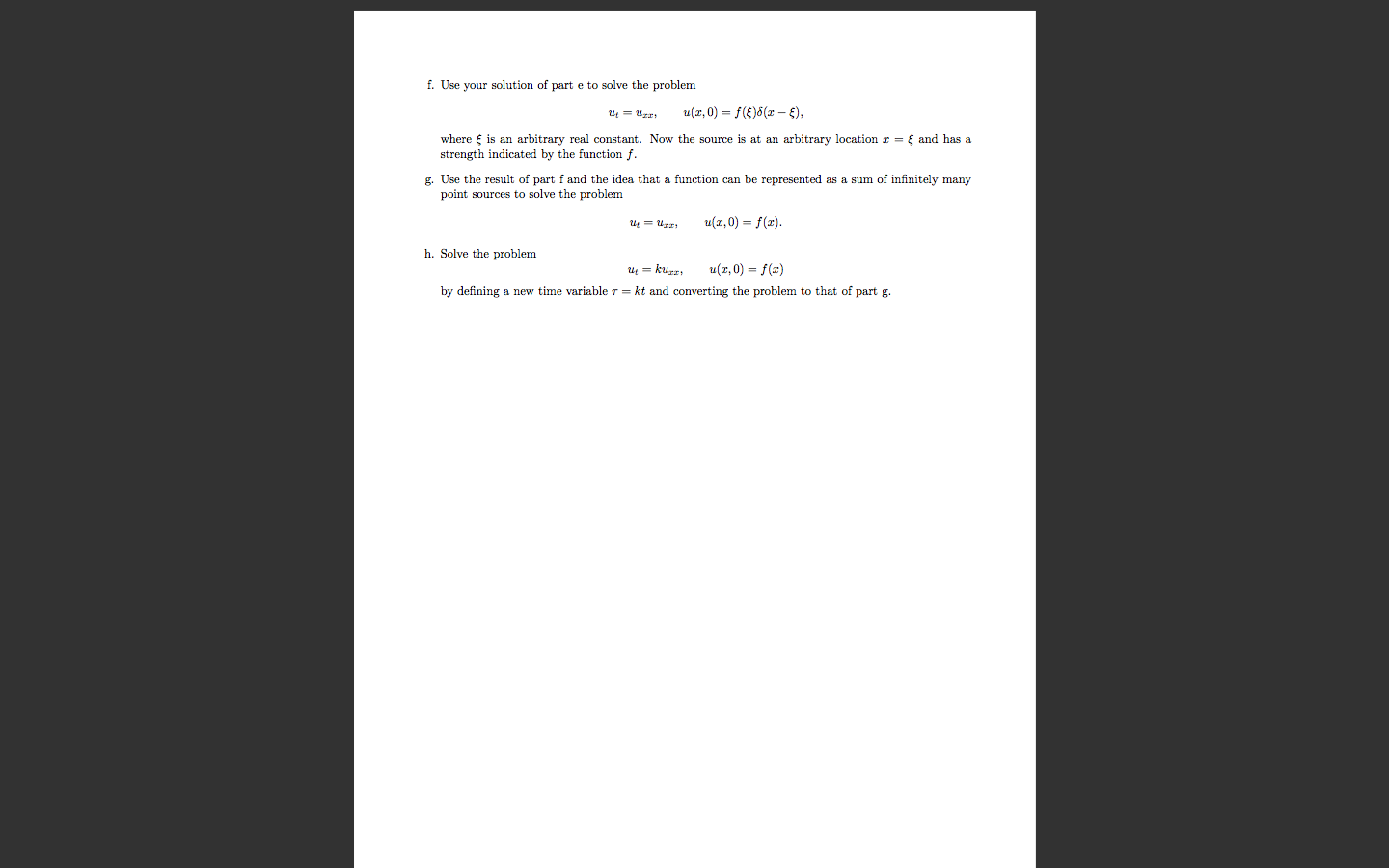
let u(r, t) be an unknown function with Fourier transform u(w, t) and let f(z) be an arbitrary function that is bounded, continuous, and has lim of(r) = 0. Note that we are using the Fourier transform on the spatial coordinate , not the temporal coordinate. a. Use the definition of the Fourier transform to show that the transform of the derivative uzz is -w20 and that of u, is it. b. Take the Fourier transform of the initial value problem u(r, 0) = f(x). Just leave the Fourier transform of f as f. c. Write down the inversion integral for recovering u from u. d. Let o(x) be the unit impulse function (which is not actually a function in the strictest sense). It has two defining features: 6(x) = 0 for z # 0; ['S(z) de = 1, for a, b > 0. These properties together imply the sifting property of the unit impulse function: [o(2- zola(=) d = [o(z-20)9(20) du = 9(20). Use these facts as needed to compute the Fourier transform of 6(r). e. Use the results of parts c and d, along with complex integration, to find the solution of 2(r, 0) = 6(2). This requires a lot of care. The following hints should help: (1) When you get the quantity -two + iwr, rewrite it by completing the square; that is, put it in the form tw tiwe = -1(w - k)2 - n. where you will have to find the correct k and n. (2) Use the substitution z = vt(w -k) in the inversion integral. (3) If you have done the substitution correctly, your new integral in z will be on a horizontal line in the complex plane. This means that the integral is now a contour integral. Let [ be the segment of that horizontal line that runs from r = -p to z = p. Let Lo be the line that follows the real axis from z = -p to z = p. Choose an appropriate way to complete a closed contour and then finish the integration using the residue theorem. You must appropriately handle all boundaries of the closed contour. You may use the integral formula Jet dt = va without proving it. [The proof is a good Calculus 3 problem. Name the quantity ); then write out /2 using a different integration variable for each of the factors. Calculate the resulting double integral and you will get 12 = *.] The solution of this problem represents the response of the function u to a point source of unit strength located at position z = 0 and time t = 0.f. Use your solution of part e to solve the problem u(x, 0) = f(E)6(2 - [), where { is an arbitrary real constant. Now the source is at an arbitrary location r = { and has a strength indicated by the function f. g. Use the result of part f and the idea that a function can be represented as a sum of infinitely many point sources to solve the problem 1 = Wer; u(x, 0) = f(z). h. Solve the problem 1 = kurz: u(x, 0) = f(x) by defining a new time variable 7 = kt and converting the problem to that of part g
Step by Step Solution
There are 3 Steps involved in it

Get step-by-step solutions from verified subject matter experts
 Study Help