



Question: It is all one question, and I am stumped. I tried looking through my chapters and book glossary, but they are not all there! There
It is all one question, and I am stumped. I tried looking through my chapters and book glossary, but they are not all there! There are more definitions than words, so not all definitions will have a word.
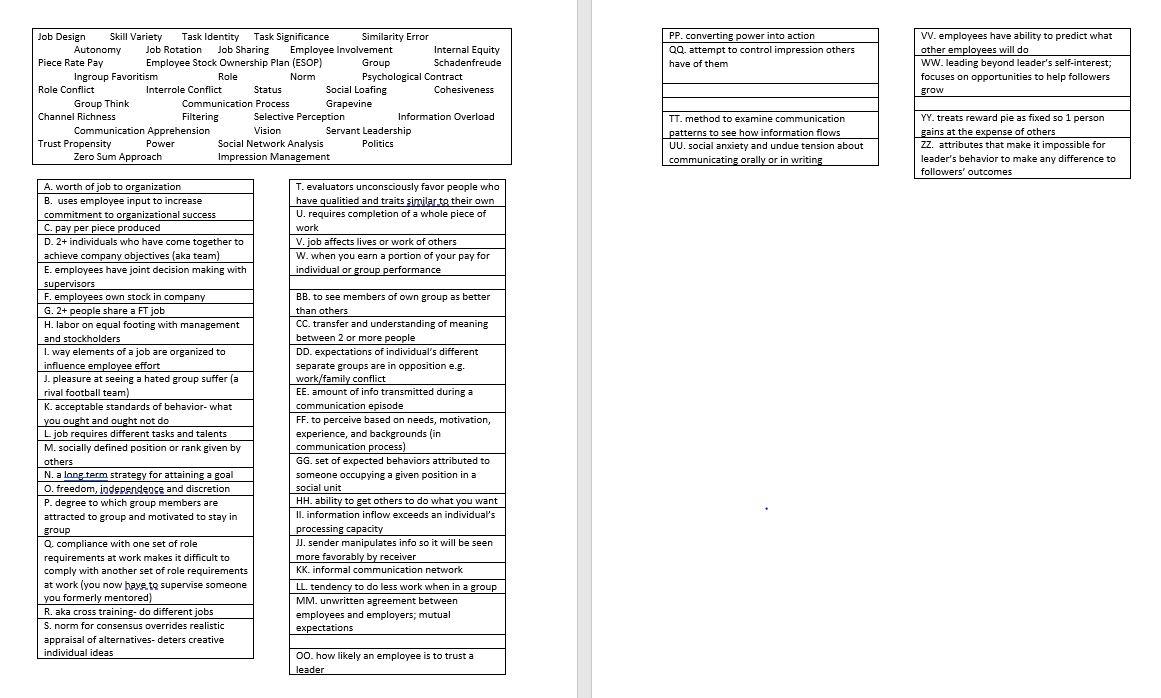
it is matching. i have to match each word with a definition but i am having trouble.
PP. converting power into action QQ. attempt to control impression others have of them W. employees have ability to predict what other employees will do ww.leading beyond leader's self-interest; focuses on opportunities to help followers grow Job Design Skill Variety Task Identity Task Significance Similarity Error Autonomy Job Rotation Job Sharing Employee Involvement Internal Equity Piece Rate Pay Employee Stock Ownership Plan (ESOP) Group Schadenfreude Ingroup Favoritism Role Norm Psychological Contract Role Conflict Interrole Conflict Status Social Loafing Cohesiveness Group Think Communication Process Grapevine Channel Richness Filtering Selective Perception Information Overload Communication Apprehension Vision Servant Leadership Trust Propensity Power Social Network Analysis Politics Zero Sum Approach Impression Management TT. method to examine communication patterns to see how information flows UU. social anxiety and undue tension about communicating orally or in writing YY, treats reward pie as fixed so 1 person gains at the expense of others zz. attributes that make it impossible for leader's behavior to make any difference to followers' outcomes T. evaluators unconsciously favor people who have qualitied and traits similar to their own U. requires completion of a whole piece of work V. job affects lives or work of others W. when you earn a portion of your pay for individual or group performance A. worth of job to organization B. uses employee input to increase commitment to organizational success C. pay per piece produced D. 2+ individuals who have come together to achieve company objectives (aka team) E. employees have joint decision making with supervisors F. employees own stock in company G. 2+ people share a FT job H. labor on equal footing with management and stockholders I. way elements of a job are organized to influence employee effort J. pleasure at seeing a hated group suffer (a rival football team) K. acceptable standards of behavior-what you ought and ought not do L job requires different tasks and talents M. socially defined position or rank given by others N. a long term strategy for attaining a goal O. freedom, iodependeace and discretion P. degree to which group members are attracted to group and motivated to stay in group Q. compliance with one set of role requirements at work makes it difficult to comply with another set of role requirements at work (you now have to supervise someone you formerly mentored) R. aka cross training-do different jobs S. norm for consensus overrides realistic appraisal of alternatives-deters creative individual ideas BB. to see members of own group as better than others CC. transfer and understanding of meaning between 2 or more people DD. expectations of individual's different separate groups are in opposition e.g. work/family conflict EE. amount of info transmitted during a communication episode FF.to perceive based on needs, motivation, experience, and backgrounds (in communication process) GG. set of expected behaviors attributed to someone occupying a given position in a social unit HH. ability to get others to do what you want II. information inflow exceeds an individual's processing capacity JJ. sender manipulates info so it will be seen more favorably by receiver KK. informal communication network LL. tendency to do less work when in a group MM. unwritten agreement between employees and employers, mutual expectations 00. how likely an employee is to trust a leader PP. converting power into action QQ. attempt to control impression others have of them W. employees have ability to predict what other employees will do ww.leading beyond leader's self-interest; focuses on opportunities to help followers grow Job Design Skill Variety Task Identity Task Significance Similarity Error Autonomy Job Rotation Job Sharing Employee Involvement Internal Equity Piece Rate Pay Employee Stock Ownership Plan (ESOP) Group Schadenfreude Ingroup Favoritism Role Norm Psychological Contract Role Conflict Interrole Conflict Status Social Loafing Cohesiveness Group Think Communication Process Grapevine Channel Richness Filtering Selective Perception Information Overload Communication Apprehension Vision Servant Leadership Trust Propensity Power Social Network Analysis Politics Zero Sum Approach Impression Management TT. method to examine communication patterns to see how information flows UU. social anxiety and undue tension about communicating orally or in writing YY, treats reward pie as fixed so 1 person gains at the expense of others zz. attributes that make it impossible for leader's behavior to make any difference to followers' outcomes T. evaluators unconsciously favor people who have qualitied and traits similar to their own U. requires completion of a whole piece of work V. job affects lives or work of others W. when you earn a portion of your pay for individual or group performance A. worth of job to organization B. uses employee input to increase commitment to organizational success C. pay per piece produced D. 2+ individuals who have come together to achieve company objectives (aka team) E. employees have joint decision making with supervisors F. employees own stock in company G. 2+ people share a FT job H. labor on equal footing with management and stockholders I. way elements of a job are organized to influence employee effort J. pleasure at seeing a hated group suffer (a rival football team) K. acceptable standards of behavior-what you ought and ought not do L job requires different tasks and talents M. socially defined position or rank given by others N. a long term strategy for attaining a goal O. freedom, iodependeace and discretion P. degree to which group members are attracted to group and motivated to stay in group Q. compliance with one set of role requirements at work makes it difficult to comply with another set of role requirements at work (you now have to supervise someone you formerly mentored) R. aka cross training-do different jobs S. norm for consensus overrides realistic appraisal of alternatives-deters creative individual ideas BB. to see members of own group as better than others CC. transfer and understanding of meaning between 2 or more people DD. expectations of individual's different separate groups are in opposition e.g. work/family conflict EE. amount of info transmitted during a communication episode FF.to perceive based on needs, motivation, experience, and backgrounds (in communication process) GG. set of expected behaviors attributed to someone occupying a given position in a social unit HH. ability to get others to do what you want II. information inflow exceeds an individual's processing capacity JJ. sender manipulates info so it will be seen more favorably by receiver KK. informal communication network LL. tendency to do less work when in a group MM. unwritten agreement between employees and employers, mutual expectations 00. how likely an employee is to trust a leader
Step by Step Solution
There are 3 Steps involved in it
1 Expert Approved Answer
Step: 1 Unlock

Question Has Been Solved by an Expert!
Get step-by-step solutions from verified subject matter experts
Step: 2 Unlock
Step: 3 Unlock