







Question: It is January 2 , 2 0 2 4 . You have just been hired to be the finance manager at Crocs, Inc., working for
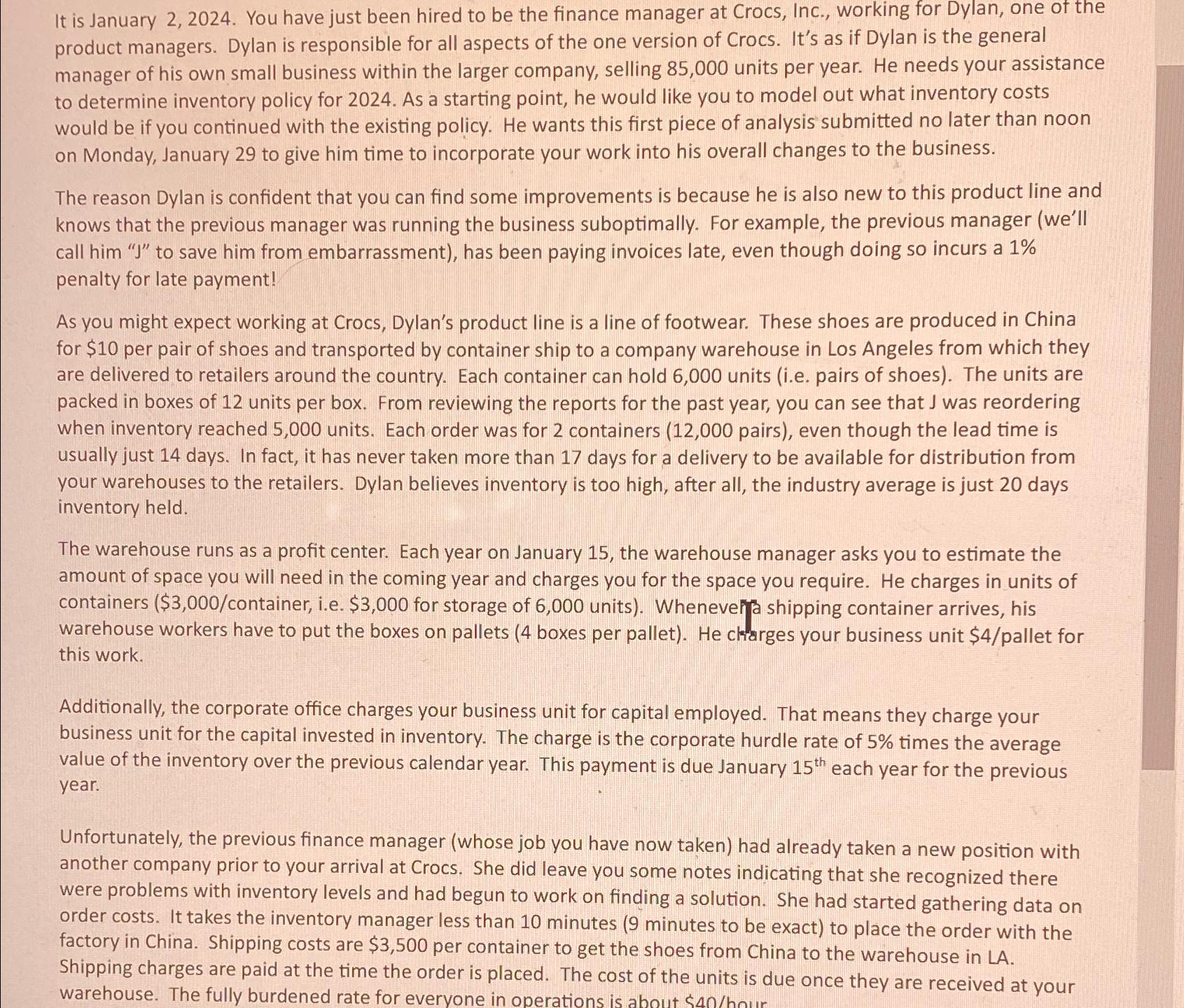
It is January You have just been hired to be the finance manager at Crocs, Inc., working for Dylan, one of the product managers. Dylan is responsible for all aspects of the one version of Crocs. It's as if Dylan is the general manager of his own small business within the larger company, selling units per year. He needs your assistance to determine inventory policy for As a starting point, he would like you to model out what inventory costs would be if you continued with the existing policy. He wants this first piece of analysis submitted no later than noon on Monday, January to give him time to incorporate your work into his overall changes to the business.
The reason Dylan is confident that you can find some improvements is because he is also new to this product line and knows that the previous manager was running the business suboptimally. For example, the previous manager well call him to save him from embarrassment has been paying invoices late, even though doing so incurs a penalty for late payment!
As you might expect working at Crocs, Dylan's product line is a line of footwear. These shoes are produced in China for $ per pair of shoes and transported by container ship to a company warehouse in Los Angeles from which they are delivered to retailers around the country. Each container can hold units ie pairs of shoes The units are packed in boxes of units per box. From reviewing the reports for the past year, you can see that was reordering when inventory reached units. Each order was for containers pairs even though the lead time is usually just days. In fact, it has never taken more than days for a delivery to be available for distribution from your warehouses to the retailers. Dylan believes inventory is too high, after all, the industry average is just days inventory held.
The warehouse runs as a profit center. Each year on January the warehouse manager asks you to estimate the amount of space you will need in the coming year and charges you for the space you require. He charges in units of containers container, ie $ for storage of units Whenever a shipping container arrives, his warehouse workers have to put the boxes on pallets boxes per pallet He charges your business unit $ pallet for this work.
Additionally, the corporate office charges your business unit for capital employed. That means they charge your business unit for the capital invested in inventory. The charge is the corporate hurdle rate of times the average value of the inventory over the previous calendar year. This payment is due January each year for the previous year.
Unfortunately, the previous finance manager whose job you have now taken had already taken a new position with another company prior to your arrival at Crocs. She did leave you some notes indicating that she recognized there were problems with inventory levels and had begun to work on finding a solution. She had started gathering data on order costs. It takes the inventory manager less than minutes minutes to be exact to place the order with the factory in China. Shipping costs are $ per container to get the shoes from China to the warehouse in LA Shipping charges are paid at the time the order is placed. The cost of the units is due once they are received at your warehouse. The fully burdened rate for everyone in operations is about $ to
Step by Step Solution
There are 3 Steps involved in it
1 Expert Approved Answer
Step: 1 Unlock

Question Has Been Solved by an Expert!
Get step-by-step solutions from verified subject matter experts
Step: 2 Unlock
Step: 3 Unlock
 Study Help