







Question: ---- (It is possible to answer questions c-d directly) ID A-B crystal: The crystal is shown schematically below. The elementary cell has period 2d. For
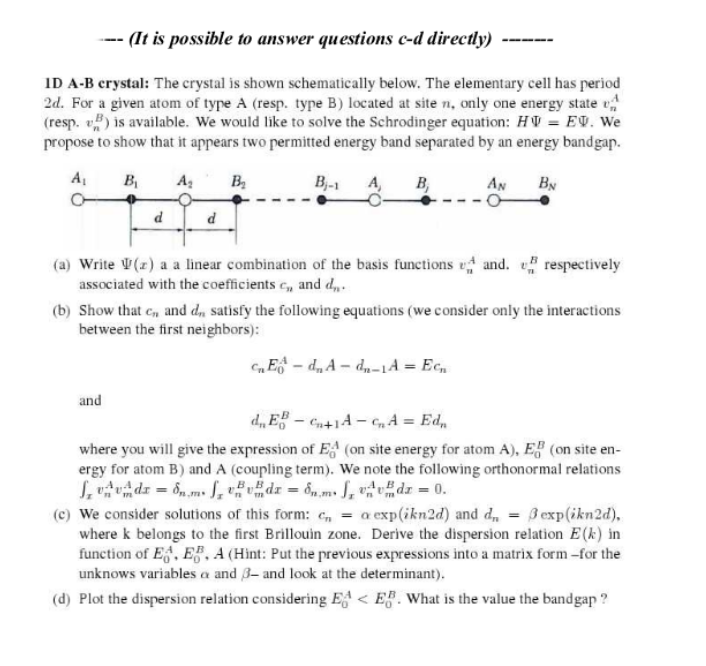
---- (It is possible to answer questions c-d directly) ID A-B crystal: The crystal is shown schematically below. The elementary cell has period 2d. For a given atom of type A (resp. type B) located at site n, only one energy state (resp. ~,) is available. We would like to solve the Schrodinger equation: HV = EV. We propose to show that it appears two permitted energy band separated by an energy bandgap. A B A B . B BN B-1 AN d (a) Write V(x) a a linear combination of the basis functions and respectively associated with the coefficients, and d. (b) Show that cand dr satisfy the following equations (we consider only the interactions between the first neighbors): GEM-d, A-dn-14 = Ec, and d., E - 6+14 - A = Ed. where you will give the expression of EA (on site energy for atom A), E5 (on site en- ergy for atom B) and A (coupling term). We note the following orthonormal relations Td = Omda = 8 m, d = 0. (C) We consider solutions of this form: n = a exp(ikn2d) and d = 3 exp(ikn2d), where k belongs to the first Brillouin zone. Derive the dispersion relation E (k) in function of EA, E , A (Hint: Put the previous expressions into a matrix form--for the unknows variables a and 3- and look at the determinant). (d) Plot the dispersion relation considering E^
Step by Step Solution
There are 3 Steps involved in it

Get step-by-step solutions from verified subject matter experts
 Study Help