







Question: It is possible to estimate the solution to a linear system using an iterative process known as the GaussSeidel iteration method. Consider the linear system
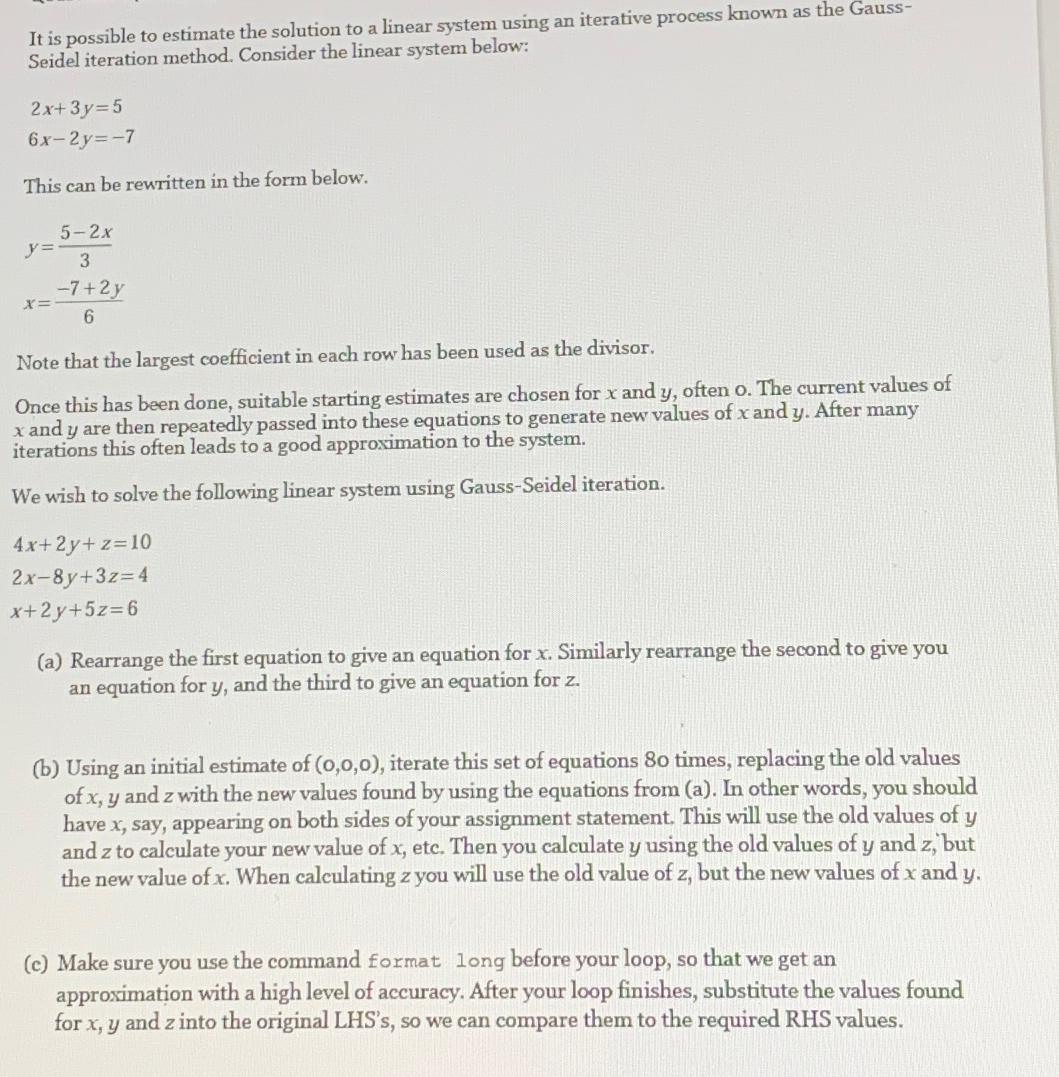
It is possible to estimate the solution to a linear system using an iterative process known as the GaussSeidel iteration method. Consider the linear system below:
This can be rewritten in the form below.
Note that the largest coefficient in each row has been used as the divisor.
Once this has been done, suitable starting estimates are chosen for and often The current values of and are then repeatedly passed into these equations to generate new values of and After many iterations this often leads to a good approximation to the system.
We wish to solve the following linear system using GaussSeidel iteration.
a Rearrange the first equation to give an equation for Similarly rearrange the second to give you an equation for and the third to give an equation for
b Using an initial estimate of iterate this set of equations times, replacing the old values of and with the new values found by using the equations from a In other words, you should have say, appearing on both sides of your assignment statement. This will use the old values of and to calculate your new value of etc. Then you calculate using the old values of and but the new value of When calculating you will use the old value of but the new values of and
c Make sure you use the command format long before your loop, so that we get an approximation with a high level of accuracy. After your loop finishes, substitute the values found for and into the original LHSs so we can compare them to the required RHS values.
How to write a matlab code for it
Step by Step Solution
There are 3 Steps involved in it
1 Expert Approved Answer
Step: 1 Unlock

Question Has Been Solved by an Expert!
Get step-by-step solutions from verified subject matter experts
Step: 2 Unlock
Step: 3 Unlock
 Study Help