







Question: It turns out that we can also identify the type of solution from the reduced row-echelon form of the augmented matrix. Kuttler (the author) goes
"It turns out that we can also identify the type of solution from the reduced row-echelon form of the augmented matrix." Kuttler (the author) goes on to show what the reduced row-echelon form of the augmented matrix will look like when there is (a) no solution, (b) one solution, or (c) infinitely many solutions. Write justifications (informal explanations) for **why** these are true. (Hint! I like to think about it in terms of the system of equations that the reduced row-echelon form of the augmented matrix represents.)
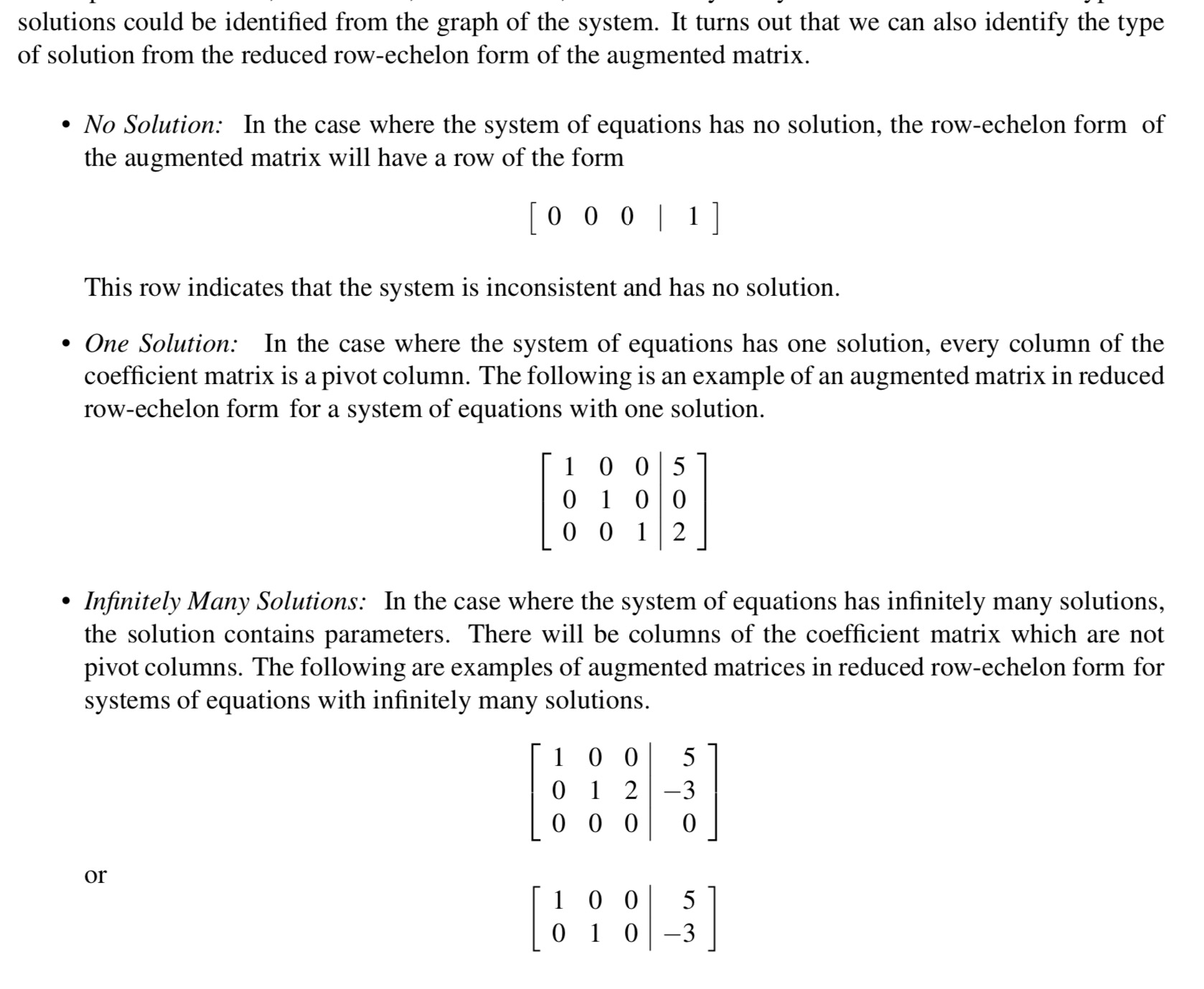
solutions could be identified from the graph of the system. It turns out that we can also identify the type of solution from the reduced row-echelon form of the augmented matrix. . No Solution: In the case where the system of equations has no solution, the row-echelon form of the augmented matrix will have a row of the form [0 0 0 | 1 ] This row indicates that the system is inconsistent and has no solution. . One Solution: In the case where the system of equations has one solution, every column of the coefficient matrix is a pivot column. The following is an example of an augmented matrix in reduced row-echelon form for a system of equations with one solution. 0 0 . Infinitely Many Solutions: In the case where the system of equations has infinitely many solutions, the solution contains parameters. There will be columns of the coefficient matrix which are not pivot columns. The following are examples of augmented matrices in reduced row-echelon form for systems of equations with infinitely many solutions. 0 0 0 1 2 0 0 0 or
Step by Step Solution
There are 3 Steps involved in it

Get step-by-step solutions from verified subject matter experts
 Study Help