







Question: It would be really pleasure to do the bonus question. . Use R or MatLab. The result of this part of the assignment can consist
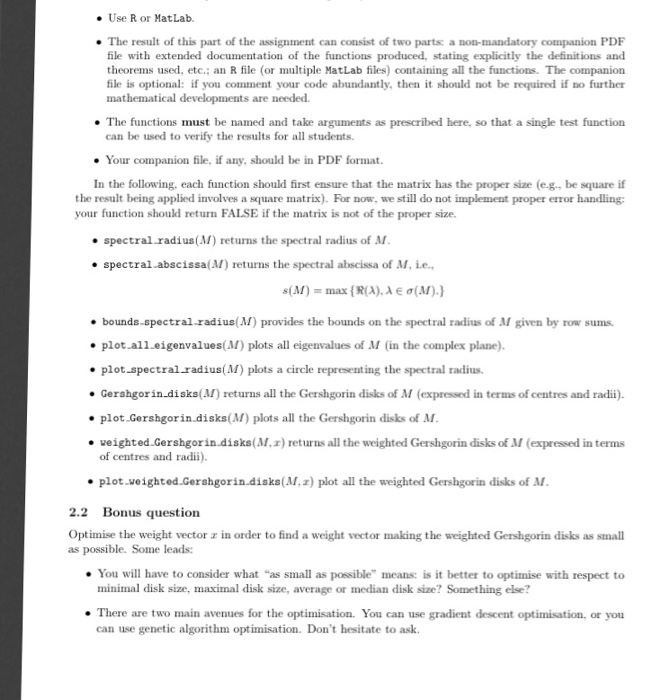
. Use R or MatLab. The result of this part of the assignment can consist of two parts: a non-mandatory companion PDF file with extended documentation of the functions produced, stating explicitly the definitions and theorems used, etc.; an R file (or multiple MatLab files) containing all the functions. The companion file is optional: if you comment your code abundantly, then it should not be required if no further mathematical developments are needed The functions must be named and take arguments as prescribed here, so that a single test function can be used to verify the results for all students. * Your companion file if any, should be in PDF format. In the following, each function should first ensure that the matrix has the proper size (e.g., be square if the result being applied involves a square matrix). For now, we still do not implement proper error handling- your function should return FALSE if the matrix is not of the proper size. spectral radius(M) returns the spectral radius of AM e spectral abscissa(f) returns the spectral abscissa of M, ie bounds-spectral radius(M) provides the bounds on the spectral radius of M given by row sums. plot al1 eigenvalues(M) plots all eigenvalues of M (in the complex plane). plot.spectral radius(M) plots a circle representing the spectral radius. . Gershgorin disks(A)returns all the Gershgorin disks of M (expressed in terms of centres and radii). . plot.Gershgorin.disks(M) plots all the Gershgorin disks of M * weighted.Gershgorin disks(M.) returns all the weighted Gershgorin disks of M (expressed in terms of centres and radii plot.veighted.Gershgorin disks(M,z) plot all the weighted Gershgorin disks of M 2.2 Bonus question Optimise the weight vector z in order to find a weight vector making the weighted Gershgorin disks as small as possible. Some leads: You will have to consider what "as small as possible" means is it better to optimise with respect to minimal disk size, maximal disk size, average or median disk size? Something else . There are two main avenues for the optimisation You can use gradient descent optimisation, or you can use genetic algorithm optimisation. Don't hesitate to ask. . Use R or MatLab. The result of this part of the assignment can consist of two parts: a non-mandatory companion PDF file with extended documentation of the functions produced, stating explicitly the definitions and theorems used, etc.; an R file (or multiple MatLab files) containing all the functions. The companion file is optional: if you comment your code abundantly, then it should not be required if no further mathematical developments are needed The functions must be named and take arguments as prescribed here, so that a single test function can be used to verify the results for all students. * Your companion file if any, should be in PDF format. In the following, each function should first ensure that the matrix has the proper size (e.g., be square if the result being applied involves a square matrix). For now, we still do not implement proper error handling- your function should return FALSE if the matrix is not of the proper size. spectral radius(M) returns the spectral radius of AM e spectral abscissa(f) returns the spectral abscissa of M, ie bounds-spectral radius(M) provides the bounds on the spectral radius of M given by row sums. plot al1 eigenvalues(M) plots all eigenvalues of M (in the complex plane). plot.spectral radius(M) plots a circle representing the spectral radius. . Gershgorin disks(A)returns all the Gershgorin disks of M (expressed in terms of centres and radii). . plot.Gershgorin.disks(M) plots all the Gershgorin disks of M * weighted.Gershgorin disks(M.) returns all the weighted Gershgorin disks of M (expressed in terms of centres and radii plot.veighted.Gershgorin disks(M,z) plot all the weighted Gershgorin disks of M 2.2 Bonus question Optimise the weight vector z in order to find a weight vector making the weighted Gershgorin disks as small as possible. Some leads: You will have to consider what "as small as possible" means is it better to optimise with respect to minimal disk size, maximal disk size, average or median disk size? Something else . There are two main avenues for the optimisation You can use gradient descent optimisation, or you can use genetic algorithm optimisation. Don't hesitate to ask
Step by Step Solution
There are 3 Steps involved in it

Get step-by-step solutions from verified subject matter experts
 Study Help