





Question: Item 2Question 1 This question is a short free-response question. Show your work for each part of the question. ? An astronaut holds a rock

The figure presents a diagram labeled Figure 1 and is composed of a circle, a triangle, which represents an incline, and a horizontal surface. The base of the triangle rests on the horizontal surface, the vertical leg is on the left side of the base and the hypotenuse is labeled Incline. The horizontal surface extends to the right, beyond the end of the triangle. A circle is on the triangle at the top of the incline and is labeled Cylindrical Object. An arrow points down the incline from the right side of the circle and is parallel to the incline.??

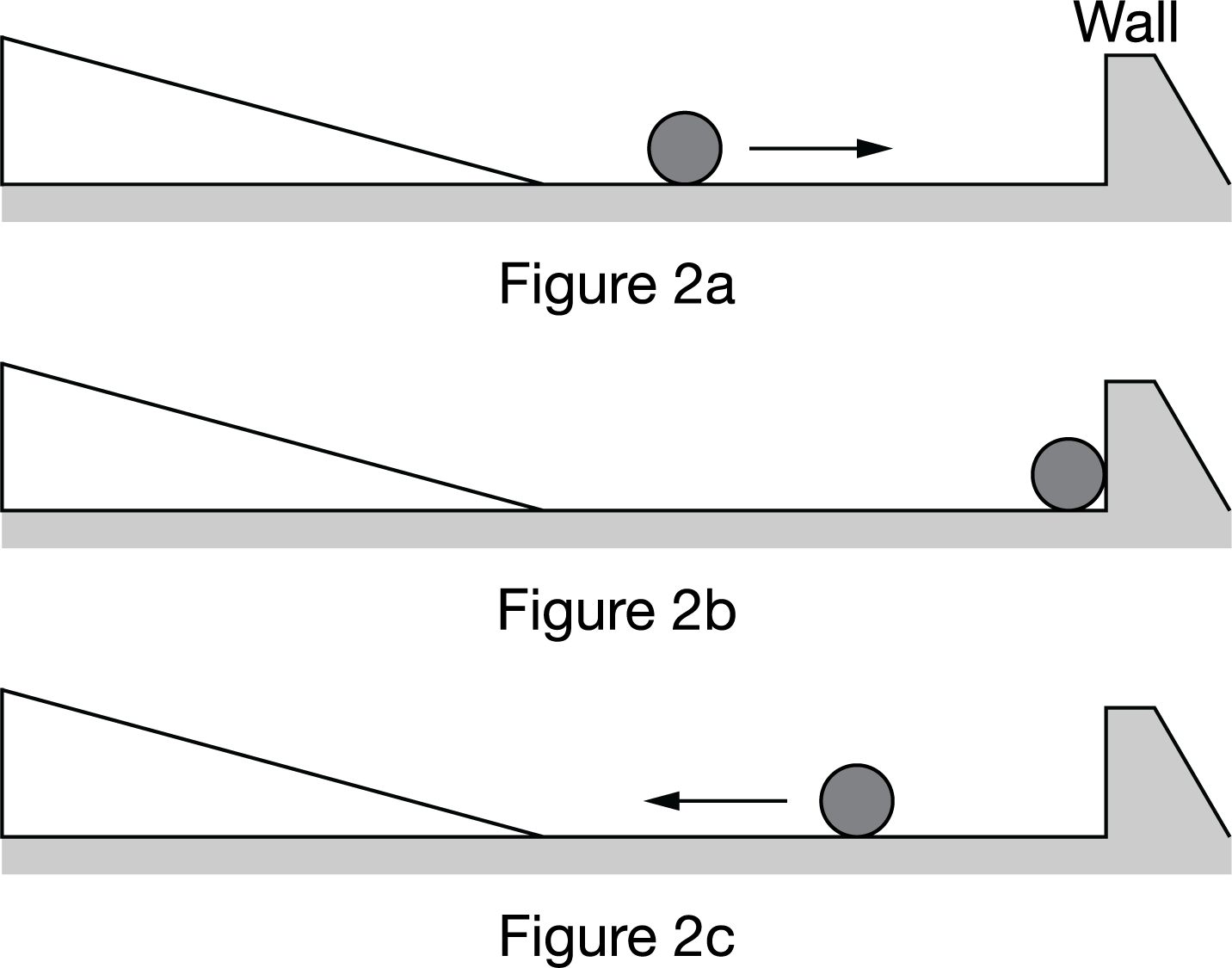
The figure presents 3 diagrams labeled Figure 2 a, Figure 2 b, and Figure 2 c, respectively. Each diagram has a triangle on the left side of a horizontal surface, a circle, and a vertical wall on the right side of the horizontal surface. The base of the triangle rests on the horizontal surface, the vertical leg is on the left side of the base and the hypotenuse is the incline. The horizontal surface extends to the right beyond the end of the incline and ends at the wall. In figure 2 a, the circle is on a horizontal plane just to the right of the end of the incline and a horizontal arrow to the right of the circle, points towards the wall. In figure 2 b, the right side of the circle is touching the wall. In figure 2 c, the circle is between the incline and the wall and a horizontal arrow to the left of the circle, points towards the incline.?

NONE

Item 2Question 1

This question is a short free-response question. Show your work for each part of the question.

?
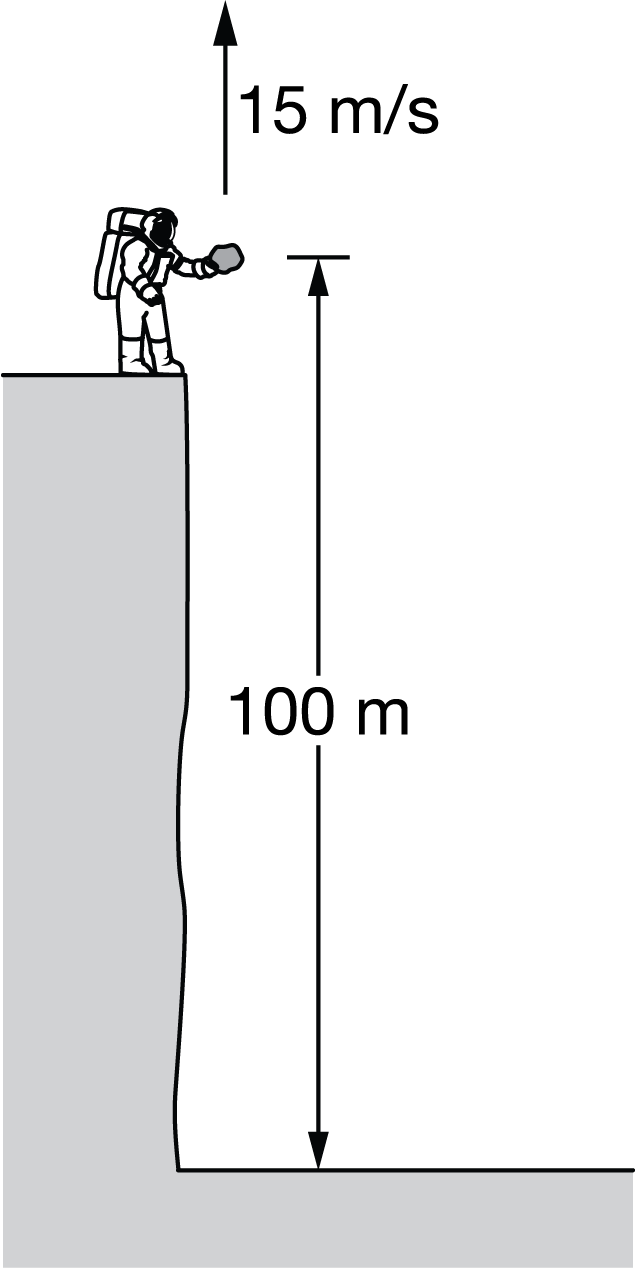
The figure presents aastronaut standing on the edge of a cliff holding a rock over the edge of the cliff. An arrow pointing vertically upward just above the rock is labeled 15 meters per second. The distance between the height of the rock and the horizontal surface at the base of the cliff is labeled 100 meters.

An astronaut holds a rock 100m above the surface of Planet X . The rock is then thrown upward with a speed of 15m/s , as shown in the figure. The rock reaches the ground 10s after it is thrown. The atmosphere of Planet X has a negligible effect on the rock when it is in free fall.

(a)

(i) Determine the acceleration due to gravity of the rock when it is on Planet X .

Question 2

ii. How does the speed of the rock when it reaches the ground vd compare to the speed of the rock when it is thrown upward vu ?

_____ vd>vu _____ vd=vu _____ vd

Question 3

State your reasoning.

Question 4

(b) A student wants to know how the motion of the rock would be different if it was thrown upward at 15m/s from a height of 100m above Earth?s surface. In a clear, coherent, paragraph-length response that may also contain figures and/or equations, explain how the motion of the rock on Earth will be different from its motion on Planet X in terms of its maximum height above the ground, the speed at which it reaches the ground, the time in which it is in free fall, and its acceleration due to gravity.

Cylindrical Object Incline Figure 1 Figure 2a Figure 2b Figure 2c Wall 15 m/s T 100 m

Step by Step Solution

3.49 Rating (149 Votes )

There are 3 Steps involved in it

1 Expert Approved Answer
Step: 1 Unlock

To solve this lets break it down step by step ai Determine the acceleration due to gravity on Planet ... View full answer

blur-text-image
Question Has Been Solved by an Expert!

Get step-by-step solutions from verified subject matter experts

Step: 2 Unlock
Step: 3 Unlock

Students Have Also Explored These Related Physics Questions!