Question: Item 5 In the case below, the original source material is given along with a sample of student work. Determine the type of plagiarism by
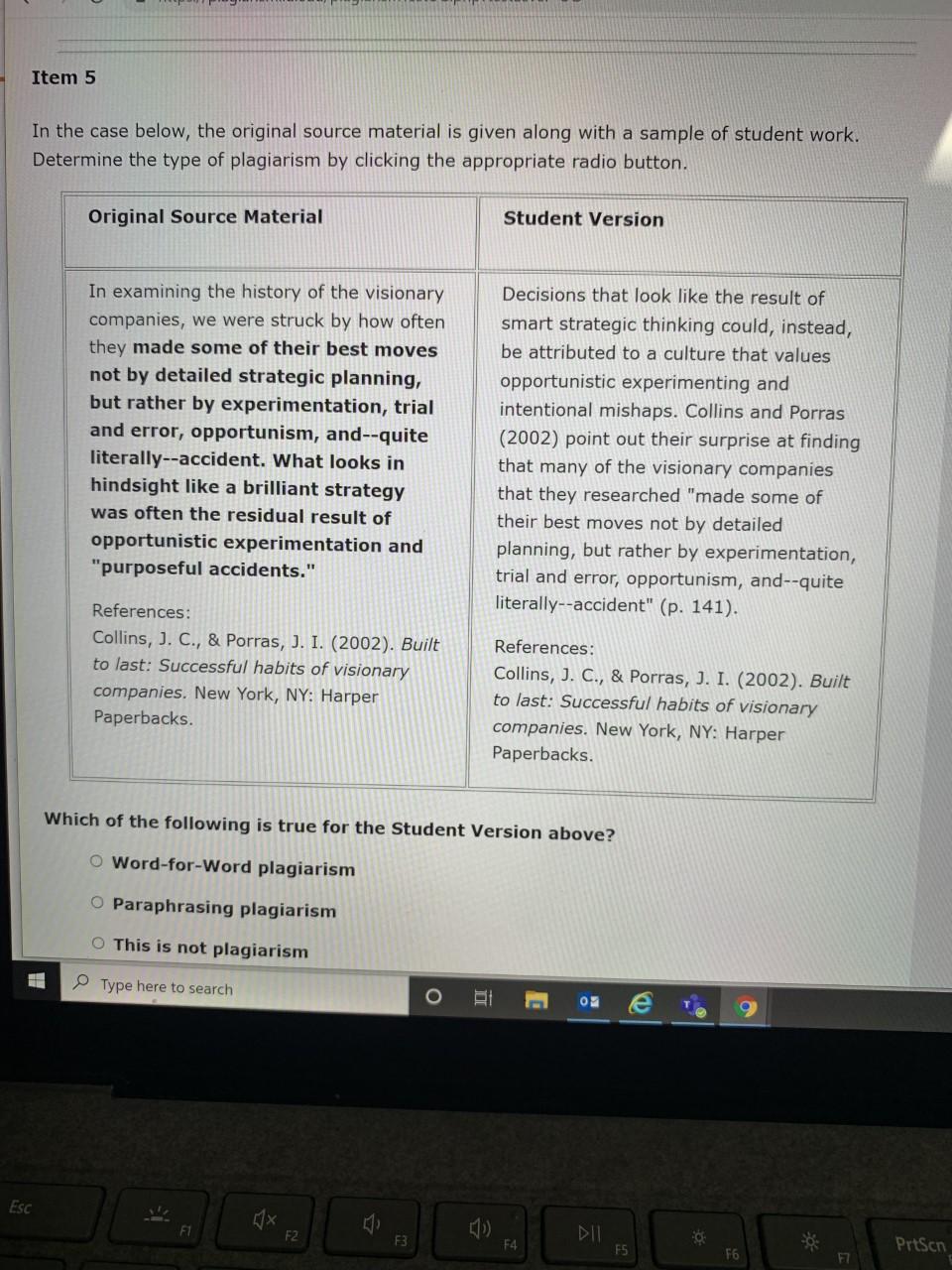
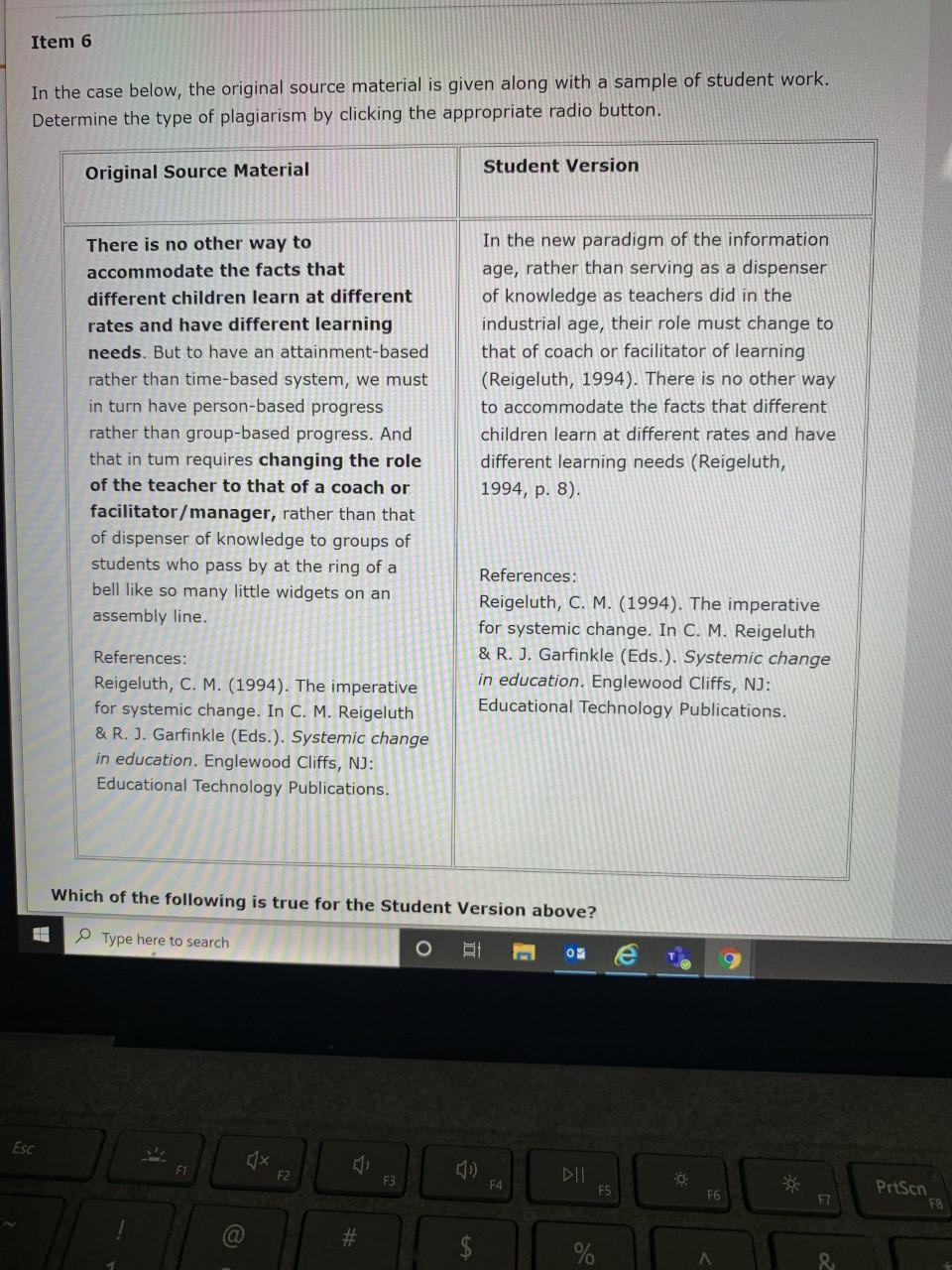
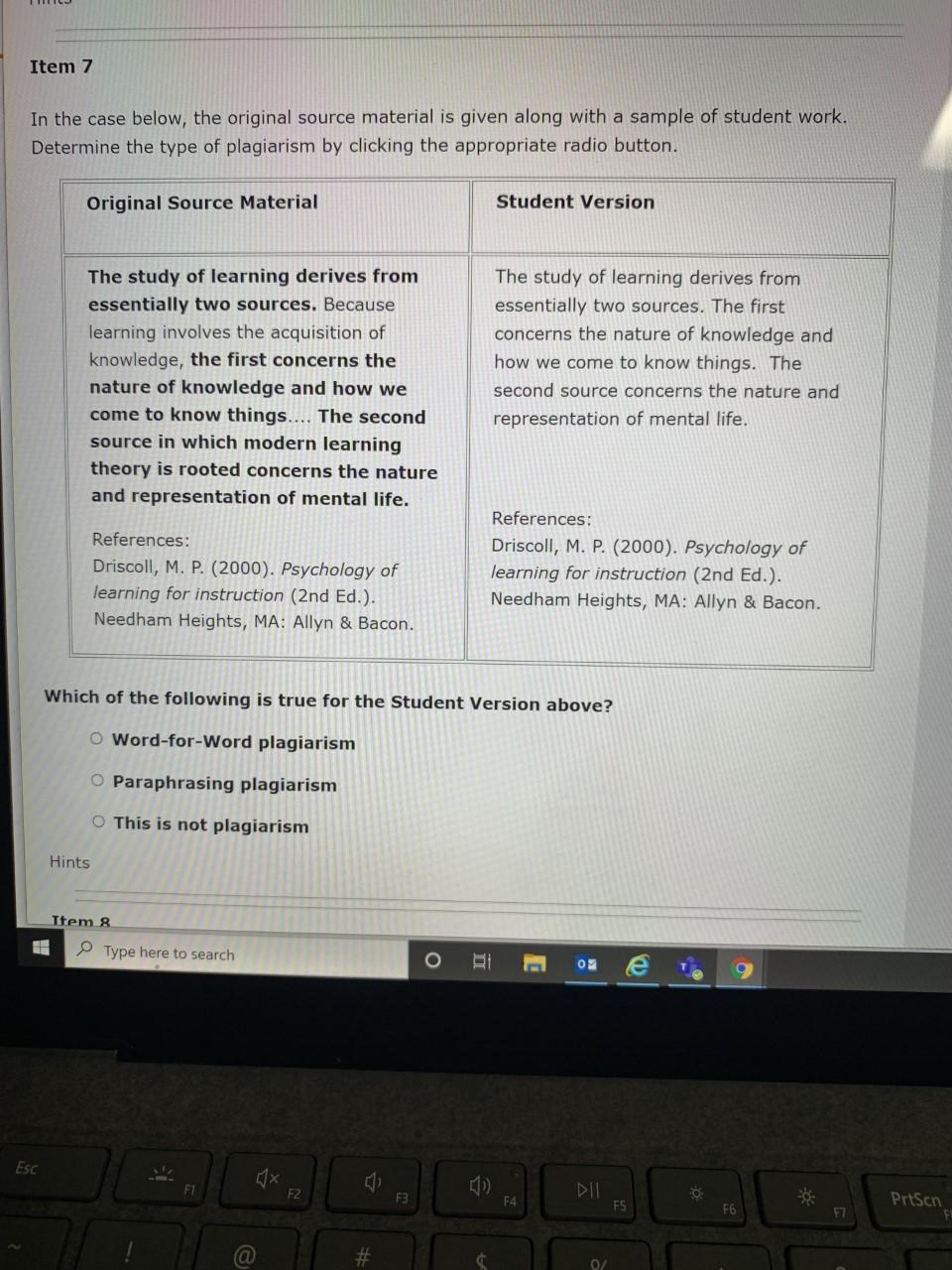
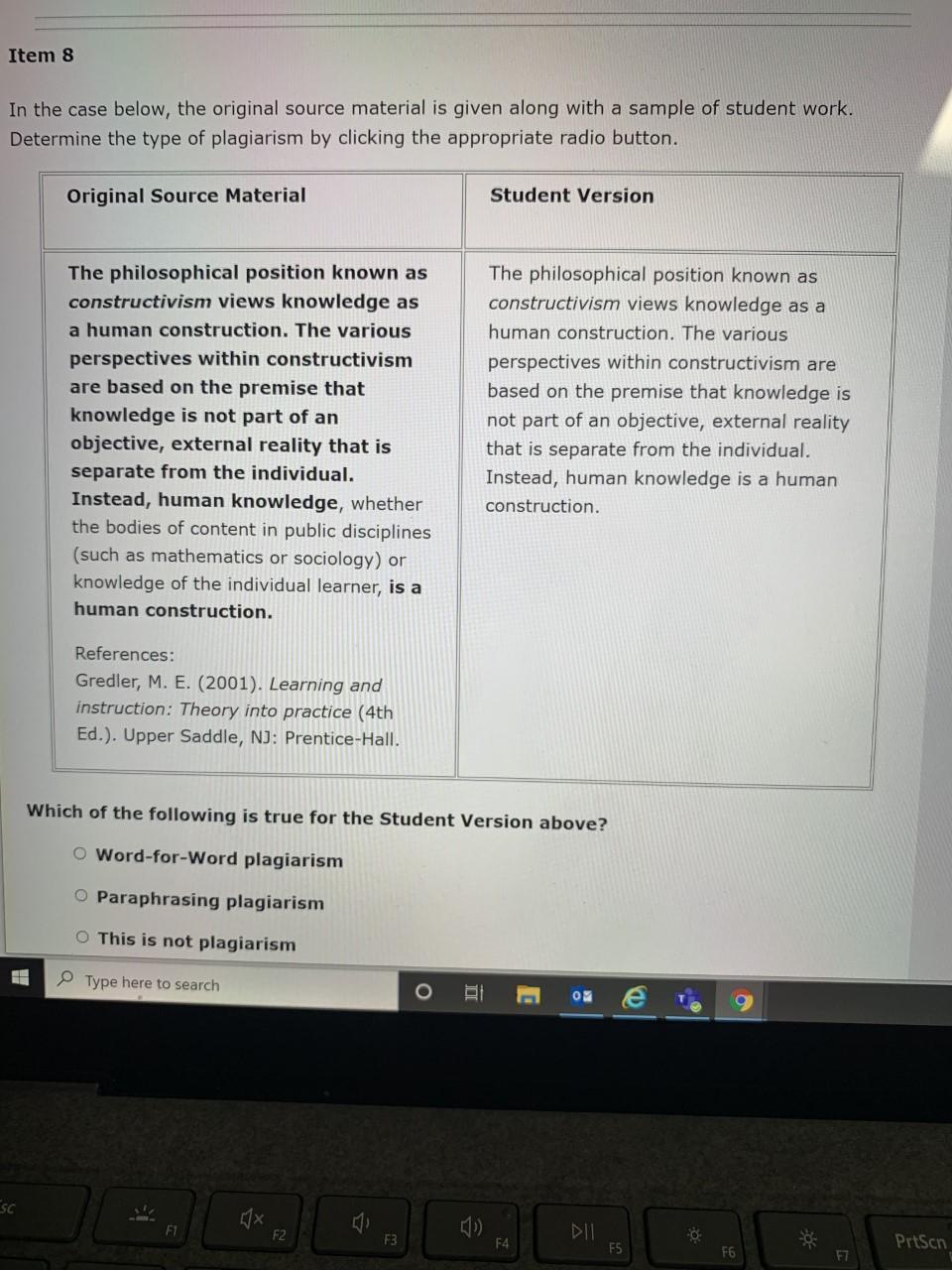
Item 5 In the case below, the original source material is given along with a sample of student work. Determine the type of plagiarism by clicking the appropriate radio button. Original Source Material Student Version In examining the history of the visionary companies, we were struck by how often they made some of their best moves not by detailed strategic planning, but rather by experimentation, trial and error, opportunism, and--quite literally--accident. What looks in hindsight like a brilliant strategy was often the residual result of opportunistic experimentation and "purposeful accidents." Decisions that look like the result of smart strategic thinking could, instead, be attributed to a culture that values opportunistic experimenting and intentional mishaps. Collins and Porras (2002) point out their surprise at finding that many of the visionary companies that they researched "made some of their best moves not by detailed planning, but rather by experimentation, trial and error, opportunism, and--quite literally--accident" (p. 141). References: Collins, J. C., & Porras, J. I. (2002). Built to last: Successful habits of visionary companies. New York, NY: Harper Paperbacks. References: Collins, J. C., & Porras, J. I. (2002). Built to last: Successful habits of visionary companies. New York, NY: Harper Paperbacks. Which of the following is true for the Student Version above? O Word-for-Word plagiarism O Paraphrasing plagiarism O This is not plagiarism Type here to search O . E 07 e a Esc x F1 170) F2 F3 0 F4 F5 Prtsch F6 F Item 6 In the case below, the original source material is given along with a sample of student work. Determine the type of plagiarism by clicking the appropriate radio button. Original Source Material Student Version There is no other way to accommodate the facts that different children learn at different rates and have different learning needs. But to have an attainment-based rather than time-based system, we must in turn have person-based progress rather than group-based progress. And that in tum requires changing the role of the teacher to that of a coach or facilitator/manager, rather than that of dispenser of knowledge to groups of students who pass by at the ring of a bell like so many little widgets on an assembly line. In the new paradigm of the information age, rather than serving as a dispenser of knowledge as teachers did in the industrial age, their role must change to that of coach or facilitator of learning (Reigeluth, 1994). There is no other way to accommodate the facts that different children learn at different rates and have different learning needs (Reigeluth, 1994, p. 8). References: Reigeluth, C. M. (1994). The imperative for systemic change. In C. M. Reigeluth & R. J. Garfinkle (Eds.). Systemic change in education. Englewood Cliffs, NJ: Educational Technology Publications. References: Reigeluth, C. M. (1994). The imperative for systemic change. In C. M. Reigeluth & R. J. Garfinkle (Eds.). Systemic change in education. Englewood Cliffs, NJ: Educational Technology Publications. Which of the following is true for the Student Version above? Type here to search i 07 e Esc ni F1 F2 F3 0 F4 F5 F6 F7 PrtScn 58 a A & Item 7 In the case below, the original source material is given along with a sample of student work. Determine the type of plagiarism by clicking the appropriate radio button. Original Source Material Student Version The study of learning derives from essentially two sources. Because learning involves the acquisition of knowledge, the first concerns the nature of knowledge and how we come to know things.... The second source in which modern learning theory is rooted concerns the nature and representation of mental life. The study of learning derives from essentially two sources. The first concerns the nature of knowledge and how we come to know things. The second source concerns the nature and representation of mental life. References: Driscoll, M. P. (2000). Psychology of learning for instruction (2nd Ed.). Needham Heights, MA: Allyn & Bacon. References: Driscoll, M. P. (2000). Psychology of learning for instruction (2nd Ed.). Needham Heights, MA: Allyn & Bacon. Which of the following is true for the Student Version above? O Word-for-Word plagiarism O Paraphrasing plagiarism This is not plagiarism Hints Ttem 8 H Type here to search 1 e Esc ui F2 F3 0 F4 Pitsch FS F6 FT # Item 8 In the case below, the original source material is given along with a sample of student work. Determine the type of plagiarism by clicking the appropriate radio button. Original Source Material Student Version The philosophical position known as constructivism views knowledge as a human construction. The various perspectives within constructivism are based on the premise that knowledge is not part of an objective, external reality that is separate from the individual. Instead, human knowledge, whether the bodies of content in public disciplines (such as mathematics or sociology) or knowledge of the individual learner, is a human construction. The philosophical position known as constructivism views knowledge as a human construction. The various perspectives within constructivism are based on the premise that knowledge is not part of an objective, external reality that is separate from the individual. Instead, human knowledge is a human construction. References: Gredler, M. E. (2001). Learning and instruction: Theory into practice (4th Ed.). Upper Saddle, NJ: Prentice-Hall. Which of the following is true for the Student Version above? Word-for-Word plagiarism O Paraphrasing plagiarism This is not plagiarism Type here to search E 07 e SC x F1 1) F2 DIL F3 0 F4 F5 Prtsen F6 F7









 Study Help