Question: Item 8 In the case below, the original source material is given along with a sample of student work. Determine the type of plagiarism by
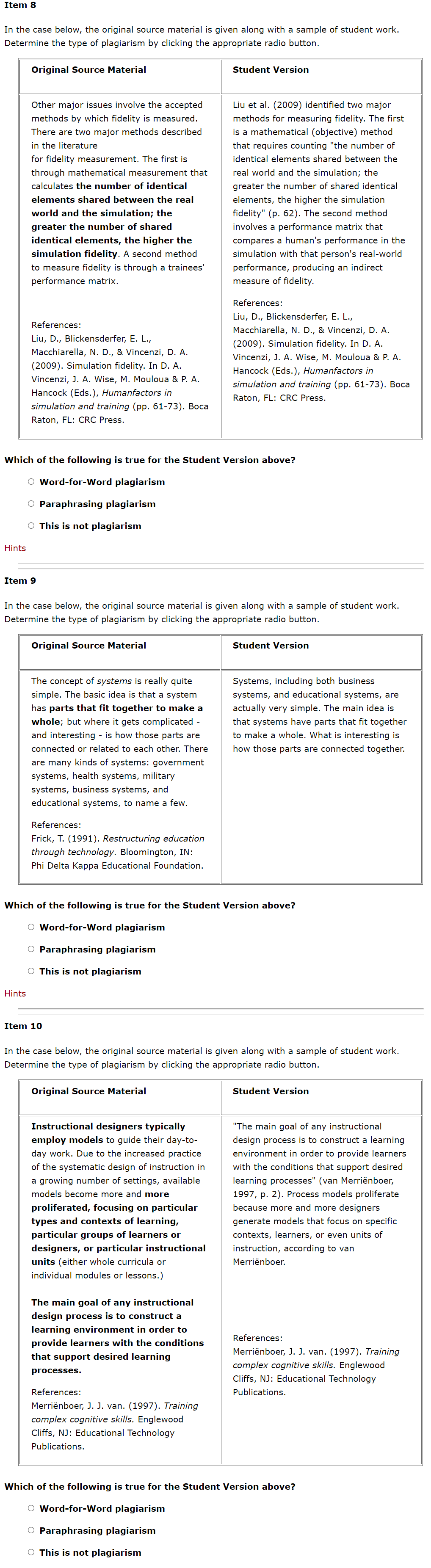
Item 8 In the case below, the original source material is given along with a sample of student work. Determine the type of plagiarism by clicking the appropriate radio button. Original Source Material Student Version Other major issues involve the accepted methods by which fidelity is measured. There are two major methods described in the literature for fidelity measurement. The first is through mathematical measurement that calculates the number of identical elements shared between the real world and the simulation; the greater the number of shared identical elements, the higher the simulation fidelity. A second method to measure fidelity is through a trainees' performance matrix. Liu et al. (2009) identified two major methods for measuring fidelity. The first is a mathematical (objective) method that requires counting "the number of identical elements shared between the real world and the simulation; the greater the number of shared identical elements, the higher the simulation fidelity" (p. 62). The second method involves a performance matrix that compares a human's performance in the simulation with that person's real-world performance, producing an indirect measure of fidelity. References: Liu, D., Blickensderfer, E. L., Macchiarella, N. D., & Vincenzi, D. A. (2009). Simulation fidelity. In D. A. Vincenzi, J. A. Wise, M. Mouloua & P. A. Hancock (Eds.), Humanfactors in simulation and training (pp. 61-73). Boca Raton, FL: CRC Press. References: Liu, D., Blickensderfer, E. L., Macchiarella, N. D., & Vincenzi, D. A. (2009). Simulation fidelity. In D. A. Vincenzi, J. A. Wise, M. Mouloua & P. A. Hancock (Eds.), Humanfactors in simulation and training (pp. 61-73). Boca Raton, FL: CRC Press. Which of the following is true for the Student Version above? O Word-for-Word plagiarism O Paraphrasing plagiarism O This is not plagiarism Hints Item 9 In the case below, the original source material is given along with a sample of student work. Determine the type of plagiarism by clicking the appropriate radio button. Original Source Material Student Version The concept of systems is really quite simple. The basic idea is that a system has parts that fit together to make a whole; but where it gets complicated - and interesting - is how those parts are connected or related to each other. There are many kinds of systems: government systems, health systems, military systems, business systems, and educational systems, to name a few. Systems, including both business systems, and educational systems, are actually very simple. The main idea is that systems have parts that fit together to make a whole. What is interesting is how those parts are connected together. References: Frick, T. (1991). Restructuring education through technology. Bloomington, IN: Phi Delta Kappa Educational Foundation. Which of the following is true for the Student Version above? O Word-for-Word plagiarism Paraphrasing plagiarism O This is not plagiarism Hints Item 10 In the case below, the original source material is given along with a sample of student work. Determine the type of plagiarism by clicking the appropriate radio button. Original Source Material Student Version Instructional designers typically employ models to guide their day-to- day work. Due to the increased practice of the systematic design of instruction in a growing number of settings, available models become more and more proliferated, focusing on particular types and contexts of learning, particular groups of learners or designers, or particular instructional units (either whole curricula or individual modules or lessons.) "The main goal of any instructional design process is to construct a learning environment in order to provide learners with the conditions that support desired learning processes" (van Merrinboer, 1997, p. 2). Process models proliferate because more and more designers generate models that focus on specific contexts, learners, or even units of instruction, according to van Merrinboer. The main goal of any instructional design process is to construct a learning environment in order to provide learners with the conditions that support desired learning processes. References: Merrinboer, J. J. van. (1997). Training complex cognitive skills. Englewood Cliffs, NJ: Educational Technology Publications. References: Merrinboer, J. J. van. (1997). Training complex cognitive skills. Englewood Cliffs, NJ: Educational Technology Publications. Which of the following is true for the Student Version above? O Word-for-Word plagiarism O Paraphrasing plagiarism O This is not plagiarism









 Study Help