Question: its a resource optimaztion for DHS course 3.4-13.* Al Ferris has $60,000 that he wishes to invest now in order to use the accumulation for
its a resource optimaztion for DHS course
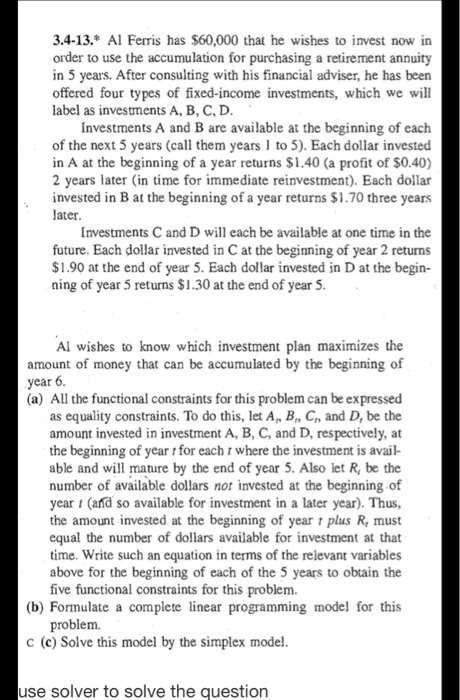
3.4-13.* Al Ferris has $60,000 that he wishes to invest now in order to use the accumulation for purchasing a retirement annuity in 5 years. After consulting with his financial adviser, he has been offered four types of fixed-income investments, which we will label as investments A, B, C, D. Investments A and B are available at the beginning of each of the next 5 years (call them years 1 to 5). Each dollar invested in A at the beginning of a year returns $1.40 (a profit of $0.40) 2 years later in time for immediate reinvestment). Each dollar invested in B at the beginning of a year returns $1.70 three years later. Investments C and D will each be available at one time in the future. Each dollar invested in C at the beginning of year 2 returns $1.90 at the end of year 5. Each dollar invested in D at the begin ning of year 5 returns $1.30 at the end of year 5. Al wishes to know which investment plan maximizes the amount of money that can be accumulated by the beginning of year 6. (a) All the functional constraints for this problem can be expressed as equality constraints. To do this, let A, B, C, and D, be the amount invested in investment A, B, C, and D, respectively, at the beginning of year for each where the investment is avail- able and will mature by the end of year 5. Also let R, be the number of available dollars nor invested at the beginning of year and so available for investment in a later year). Thus, the amount invested at the beginning of year t plus R, must equal the number of dollars available for investment at that time. Write such an equation in terms of the relevant variables above for the beginning of each of the 5 years to obtain the five functional constraints for this problem. (b) Formulate a complete linear programming model for this problem. c (c) Solve this model by the simplex model use solver to solve the question 3.4-13.* Al Ferris has $60,000 that he wishes to invest now in order to use the accumulation for purchasing a retirement annuity in 5 years. After consulting with his financial adviser, he has been offered four types of fixed-income investments, which we will label as investments A, B, C, D. Investments A and B are available at the beginning of each of the next 5 years (call them years 1 to 5). Each dollar invested in A at the beginning of a year returns $1.40 (a profit of $0.40) 2 years later in time for immediate reinvestment). Each dollar invested in B at the beginning of a year returns $1.70 three years later. Investments C and D will each be available at one time in the future. Each dollar invested in C at the beginning of year 2 returns $1.90 at the end of year 5. Each dollar invested in D at the begin ning of year 5 returns $1.30 at the end of year 5. Al wishes to know which investment plan maximizes the amount of money that can be accumulated by the beginning of year 6. (a) All the functional constraints for this problem can be expressed as equality constraints. To do this, let A, B, C, and D, be the amount invested in investment A, B, C, and D, respectively, at the beginning of year for each where the investment is avail- able and will mature by the end of year 5. Also let R, be the number of available dollars nor invested at the beginning of year and so available for investment in a later year). Thus, the amount invested at the beginning of year t plus R, must equal the number of dollars available for investment at that time. Write such an equation in terms of the relevant variables above for the beginning of each of the 5 years to obtain the five functional constraints for this problem. (b) Formulate a complete linear programming model for this problem. c (c) Solve this model by the simplex model use solver to solve the




