







Question: it's a transport phenomena problem. The rotating disk viscometer is a precise device for measuring the viscosity of fluids. In this type of viscometer, the
it's a transport phenomena problem.
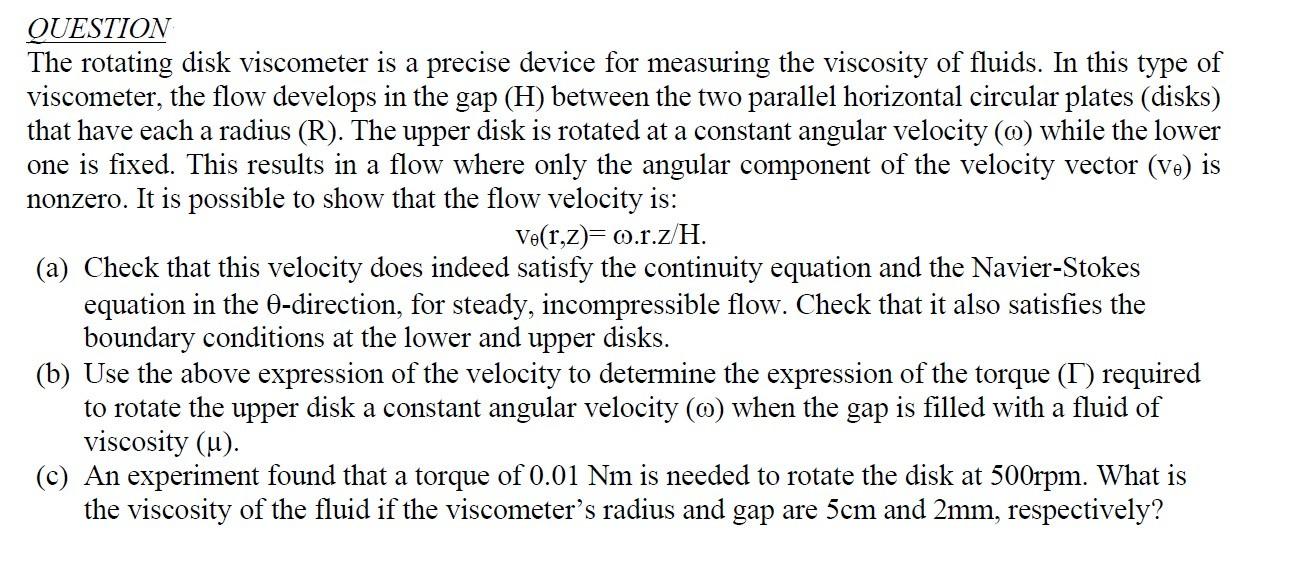
The rotating disk viscometer is a precise device for measuring the viscosity of fluids. In this type of viscometer, the flow develops in the gap (H) between the two parallel horizontal circular plates (disks) that have each a radius (R). The upper disk is rotated at a constant angular velocity () while the lower one is fixed. This results in a flow where only the angular component of the velocity vector (v) is nonzero. It is possible to show that the flow velocity is: v(r,z)=rz/H. (a) Check that this velocity does indeed satisfy the continuity equation and the Navier-Stokes equation in the -direction, for steady, incompressible flow. Check that it also satisfies the boundary conditions at the lower and upper disks. (b) Use the above expression of the velocity to determine the expression of the torque () required to rotate the upper disk a constant angular velocity () when the gap is filled with a fluid of viscosity (). (c) An experiment found that a torque of 0.01Nm is needed to rotate the disk at 500rpm. What is the viscosity of the fluid if the viscometer's radius and gap are 5cm and 2mm, respectively
Step by Step Solution
There are 3 Steps involved in it

Get step-by-step solutions from verified subject matter experts
 Study Help