







Question: it's about forecasting problem. this is article, and the question is ignoring @words condition, can you give me some guideline to solve those two problem??
it's about forecasting problem.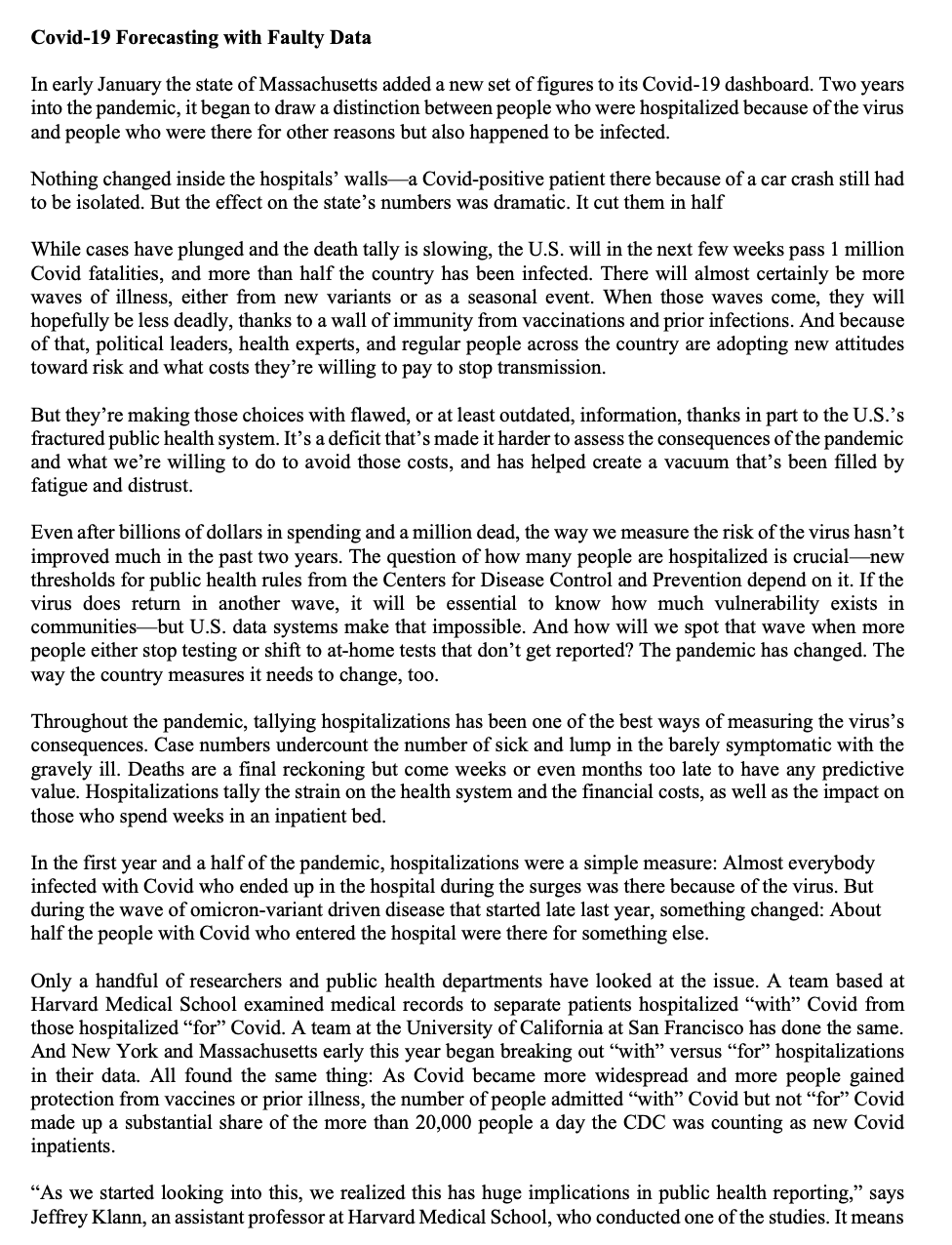
this is article, and the question is
ignoring @words condition,
can you give me some guideline to solve those two problem?? i really can't understand what the article means like different between "for"covid and "with" covid, so what is correct way to make data smt like that.
i would be really happy if you help me. thank you for reading.
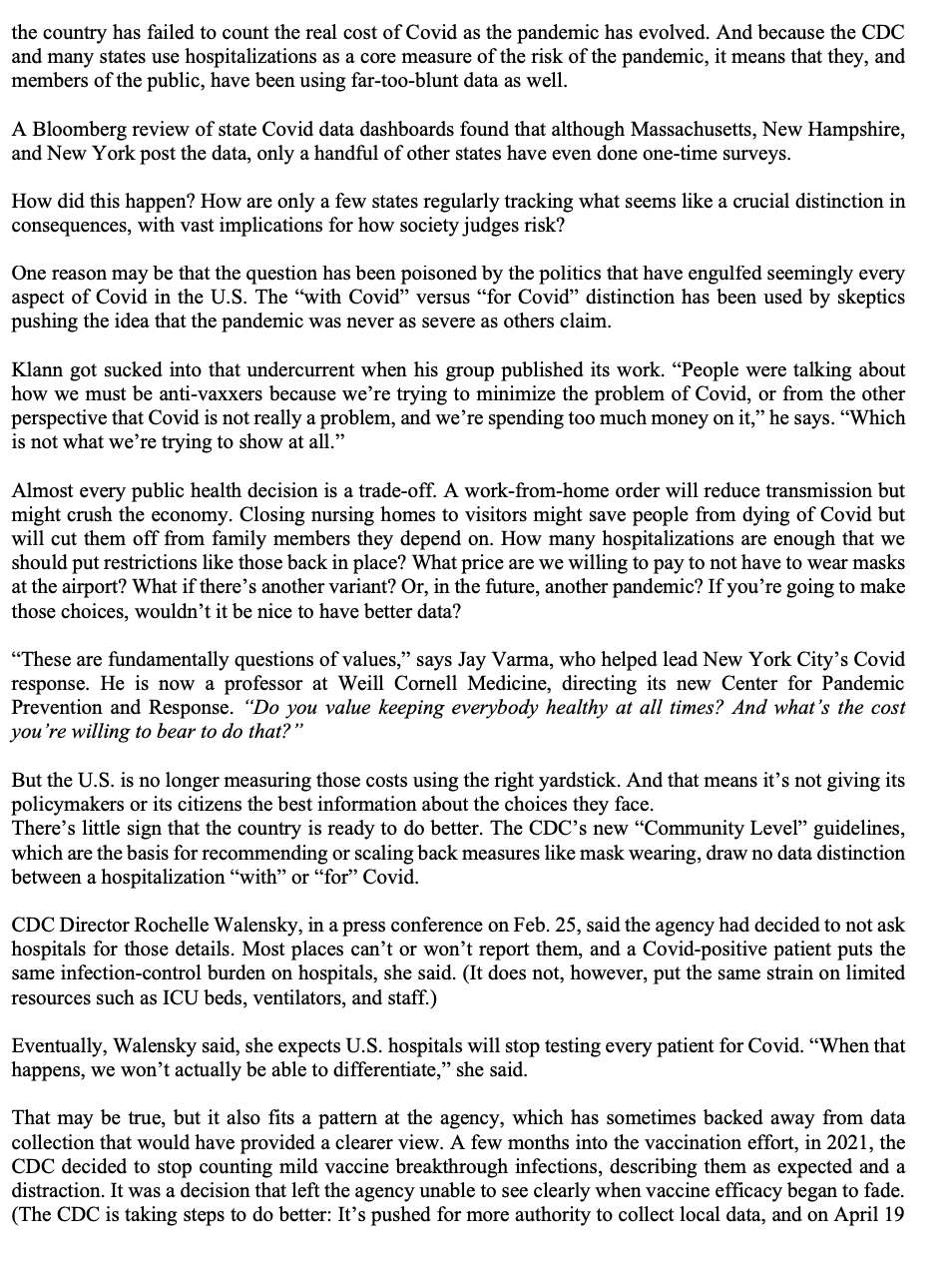
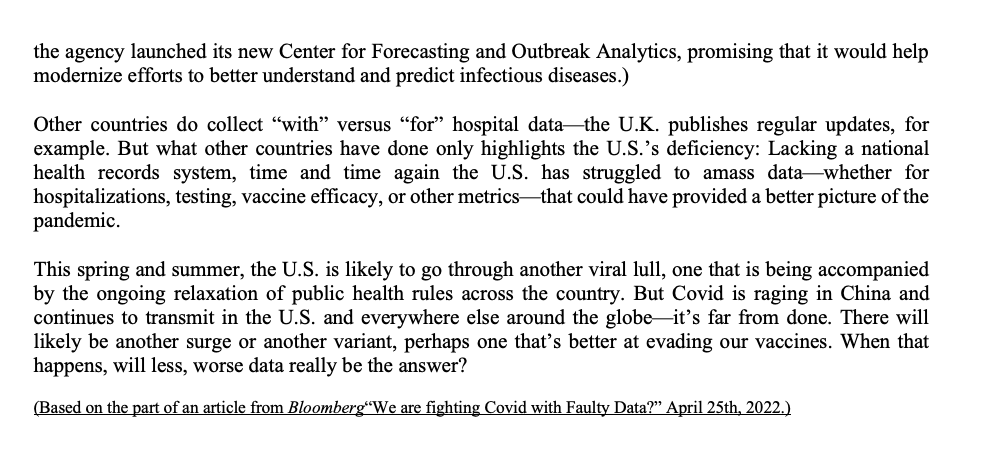
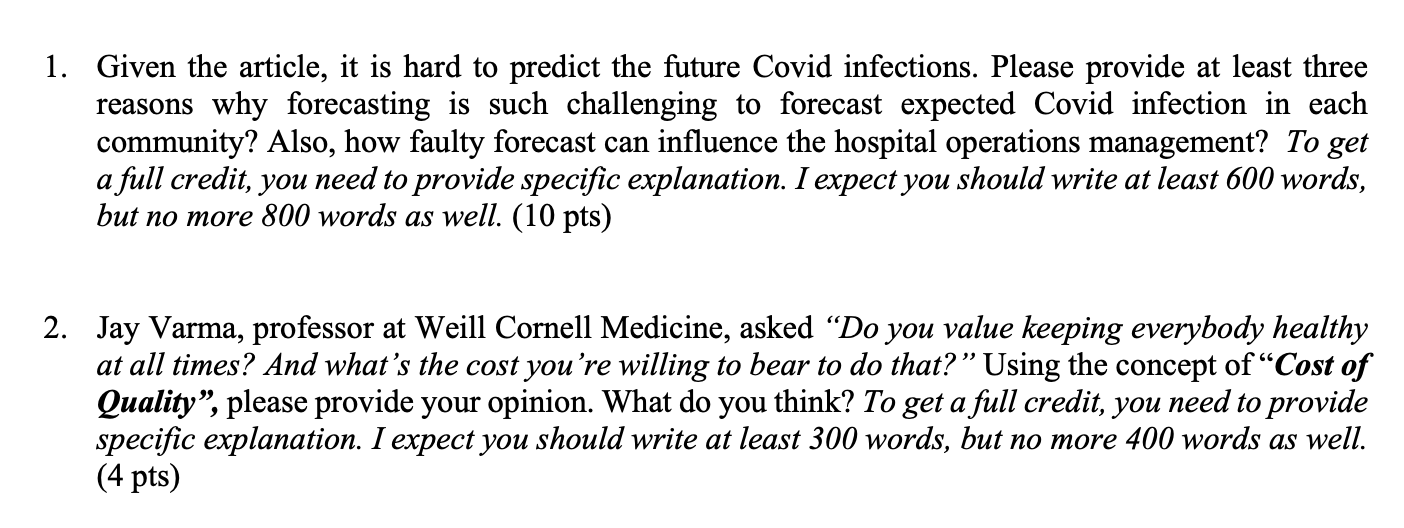
Covid-19 Forecasting with Faulty Data In early January the state of Massachusetts added a new set of figures to its Covid-19 dashboard. Two years into the pandemic, it began to draw a distinction between people who were hospitalized because of the virus and people who were there for other reasons but also happened to be infected. Nothing changed inside the hospitals' wallsa Covid-positive patient there because of a car crash still had to be isolated. But the effect on the state's numbers was dramatic. It cut them in half While cases have plunged and the death tally is slowing, the U.S. will in the next few weeks pass 1 million Covid fatalities, and more than half the country has been infected. There will almost certainly be more waves of illness, either from new variants or as a seasonal event. When those waves come, they will hopefully be less deadly, thanks to a wall of immunity from vaccinations and prior infections. And because of that, political leaders, health experts, and regular people across the country are adopting new attitudes toward risk and what costs they're willing to pay to stop transmission. But they're making those choices with flawed, or at least outdated, information, thanks in part to the U.S.'s fractured public health system. It's a deficit thats made it harder to assess the consequences of the pandemic and what we're willing to do to avoid those costs, and has helped create a vacuum that's been filled by fatigue and distrust. Even after billions of dollars in spending and a million dead, the way we measure the risk of the virus hasn't improved much in the past two years. The question of how many people are hospitalized is crucial-new thresholds for public health rules from the Centers for Disease Control and Prevention depend on it. If the virus does return in another wave, it will be essential to know how much vulnerability exists in communitiesbut U.S. data systems make that impossible. And how will we spot that wave when more people either stop testing or shift to at-home tests that don't get reported? The pandemic has changed. The way the country measures it needs to change, too. Throughout the pandemic, tallying hospitalizations has been one of the best ways of measuring the virus's consequences. Case numbers undercount the number of sick and lump in the barely symptomatic with the gravely ill. Deaths are a final reckoning but come weeks or even months too late to have any predictive value. Hospitalizations tally the strain on the health system and the financial costs, as well as the impact on those who spend weeks in an inpatient bed. In the first year and a half of the pandemic, hospitalizations were a simple measure: Almost everybody infected with Covid who ended up in the hospital during the surges was there because of the virus. But during the wave of omicron-variant driven disease that started late last year, something changed: About half the people with Covid who entered the hospital were there for something else. Only a handful of researchers and public health departments have looked at the issue. A team based at Harvard Medical School examined medical records to separate patients hospitalized "with Covid from those hospitalized for Covid. A team at the University of California at San Francisco has done the same. And New York and Massachusetts early this year began breaking out with versus for hospitalizations in their data. All found the same thing: As Covid became more widespread and more people gained protection from vaccines or prior illness, the number of people admitted with Covid but not for Covid made up a substantial share of the more than 20,000 people a day the CDC was counting as new Covid inpatients. " As we started looking into this, we realized this has huge implications in public health reporting, says Jeffrey Klann, an assistant professor at Harvard Medical School, who conducted one of the studies. It means the country has failed to count the real cost of Covid as the pandemic has evolved. And because the CDC and many states use hospitalizations as a core measure of the risk of the pandemic, it means that they, and members of the public, have been using far-too-blunt data as well. A Bloomberg review of state Covid data dashboards found that although Massachusetts, New Hampshire, and New York post the data, only a handful of other states have even done one-time surveys. How did this happen? How are only a few states regularly tracking what seems like a crucial distinction in consequences, with vast implications for how society judges risk? One reason may be that the question has been poisoned by the politics that have engulfed seemingly every aspect of Covid in the U.S. The with Covid versus "for Covid distinction has been used by skeptics pushing the idea that the pandemic was never as severe as others claim. Klann got sucked into that undercurrent when his group published its work. People were talking about how we must be anti-vaxxers because we're trying to minimize the problem of Covid, or from the other perspective that Covid is not really a problem, and we're spending too much money on it, he says. "Which is not what we're trying to show at all. Almost every public health decision is a trade-off. A work-from-home order will reduce transmission but might crush the economy. Closing nursing homes to visitors might save people from dying of Covid but will cut them off from family members they depend on. How many hospitalizations are enough that we should put restrictions like those back in place? What price are we willing to pay to not have to wear masks at the airport? What if there's another variant? Or, in the future, another pandemic? If you're going to make those choices, wouldn't it be nice to have better data? These are fundamentally questions of values, says Jay Varma, who helped lead New York City's Covid response. He is now a professor at Weill Cornell Medicine, directing its new Center for Pandemic Prevention and Response. Do you value keeping everybody healthy at all times? And what's the cost you're willing to bear to do that? But the U.S. is no longer measuring those costs using the right yardstick. And that means it's not giving its policymakers or its citizens the best information about the choices they face. There's little sign that the country is ready to do better. The CDC's new Community Level guidelines, which are the basis for recommending or scaling back measures like mask wearing, draw no data distinction between a hospitalization with or for Covid. CDC Director Rochelle Walensky, in a press conference on Feb. 25, said the agency had decided to not ask hospitals for those details. Most places can't or won't report them, and a Covid-positive patient puts the same infection-control burden on hospitals, she said. (It does not, however, put the same strain on limited resources such as ICU beds, ventilators, and staff.) Eventually, Walensky said, she expects U.S. hospitals will stop testing every patient for Covid. When that happens, we won't actually be able to differentiate, she said. That may be true, but it also fits a pattern at the agency, which has sometimes backed away from data collection that would have provided a clearer view. A few months into the vaccination effort, in 2021, the CDC decided to stop counting mild vaccine breakthrough infections, describing them as expected and a distraction. It was a decision that left the agency unable to see clearly when vaccine efficacy began to fade. (The CDC is taking steps to do better: It's pushed for more authority to collect local data, and on April 19 the agency launched its new Center for Forecasting and Outbreak Analytics, promising that it would help modernize efforts to better understand and predict infectious diseases.) Other countries do collect "with versus for hospital data-the U.K. publishes regular updates, for example. But what other countries have done only highlights the U.S.'s deficiency: Lacking a national health records system, time and time again the U.S. has struggled to amass datawhether for hospitalizations, testing, vaccine efficacy, or other metricsthat could have provided a better picture of the pandemic. This spring and summer, the U.S. is likely to go through another viral lull, one that is being accompanied by the ongoing relaxation of public health rules across the country. But Covid is raging in China and continues to transmit in the U.S. and everywhere else around the globeit's far from done. There will likely be another surge or another variant, perhaps one that's better at evading our vaccines. When that happens, will less, worse data really be the answer? (Based on the part of an article from BloombergWe are fighting Covid with Faulty Data?" April 25th, 2022.) 1. Given the article, it is hard to predict the future Covid infections. Please provide at least three reasons why forecasting is such challenging to forecast expected Covid infection in each community? Also, how faulty forecast can influence the hospital operations management? To get a full credit, you need to provide specific explanation. I expect you should write at least 600 words, but no more 800 words as well. (10 pts) 2. Jay Varma, professor at Weill Cornell Medicine, asked Do you value keeping everybody healthy at all times? And what's the cost you're willing to bear to do that? Using the concept of Cost of Quality', please provide your opinion. What do you think? To get a full credit, you need to provide specific explanation. I expect you should write at least 300 words, but no more 400 words as well. (4 pts) Covid-19 Forecasting with Faulty Data In early January the state of Massachusetts added a new set of figures to its Covid-19 dashboard. Two years into the pandemic, it began to draw a distinction between people who were hospitalized because of the virus and people who were there for other reasons but also happened to be infected. Nothing changed inside the hospitals' wallsa Covid-positive patient there because of a car crash still had to be isolated. But the effect on the state's numbers was dramatic. It cut them in half While cases have plunged and the death tally is slowing, the U.S. will in the next few weeks pass 1 million Covid fatalities, and more than half the country has been infected. There will almost certainly be more waves of illness, either from new variants or as a seasonal event. When those waves come, they will hopefully be less deadly, thanks to a wall of immunity from vaccinations and prior infections. And because of that, political leaders, health experts, and regular people across the country are adopting new attitudes toward risk and what costs they're willing to pay to stop transmission. But they're making those choices with flawed, or at least outdated, information, thanks in part to the U.S.'s fractured public health system. It's a deficit thats made it harder to assess the consequences of the pandemic and what we're willing to do to avoid those costs, and has helped create a vacuum that's been filled by fatigue and distrust. Even after billions of dollars in spending and a million dead, the way we measure the risk of the virus hasn't improved much in the past two years. The question of how many people are hospitalized is crucial-new thresholds for public health rules from the Centers for Disease Control and Prevention depend on it. If the virus does return in another wave, it will be essential to know how much vulnerability exists in communitiesbut U.S. data systems make that impossible. And how will we spot that wave when more people either stop testing or shift to at-home tests that don't get reported? The pandemic has changed. The way the country measures it needs to change, too. Throughout the pandemic, tallying hospitalizations has been one of the best ways of measuring the virus's consequences. Case numbers undercount the number of sick and lump in the barely symptomatic with the gravely ill. Deaths are a final reckoning but come weeks or even months too late to have any predictive value. Hospitalizations tally the strain on the health system and the financial costs, as well as the impact on those who spend weeks in an inpatient bed. In the first year and a half of the pandemic, hospitalizations were a simple measure: Almost everybody infected with Covid who ended up in the hospital during the surges was there because of the virus. But during the wave of omicron-variant driven disease that started late last year, something changed: About half the people with Covid who entered the hospital were there for something else. Only a handful of researchers and public health departments have looked at the issue. A team based at Harvard Medical School examined medical records to separate patients hospitalized "with Covid from those hospitalized for Covid. A team at the University of California at San Francisco has done the same. And New York and Massachusetts early this year began breaking out with versus for hospitalizations in their data. All found the same thing: As Covid became more widespread and more people gained protection from vaccines or prior illness, the number of people admitted with Covid but not for Covid made up a substantial share of the more than 20,000 people a day the CDC was counting as new Covid inpatients. " As we started looking into this, we realized this has huge implications in public health reporting, says Jeffrey Klann, an assistant professor at Harvard Medical School, who conducted one of the studies. It means the country has failed to count the real cost of Covid as the pandemic has evolved. And because the CDC and many states use hospitalizations as a core measure of the risk of the pandemic, it means that they, and members of the public, have been using far-too-blunt data as well. A Bloomberg review of state Covid data dashboards found that although Massachusetts, New Hampshire, and New York post the data, only a handful of other states have even done one-time surveys. How did this happen? How are only a few states regularly tracking what seems like a crucial distinction in consequences, with vast implications for how society judges risk? One reason may be that the question has been poisoned by the politics that have engulfed seemingly every aspect of Covid in the U.S. The with Covid versus "for Covid distinction has been used by skeptics pushing the idea that the pandemic was never as severe as others claim. Klann got sucked into that undercurrent when his group published its work. People were talking about how we must be anti-vaxxers because we're trying to minimize the problem of Covid, or from the other perspective that Covid is not really a problem, and we're spending too much money on it, he says. "Which is not what we're trying to show at all. Almost every public health decision is a trade-off. A work-from-home order will reduce transmission but might crush the economy. Closing nursing homes to visitors might save people from dying of Covid but will cut them off from family members they depend on. How many hospitalizations are enough that we should put restrictions like those back in place? What price are we willing to pay to not have to wear masks at the airport? What if there's another variant? Or, in the future, another pandemic? If you're going to make those choices, wouldn't it be nice to have better data? These are fundamentally questions of values, says Jay Varma, who helped lead New York City's Covid response. He is now a professor at Weill Cornell Medicine, directing its new Center for Pandemic Prevention and Response. Do you value keeping everybody healthy at all times? And what's the cost you're willing to bear to do that? But the U.S. is no longer measuring those costs using the right yardstick. And that means it's not giving its policymakers or its citizens the best information about the choices they face. There's little sign that the country is ready to do better. The CDC's new Community Level guidelines, which are the basis for recommending or scaling back measures like mask wearing, draw no data distinction between a hospitalization with or for Covid. CDC Director Rochelle Walensky, in a press conference on Feb. 25, said the agency had decided to not ask hospitals for those details. Most places can't or won't report them, and a Covid-positive patient puts the same infection-control burden on hospitals, she said. (It does not, however, put the same strain on limited resources such as ICU beds, ventilators, and staff.) Eventually, Walensky said, she expects U.S. hospitals will stop testing every patient for Covid. When that happens, we won't actually be able to differentiate, she said. That may be true, but it also fits a pattern at the agency, which has sometimes backed away from data collection that would have provided a clearer view. A few months into the vaccination effort, in 2021, the CDC decided to stop counting mild vaccine breakthrough infections, describing them as expected and a distraction. It was a decision that left the agency unable to see clearly when vaccine efficacy began to fade. (The CDC is taking steps to do better: It's pushed for more authority to collect local data, and on April 19 the agency launched its new Center for Forecasting and Outbreak Analytics, promising that it would help modernize efforts to better understand and predict infectious diseases.) Other countries do collect "with versus for hospital data-the U.K. publishes regular updates, for example. But what other countries have done only highlights the U.S.'s deficiency: Lacking a national health records system, time and time again the U.S. has struggled to amass datawhether for hospitalizations, testing, vaccine efficacy, or other metricsthat could have provided a better picture of the pandemic. This spring and summer, the U.S. is likely to go through another viral lull, one that is being accompanied by the ongoing relaxation of public health rules across the country. But Covid is raging in China and continues to transmit in the U.S. and everywhere else around the globeit's far from done. There will likely be another surge or another variant, perhaps one that's better at evading our vaccines. When that happens, will less, worse data really be the answer? (Based on the part of an article from BloombergWe are fighting Covid with Faulty Data?" April 25th, 2022.) 1. Given the article, it is hard to predict the future Covid infections. Please provide at least three reasons why forecasting is such challenging to forecast expected Covid infection in each community? Also, how faulty forecast can influence the hospital operations management? To get a full credit, you need to provide specific explanation. I expect you should write at least 600 words, but no more 800 words as well. (10 pts) 2. Jay Varma, professor at Weill Cornell Medicine, asked Do you value keeping everybody healthy at all times? And what's the cost you're willing to bear to do that? Using the concept of Cost of Quality', please provide your opinion. What do you think? To get a full credit, you need to provide specific explanation. I expect you should write at least 300 words, but no more 400 words as well. (4 pts)Step by Step Solution
There are 3 Steps involved in it
1 Expert Approved Answer
Step: 1 Unlock

Question Has Been Solved by an Expert!
Get step-by-step solutions from verified subject matter experts
Step: 2 Unlock
Step: 3 Unlock
 Study Help