


Question: It's about linear Algebra: Hamilton's Quaternion Exercise 4. As an application to a different area of mathematics, explain why this proves the following: if two

It's about linear Algebra: Hamilton's Quaternion
It's about linear Algebra: Hamilton's Quaternion
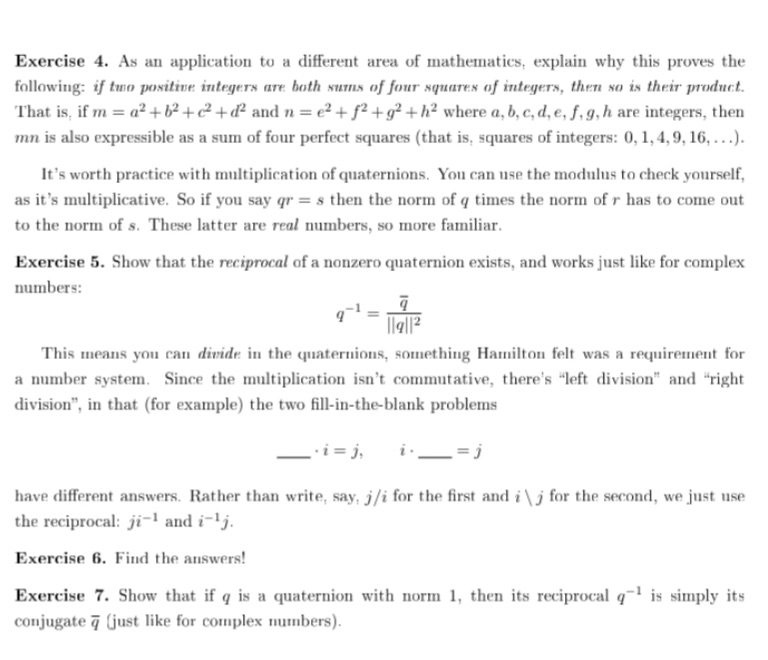
Exercise 4. As an application to a different area of mathematics, explain why this proves the following: if two positive integers are both sums of four squares of integers, then so is their product. That is, if m = a2+b3 +c3 + d2 and n = e? + f2 + 92 + h2 where a, b, c, d, e, f, g, h are integers, then mn is also expressible as a sum of four perfect squares (that is, squares of integers: 0, 1, 4, 9, 16, . ..). It's worth practice with multiplication of quaternions. You can use the modulus to check yourself, as it's multiplicative. So if you say qr = s then the norm of q times the norm of r has to come out to the norm of s. These latter are real numbers, so more familiar. Exercise 5. Show that the reciprocal of a nonzero quaternion exists, and works just like for complex numbers: 9 This means you can divide in the quaternions, something Hamilton felt was a requirement for a number system. Since the multiplication isn't commutative, there's "left division" and "right division", in that (for example) the two fill-in-the-blank problems _.i = j, i . _ = j have different answers. Rather than write, say, j/i for the first and i \\j for the second, we just use the reciprocal: ji-1 and i-1j. Exercise 6. Find the answers! Exercise 7. Show that if q is a quaternion with norm 1, then its reciprocal q is simply its conjugate q (just like for complex numbers)

Step by Step Solution

There are 3 Steps involved in it

1 Expert Approved Answer
Step: 1 Unlock blur-text-image

Question Has Been Solved by an Expert!

Get step-by-step solutions from verified subject matter experts

Step: 2 Unlock
Step: 3 Unlock

Students Have Also Explored These Related Mathematics Questions!