







Question: 5. Let me start of this question by letting you know the concept of operators. It is a concept that you might not outright
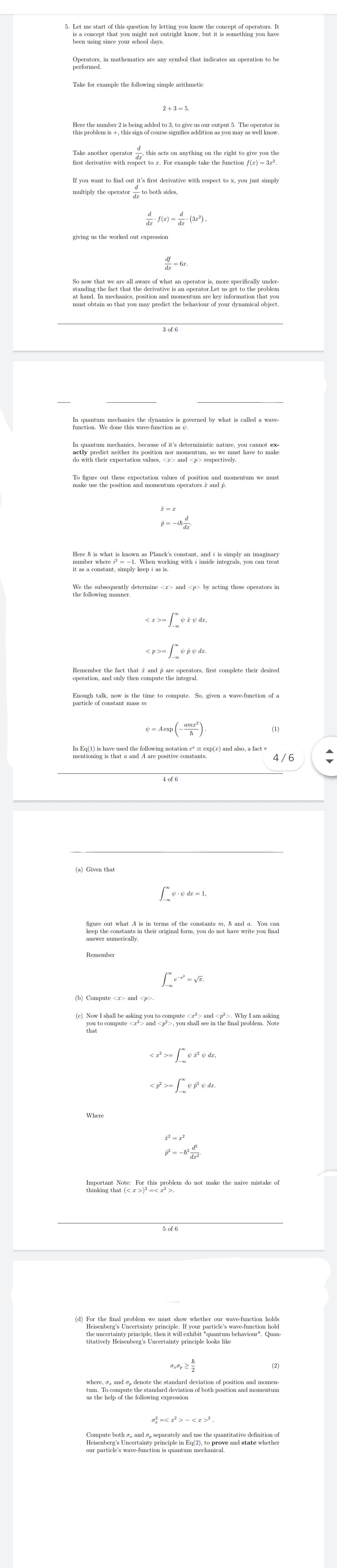
5. Let me start of this question by letting you know the concept of operators. It is a concept that you might not outright know, but it is something you have been using since your school days. Operators, in mathematics are any symbol that indicates an operation to be performed. Take for example the following simple arithmetic 2+3 = 5. Here the number 2 is being added to 3, to give us our output 5. The operator in this problem is +, this sign of course signifies addition as you may as well know. Take another operator d. this acts on anything on the right to give you the da' first derivative with respect to r. For example take the function f(x) 3x2. If you want to find out it's first derivative with respect to x, you just simply d to both sides, dx multiply the operator d. d. .f(x) d.r dr (3r), giving us the worked out expression df = 6.x. dx So now that we are all aware of what an operator is, more specifically under- standing the fact that the derivative is an operator.Let us get to the problem at hand. In mechanics, position and momentum are key information that you must obtain so that you may predict the behaviour of your dynamical object. 3 of 6 In quantum mechanics the dynamics is governed by what is called a wave- function. We done this wave-function as . In quantum mechanics, because of it's deterministic nature, you cannot ex- actly predict neither its position nor momentum, so we must have to make do with their expectation values, and respectively. To figure out these expectation values of position and momentum we must make use the position and momentum operators and p. = x d p = -ih d.x Here h is what is known as Planck's constant, and i is simply an imaginary number where i? = -1. When working with i inside integrals, you can treat it as a constant, simply keep i as is. We the subsequently determine and by acting these operators in the following manner. < x >= = v py dx. Remember the fact that and p are operators, first complete their desired operation, and only then compute the integral. Enough talk, now is the time to compute. So, given a wave-function of a particle of constant mass m ? ) = A exp (1) In Eq(1) is have used the following notation e" = exp(x) and also, a fact v mentioning is that a and A are positive constants. 4/6 4 of 6 (a) Given that p. v dr = 1, figure out what A is in terms of the constants m, and a. You can keep the constants in their original form, you do not have write you final answer numerically. Remember (b) Compute and . (c) Now I shall be asking you to compute and . Why I am asking you to compute and , you shall see in the final problem. Note that < a? >= = V p v dx. Where 2 = x? d? p = -h?- dr2 Important Note: For this problem do not make the naive mistake of thinking that ( < r >)2 = < x? >. 5 of 6 (d) For the final problem we must show whether our wave-function holds Heisenberg's Uncertainty principle. If your particle's wave-function hold the uncertainty principle, then it will exhibit "quantum behaviour". Quan- titatively Heisenberg's Uncertainty principle looks like (2) 2 where, o, and o, denote the standard deviation of position and momen- tum. To compute the standard deviation of both position and momentum us the help of the following expression = < x? > - 2. Compute both o, and o, separately and use the quantitative definition of Heisenberg's Uncertainty principle in Eq(2), to prove and state whether our particle's wave-function is quantum mechanical.
Step by Step Solution
3.42 Rating (161 Votes )
There are 3 Steps involved in it

Get step-by-step solutions from verified subject matter experts
 Study Help