



Question: It's easy to understand that the First Amendment protects speakers, but it goes much further. Having the right to speak also implies the right not
"It's easy to understand that the First Amendment protects speakers, but it goes much further. Having the right to speak also implies the right not to be forced to speak. Protecting free expression to promote democracy implies that listeners' rights also need to be protected. There is a right to hear messages as well as the right not to be forced to hear them." (Chapter 2 summary bullet point 5.)Caristi, D., Davie, W. R., & Lee, L. T. (2022). Communication Law: Practical Applications in the Digital Age (3rd ed.).Discuss this principle as it applies in the case of a "captive audience." Examine speaker rights versus listener rights using the Figure 2.2 categories and groups. Select one group from each category and share a hypothetical case whereby speaker and listener rights are contested. Provide your rationale for arguing for either the speaker or listener and justify your position with support from the text and two case sources of your choosingYour paper should be two to three pages in length not including a cover page and a reference page. Support your statements with three scholarly references in addition to the course text.
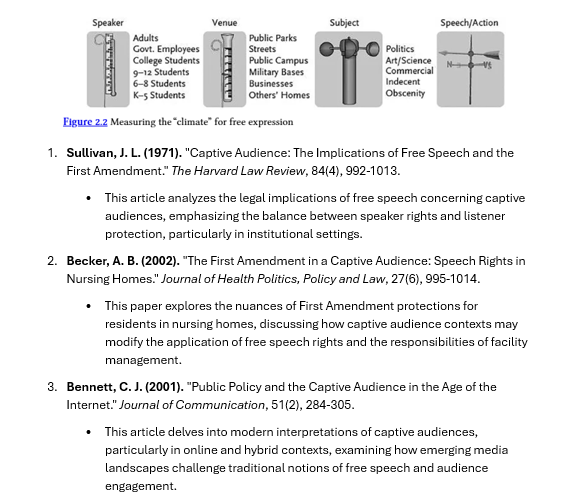
Speaker Adults Govt. Employees College Students 9-12 Students 6-8 Students K= Students Venue Subject Public Parks Streets Public Campus Military Bases Businesses Others' Homes Figure 2.2 Measuring the \"climate\" for free expression Speech/Action Politics Art/Science Commercial Indecent Obscenity . Sullivan, J. L. (1971). \"Captive Audience: The Implications of Free Speech and the First Amendment.\" The Harvard Law Review, 84(4), 992-1013. * This article analyzes the legal implications of free speech concerning captive audiences, emphasizing the balance between speaker rights and listener protection, particularly in institutional settings. . Becker, A. B. (2002), \"The First Amendment ina Captive Audience: Speech Rights in Nursing Homes.\" Journal of Health Politics, Policy and Law, 27(6), 995-1014. This paper explores the nuances of First Amendment protections for residents in nursing homes, discussing how captive audience contexts may modify the application of free speech rights and the responsibilities of facility management. . Bennett, C. J. (2001). \"Public Policy and the Captive Audience in the Age of the Internet.\" Journal of Communication, 91(2), 284-305. * This article delves into modern interpretations of captive audiences, particularly in online and hybrid contexts, examining how emerging media landscapes challenge traditional notions of free speech and auclience engagement
Step by Step Solution
There are 3 Steps involved in it

Get step-by-step solutions from verified subject matter experts